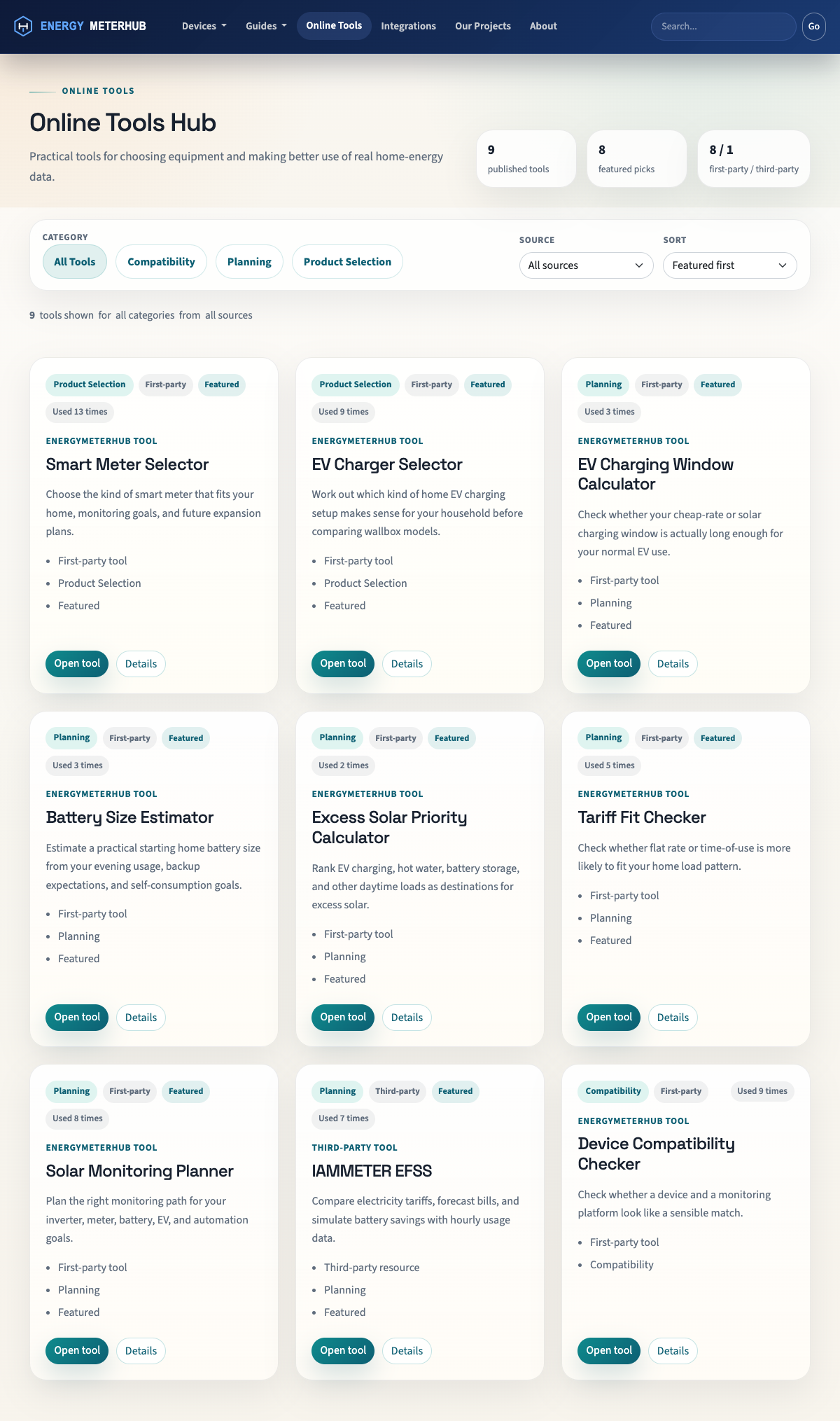
If you are trying to choose the right smart meter, work out whether a 7 kW charger is enough, decide where excess solar should go first, or figure out whether time-of-use even fits your home, the fastest next step is usually not another forum thread. It is starting with the right question and using the right tool.
EnergyMeterHub's Online Tools Hub is built for that first decision layer. The tools are not meant to replace installer advice, retailer tariff sheets, or a full engineering model. They are meant to narrow the next step quickly so you know what to compare next.
Which tool should you start with?
Best tools for choosing equipment
Smart Meter Selector
This is the best starting point when your real question is not "Which model should I buy?" but "What kind of meter setup fits my home?" That distinction matters because many homes do not need the same level of monitoring. Some only need clean import and export visibility. Others already know they want something that can grow into solar, battery, EV charging, or Home Assistant later.
Start here before reading Best Smart Energy Meters for Solar Homes in 2026 or Which Smart Energy Meter Works Best with Home Assistant? 5 Popular Options Compared. If that sounds like your question, open the Smart Meter Selector.
EV Charger Selector
This is the right first tool when you are still deciding the charging setup rather than comparing wallbox brands. In practice, many EV buyers jump straight into product lists before they answer more important questions: whether the home really needs solar-aware charging, whether electrical capacity is tight, and whether load management matters more than headline charger power.
Use this before narrowing a shortlist with Best EV Chargers for Solar Homes in 2026 or Is a 7 kW EV Charger Enough for Home Use in 2026?. If you are still at the setup stage, open the EV Charger Selector.
Best tools for planning savings and upgrade paths
EV Charging Window Calculator
This tool becomes useful once the charger question turns into a timing question. Many homes already have enough charger power on paper, but the real issue is whether the available solar or off-peak window is actually long enough for normal driving. That is a much better question to answer before paying for a larger charger or more complicated setup.
It works especially well alongside Best EV Charging Schedule for Solar and Off-Peak in 2026 and Charge Your EV With Solar or Off-Peak in Australia? What Actually Saves More in 2026. If timing is your bottleneck, open the EV Charging Window Calculator.
Battery Size Estimator
Battery shopping goes wrong quickly when the first comparison happens at brand level instead of size level. This tool is useful because it pushes the decision back to the earlier question: what battery size band are you actually trying to cover? That makes the later shortlist much cleaner.
Use it before or alongside What Size Home Battery Do I Need in Australia? A Practical 2026 Guide and Best Home Batteries for Solar Homes in Australia (2026): 3 Batteries Worth Shortlisting. If you need a starting size range before comparing products, open the Battery Size Estimator.
Excess Solar Priority Calculator
This is one of the most useful tools for homes that are already exporting plenty of solar but are not sure what should absorb that surplus first. The right answer is not always "buy a battery." In many homes, daytime EV charging or hot water control is the better first move, especially when budget is tight.
It pairs naturally with How to Use Excess Solar at Home in 2026 and Solar Diverter vs Battery vs EV Charger in 2026: What Should Get Your Excess Solar First?. If your main problem is daytime export, open the Excess Solar Priority Calculator.
Tariff Fit Checker
This tool is useful when you are not yet at the stage of comparing retailer offers, but you do need to know whether your home behavior is more naturally suited to flat rate or time-of-use. That is a cleaner first question than diving straight into plan comparisons without understanding when your home actually imports energy.
Use it together with Demand Tariffs Explained for Solar, Battery, and EV Homes and Best Tariff for Solar Homes in Australia (2026): Time-of-Use vs Flat Rate. If tariff direction is still unclear, open the Tariff Fit Checker.
IAMMETER EFSS
IAMMETER EFSS is the one current tool in the hub that is clearly a third-party planning tool rather than a first-party EnergyMeterHub tool. It fits a later stage of the process: households that already have interval or hourly data and want deeper bill comparison or battery ROI simulation.
That makes it a good follow-on option after you have already narrowed the general question using the simpler first-party tools. If you are already working with interval data and want deeper bill modeling, open IAMMETER EFSS.
Best tools for monitoring and compatibility decisions
Solar Monitoring Planner
This is the right tool when the home already has solar or is about to add battery, EV charging, or a more ambitious monitoring stack. It is less about one product and more about the whole monitoring path: whether you only need a vendor app, whether you need better metering, or whether the home is ready for a broader local or mixed-brand setup.
Use it alongside Solar Monitoring System Australia: What Homeowners Should Buy in 2026 and How to Read Smart Meter Interval Data Before You Buy Solar or a Battery in Australia (2026). If your problem is really "What monitoring path should this house grow into?", open the Solar Monitoring Planner.
Device Compatibility Checker
This tool is best used late in the decision, not first. Once you already have a device and a monitoring platform in mind, this helps you sanity-check whether the pairing looks sensible before you buy around assumptions. It is particularly useful for homes trying to avoid vague brand-level compatibility guesses.
It works well with Which Smart Energy Meter Works Best with Home Assistant? 5 Popular Options Compared and Home Assistant Energy Dashboard: Integrating Smart Meters. If you are already evaluating an exact pairing, open the Device Compatibility Checker.
A practical way to use these tools together
If you are not sure where to begin, this sequence works for most homeowners:
- Start with a selector or planner if the question is still broad.
- Use the Smart Meter Selector, EV Charger Selector, or Solar Monitoring Planner first when you are still narrowing the decision.
- Move to a calculator when the question becomes more specific.
- Use the EV Charging Window Calculator, Battery Size Estimator, Excess Solar Priority Calculator, or Tariff Fit Checker once you know what kind of decision you are trying to test.
- Use the compatibility checker near the end, not the beginning.
- Compatibility questions are usually most useful after you already have a short device and platform shortlist.
- Use a deeper simulator only when you already have better data.
- IAMMETER EFSS makes the most sense once you already have usable interval or hourly data.
What these tools do not replace
These tools are designed to make the next decision clearer. They do not replace:
- final installer design
- retailer-by-retailer tariff comparison
- hard compatibility confirmation for every firmware, region, or electrical constraint
- real household monitoring data where a decision depends on actual timing instead of estimates
That is why the strongest way to use the tools is together with the surrounding guides, device pages, and integration pages rather than in isolation.
If you want to browse everything in one place, start with the Online Tools Hub.