Choosing a three-phase meter for a solar home is not only about finding a device that says "3-phase" on the box. The right choice depends on where the meter will sit, whether the inverter expects a specific meter model, how much current the service carries, and whether the homeowner wants a vendor dashboard, local data, or a deeper Home Assistant setup.
For many residential solar projects, three names come up often: IAMMETER WEM3080T, Eastron SDM630, and Chint DTSU666. They can all support serious energy monitoring, but they are not the same kind of product.
The short version: choose IAMMETER WEM3080T when you want a monitoring-first meter with Wi-Fi, cloud plus local API options, and strong smart-home flexibility. Choose Eastron SDM630 when you want a direct-connected Modbus DIN-rail meter with broad installer familiarity and a clean local data path. Choose Chint DTSU666 when the inverter or installer ecosystem already expects it, especially in solar export-control or hybrid-inverter jobs.
The quick comparison
| Meter | Best fit | Measurement style | Data path | Main watch-out |
|---|---|---|---|---|
| IAMMETER WEM3080T | Homeowners and integrators who want solar import/export data, Wi-Fi, local API, and dashboard flexibility | CT-based three-phase monitoring | Wi-Fi, IAMMETER Cloud, local API, MQTT, Modbus TCP depending on setup | Needs correct CT direction, phase matching, and network setup |
| Eastron SDM630 | Installer-led DIN-rail monitoring where a direct-connected Modbus meter is the cleanest fit | Direct-connected three-phase DIN-rail meter, commonly up to 100 A depending on variant | RS485 Modbus RTU | Needs a Modbus reader, inverter, gateway, or controller to make the data useful |
| Chint DTSU666 | Solar inverter and export-control setups where the inverter brand already supports or requests this meter | Direct-connected three-phase four-wire DIN-rail meter, commonly 0.25-5(80) A for the direct model | RS485 Modbus RTU | Less app-first; compatibility depends heavily on the inverter or gateway path |
None of these is universally best. The best meter is the one that matches the electrical boundary and the software path you actually need.
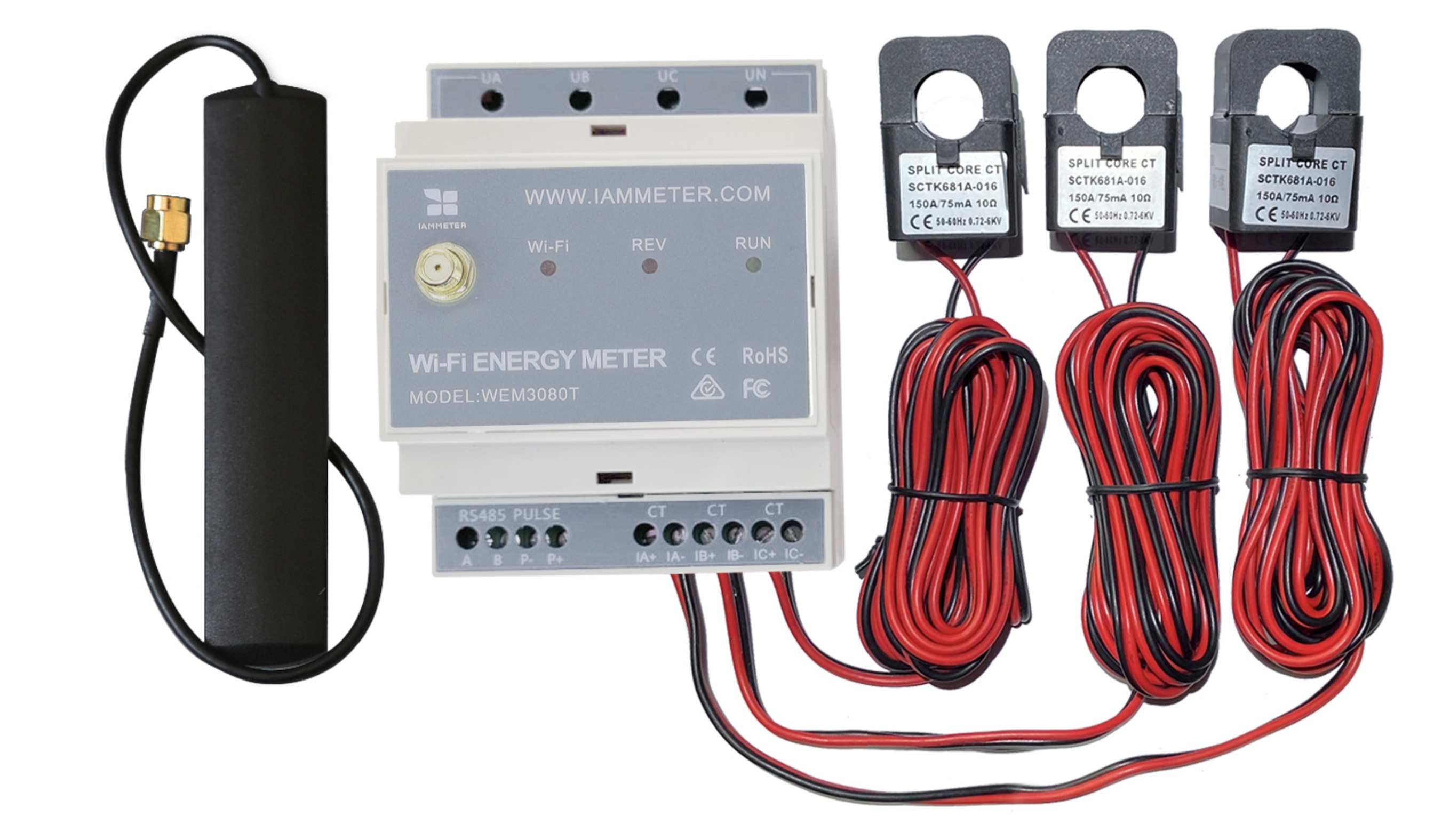
IAMMETER WEM3080T is the most monitoring-first option in this comparison because it combines three-phase measurement with Wi-Fi and local-data options.
Start with the measurement boundary
Before choosing a brand, decide what the meter needs to explain.
A three-phase solar home may need to measure:
- grid import and export at the main supply boundary
- solar production from a three-phase inverter
- net consumption across all phases
- battery charge and discharge context
- one large three-phase load or subpanel
- phase-level imbalance or load behavior
Those are different jobs. A meter at the grid connection can explain import/export and whole-home energy flow. A meter on an inverter output can explain generation. A meter on a subpanel can explain a group of loads. If the meter is placed on the wrong boundary, even a technically excellent device can produce misleading conclusions.
This is why three-phase metering decisions should be made with an electrician or installer who understands both the switchboard and the inverter data model. Software cannot fix a meter installed at the wrong point.
IAMMETER WEM3080T: best when monitoring flexibility matters
The IAMMETER WEM3080T is the strongest fit when the project is not only about satisfying an inverter requirement, but about building a readable monitoring setup.
It is a CT-based three-phase Wi-Fi energy meter intended for solar PV monitoring, home energy monitoring, import/export visibility, and local integrations. IAMMETER's official material positions the WEM3080T around three-phase monitoring, net energy metering, reactive power, power factor, local API access, and integrations such as Home Assistant.
That makes it useful when the homeowner wants to see:
- grid import and export across three phases
- live power and accumulated energy
- solar self-consumption behavior
- Home Assistant, MQTT, or local API data paths
- monitoring that is not trapped inside only one inverter brand
The important practical difference is that WEM3080T is a monitoring product in its own right. It can be part of the IAMMETER Cloud path, a local dashboard, Home Assistant, or a more custom energy-data stack.
That flexibility is valuable for technically curious homeowners, installers building repeatable monitoring packages, and solar homes that may later add batteries, EV charging, or automation.
Where WEM3080T can be the wrong fit
The same flexibility also means there is more setup discipline. CT-based metering depends on correct CT placement, direction, and phase mapping. If CT A is placed on phase B, or one clamp is reversed, the dashboard can look polished while the data is wrong.
It is also not always the meter an inverter manufacturer expects for closed-loop control. If the inverter installation guide specifies a particular Modbus meter for export limiting or battery control, do not casually substitute WEM3080T unless compatibility is confirmed.
Use WEM3080T when monitoring ownership and integration flexibility matter. Do not use it as a blind replacement for an inverter-required meter.
Eastron SDM630: best when a direct Modbus meter is the clean installer path
Eastron SDM630 is a different style of product. It is a DIN-rail, direct-fed three-phase Modbus meter that often fits electrician-led monitoring, sub-metering, and solar-adjacent control systems.
Its appeal is straightforward: it is a conventional meter form factor, direct-connected up to the relevant model rating, and communicates locally over RS485 Modbus RTU. For many installers and energy-system integrators, that is a familiar and dependable architecture.
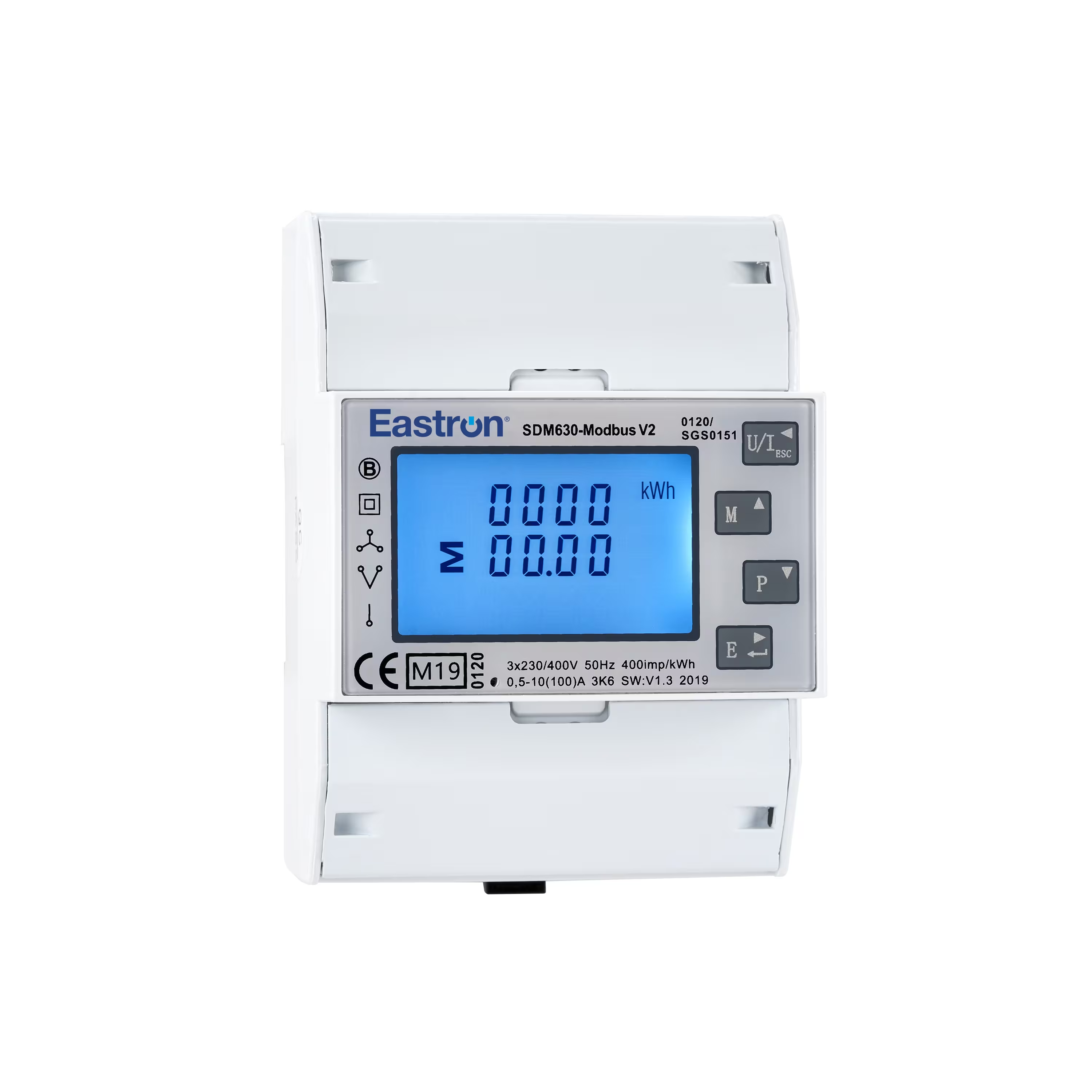
Eastron SDM630 is a good fit when a project wants a traditional DIN-rail Modbus meter rather than an app-first monitoring device.
Eastron SDM630 usually makes sense when:
- the installation already has an RS485 Modbus data path
- the meter will be read by an inverter, gateway, PLC, energy controller, or Home Assistant Modbus setup
- a direct-connected DIN-rail meter is cleaner than CT clamps
- the site wants a permanent panel meter, not a consumer app device
- the installer is comfortable with Modbus addressing and wiring
For a solar home, the SDM630 can be a strong choice where the goal is stable local meter data and the software layer is already planned.
Where SDM630 can be the wrong fit
The SDM630 is not the easiest route for a homeowner who wants an instant app experience. It needs something to read the Modbus data: an inverter, gateway, Home Assistant, RS485-to-Ethernet adapter, or another controller.
That is not a weakness if the project already has a proper data architecture. It is a weakness if the buyer expects the meter alone to behave like a consumer monitoring platform.
Use SDM630 when the electrical and Modbus path are clear. Skip it if nobody on the project wants to own the data integration.
Chint DTSU666: best when the inverter ecosystem already expects it
Chint DTSU666 is common in inverter-led solar installations because many solar ecosystems are designed around specific RS485 meters. CHINT's official product material describes DTSU666 as a compact three-phase four-wire smart energy meter with RS485 Modbus RTU, DIN-rail installation, and bidirectional energy measurement.
For a homeowner, the big advantage is not that DTSU666 has the nicest standalone monitoring experience. It is that the meter may be the expected companion for a specific inverter or export-control setup.
Chint DTSU666 is often chosen because the inverter or installer workflow already knows how to use it.
DTSU666 often makes sense when:
- the inverter manual or installer specifies it
- the main job is export limiting, inverter visibility, or hybrid-system control
- the site wants a compact DIN-rail meter on RS485
- the installation is direct-connected within the meter rating
- the homeowner does not need a separate app-first monitoring product from the meter itself
This is a very practical reason to choose a meter. In solar systems, compatibility can matter more than theoretical feature count.
Where DTSU666 can be the wrong fit
DTSU666 is usually not the most flexible choice for a homeowner who wants an open, standalone monitoring journey from day one. It can provide useful Modbus data, but the user experience depends on what reads it.
It is also important not to confuse direct-connected DTSU666 models with CT-input variants or inverter-specific versions. The exact model, wiring type, and inverter compatibility should be confirmed before purchase.
Use DTSU666 when the inverter ecosystem makes it the cleanest supported choice. Do not choose it only because it is a familiar solar meter name.
CT-based vs direct-connected: the decision that matters most
One of the biggest practical differences in this comparison is CT-based measurement versus direct-connected metering.
CT-based monitoring, as used by IAMMETER WEM3080T, is often easier to retrofit around existing conductors and can support higher-current services by selecting appropriate CTs. It is also more sensitive to installation mistakes: CT direction, phase matching, and conductor selection must be correct.
Direct-connected DIN-rail metering, as used by common Eastron SDM630 and Chint DTSU666 direct models, can be neat and robust where the current rating fits. But it may require more invasive wiring and must be chosen carefully for the actual service current, enclosure layout, and local electrical rules.
| If this is true | Prefer this direction |
|---|---|
| Existing conductors are hard to re-route through a direct meter | CT-based meter such as WEM3080T |
| You want a clean permanent DIN-rail meter and the current rating fits | Direct-connected SDM630 or DTSU666 |
| You need inverter-specified export control | Use the meter the inverter officially supports |
| You want Home Assistant and local-data flexibility | WEM3080T or SDM630 with a planned Modbus path |
| You want the least integration work for a normal homeowner | WEM3080T is usually easier than bare Modbus, provided CT installation is done correctly |
Which meter fits Home Assistant best?
For Home Assistant users, the answer depends on how much setup effort you are comfortable with.
IAMMETER WEM3080T is usually the friendlier starting point because it is designed with networked monitoring and local-data workflows in mind. It can fit homes that want cloud, local API, MQTT-style workflows, or Home Assistant energy dashboards.
Eastron SDM630 can also work well in Home Assistant, but typically through a Modbus path. That may be excellent for technical users, but it requires RS485 wiring, a gateway or adapter, register mapping, and more configuration care.
Chint DTSU666 can also expose useful Modbus data, but for many solar homes it is better treated as an inverter companion first and a standalone Home Assistant meter second, unless the integration path is already proven for the exact model and reader.
If Home Assistant is the main goal, start with the data path, not the meter brand.
Which meter fits solar import/export monitoring best?
All three can support solar import/export visibility when installed and interpreted correctly. The more important question is who will consume the data.
Choose IAMMETER WEM3080T when the meter itself will be the center of the monitoring workflow.
Choose Eastron SDM630 when a local controller, inverter, or Modbus system will read the meter and present the data elsewhere.
Choose Chint DTSU666 when the inverter or hybrid-system workflow already expects that meter for export control or energy-flow visibility.
A three-phase solar home should also check whether the site uses net metering, per-phase balancing, or phase-level import/export reporting. The meter may measure each phase clearly, while the billing meter or utility settlement rules may summarize the result differently. That is not a meter defect; it is a boundary and accounting question.
Buyer recommendations by scenario
Best for a homeowner who wants useful monitoring without building a Modbus stack
Choose IAMMETER WEM3080T.
It gives the best mix of three-phase solar visibility, local-data options, and homeowner-readable monitoring. Just make sure CT installation and phase mapping are done carefully.
Best for an installer-led Modbus panel setup
Choose Eastron SDM630.
It is a strong fit when the project already has an RS485 reader, inverter input, gateway, or controller. It is less attractive when nobody wants to configure the data path.
Best for inverter compatibility and export-control workflows
Choose Chint DTSU666 when the inverter manual or installer workflow calls for it.
This is not about brand prestige. It is about using the meter the system already knows how to talk to.
Best for future dashboards and automation
Choose IAMMETER WEM3080T if you want the shortest path to a monitoring-first setup. Choose Eastron SDM630 if you are comfortable building the Modbus layer yourself.
Best for a simple direct-connected DIN-rail meter
Choose Eastron SDM630 or Chint DTSU666, depending on current rating, regional availability, and inverter compatibility.
Mistakes to avoid
Buying a meter before checking inverter compatibility
For export limiting, battery control, or inverter energy management, the supported meter list matters. A better standalone meter can still be the wrong system meter.
Ignoring current rating and wiring type
Do not assume every three-phase meter suits every three-phase service. Direct-connected meters have current limits. CT meters need the correct CT ratio and physical installation path.
Treating Home Assistant support as one feature
Home Assistant support can mean a polished integration, a local API, MQTT, or Modbus registers that need manual configuration. Those are different levels of effort.
Forgetting phase mapping
Three-phase energy data only makes sense when voltage phase, current phase, and CT direction match. If they do not, import/export and power-factor numbers can become confusing quickly.
Expecting one meter to explain every energy question
A main-grid meter can explain import/export. It may not explain which appliance caused the demand. A branch meter can explain one load. It may not explain the whole-home solar balance. Choose the boundary first.
Final verdict
For most three-phase solar homes that want a practical monitoring upgrade, IAMMETER WEM3080T is the most flexible choice because it is built around monitoring, Wi-Fi, local data, and solar import/export visibility.
For installer-led systems where a direct DIN-rail Modbus meter is the cleaner engineering choice, Eastron SDM630 is often the more natural fit.
For inverter-led solar systems that already specify or strongly support a particular companion meter, Chint DTSU666 can be the right answer precisely because it fits the inverter workflow.
The smartest purchase is not the meter with the longest feature list. It is the meter that matches the electrical boundary, current rating, inverter compatibility, and data path the home will actually use.
Related reading
- IAMMETER WEM3080T: Three-Phase Energy Monitoring for Solar Homes Explained
- How to Read Three-Phase Home Energy Data Without Getting Lost
- Smart Meter vs Inverter Meter vs Clamp Monitor in 2026: Which Numbers Should You Trust?
- What a Good Solar Home Monitoring Setup Should Include Beyond the Inverter App
- Smart Meter Selector
- Solar Monitoring Planner
- IAMMETER WEM3080T
- Eastron SDM630
- Chint DTSU666