Quick Answer
Choose Enphase IQ Battery 5P if you want a tightly integrated AC-coupled battery that fits naturally into an Enphase solar system, gives strong per-unit power for a 5 kWh battery, and keeps the battery, microinverters, gateway, app, and backup hardware inside one ecosystem.
Choose BYD Battery-Box Premium HVS or HVM if you are building around a compatible hybrid inverter, want more flexible high-voltage battery sizing, or expect the battery to grow from a modest self-consumption setup into a larger storage system over time.
The difference is not simply brand versus brand. It is a system architecture decision. Enphase IQ Battery 5P is an AC battery with embedded grid-forming microinverters. BYD Battery-Box Premium is a modular LFP battery stack that depends on the selected inverter for conversion, backup behavior, controls, grid rules, and monitoring. That makes the best choice depend heavily on the solar inverter, the backup design, and how much control you want over the energy data.
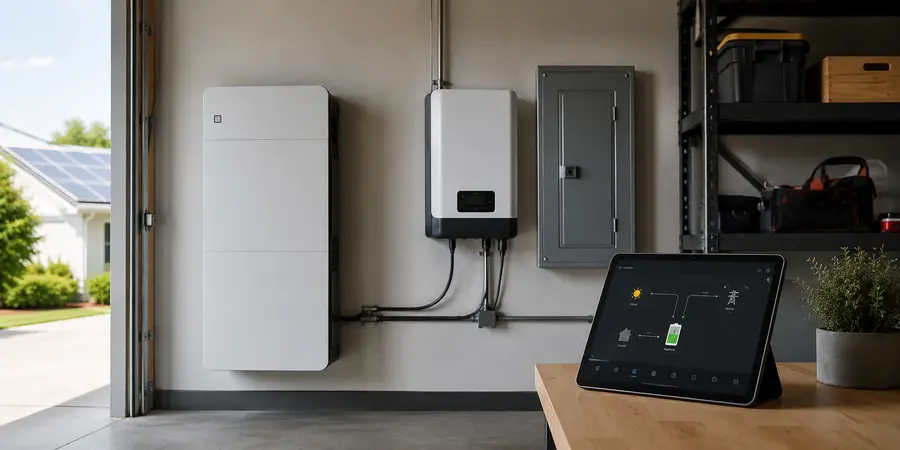
The Core Difference: AC Battery vs High-Voltage Battery Stack
Enphase IQ Battery 5P is an all-in-one AC-coupled battery. Enphase lists it with 5.0 kWh usable energy, six embedded grid-forming microinverters, 3.84 kW continuous power, and short-duration peak output up to 7.68 kW for 3 seconds. It is designed to integrate with the Enphase Energy System and can provide backup when installed with the required IQ System Controller hardware. Enphase also specifies LFP chemistry, passive cooling, remote software updates, app-based monitoring and control, and a 15-year limited warranty up to 6,000 cycles. Source: Enphase IQ Battery 5P product page.
BYD Battery-Box Premium HVS and HVM take a different path. The battery is a modular high-voltage LFP battery system used with compatible external inverters. BYD describes Battery-Box Premium HVS as 5.1 to 12.8 kWh usable capacity per tower, expandable to 38.4 kWh with up to three identical towers. BYD describes Battery-Box Premium HVM as 8.1 to 21.7 kWh usable capacity per tower, expandable to 65.0 kWh with up to three identical towers. Source: BYD Battery-Box official product page.
That means Enphase puts more of the power electronics inside the battery ecosystem. BYD puts more of the system personality in the inverter you pair it with.
Comparison Table
| Decision point | Enphase IQ Battery 5P | BYD Battery-Box Premium HVS/HVM |
|---|---|---|
| System type | AC-coupled battery with embedded microinverters | High-voltage modular battery for compatible external inverters |
| Typical best fit | Existing or planned Enphase solar systems | Hybrid inverter systems from compatible inverter brands |
| Usable capacity | 5.0 kWh per 5P unit | HVS 5.1-12.8 kWh per tower; HVM 8.1-21.7 kWh per tower |
| Expansion logic | Add more 5P units and matching Enphase system hardware | Add modules or identical parallel towers within BYD/inverter limits |
| Continuous output | 3.84 kW per unit listed by Enphase | Depends on model, inverter pairing, battery configuration, and system design |
| Backup path | Requires appropriate Enphase backup hardware such as IQ System Controller 3/3G | Depends on compatible hybrid inverter, backup wiring, and regional approvals |
| Monitoring | Enphase App and Enphase gateway ecosystem | Usually inverter app, inverter portal, or third-party monitoring through inverter/meter data |
| Home Assistant angle | Home Assistant's Enphase Envoy integration can expose entities depending on the Enphase system configuration | Usually depends on the paired inverter, Modbus path, gateway, or vendor integration |
| Buyer personality | Wants one accountable ecosystem and less architecture mixing | Wants inverter-led design flexibility and larger modular capacity options |
When Enphase IQ Battery 5P Makes More Sense
Enphase IQ Battery 5P is strongest when the home is already committed to Enphase microinverters or when the buyer wants a single-brand energy system. If the roof has Enphase IQ microinverters, an Enphase gateway, and the Enphase App is already the homeowner's daily interface, adding IQ Battery 5P keeps the system easier to explain and support.
The 5P also has a useful power-to-capacity profile. A 5 kWh battery with 3.84 kW continuous output can feel more capable than its energy capacity suggests, especially for short evening peaks, refrigerator and lighting loads, or covering a few critical circuits during an outage. The battery is not magic; runtime is still limited by usable energy. But the output rating helps it handle practical household loads without immediately forcing a much larger battery bank.
It is also a good fit where service accountability matters. With Enphase, the battery, control hardware, microinverter-based architecture, app, and installer commissioning process are part of one defined ecosystem. For homeowners who do not want the installer, inverter vendor, battery vendor, and monitoring platform pointing at each other when something looks wrong, that simplicity has value.
The tradeoff is that you are buying into the Enphase architecture. Expansion, backup, communications, commissioning, and long-term monitoring are all shaped by Enphase compatibility rules. That is not a problem for the right buyer, but it is not the most open-ended path.
When BYD Battery-Box Makes More Sense
BYD Battery-Box Premium is a better fit when the system is designed around a hybrid inverter and the buyer wants battery capacity to scale more flexibly. The HVS and HVM families cover a broad capacity range, and BYD emphasizes the ability to add modules or parallel identical stacks later. That matters for homes where today's goal is self-consumption, but tomorrow's goal may include larger evening loads, EV charging support, or more serious backup coverage.
BYD also fits buyers who are already comparing inverter ecosystems. With BYD, the inverter is not just a power converter; it becomes the main interface for charge/discharge behavior, battery limits, backup modes, export control, monitoring, grid compliance, and often Home Assistant or Modbus access. A BYD Battery-Box paired with a Fronius, GoodWe, SMA, Sungrow, or other compatible inverter can feel very different depending on the inverter model and region.
That flexibility is the point, but it is also the risk. You need to verify the exact inverter compatibility list, local approvals, backup wiring requirements, battery module rules, and monitoring path before buying hardware. A BYD stack with the wrong inverter plan can become a technically good battery attached to a frustrating system.
Backup: Do Not Compare Batteries Without Comparing Backup Design
Battery buyers often ask, "Which battery is better for backup?" The honest answer is that backup is a system design, not just a battery spec.
For Enphase IQ Battery 5P, backup capability depends on using the right Enphase system hardware. Enphase states that IQ Battery 5P can provide backup when installed with IQ System Controller 3/3G. That backup design can be clean for Enphase homes, but the installer still needs to define which loads are backed up, how the switchboard is wired, whether solar can recharge during outages, and how much runtime the selected battery capacity actually provides.
For BYD Battery-Box Premium, backup depends heavily on the paired inverter. Some compatible hybrid inverters provide strong backup or off-grid functions; others may be self-consumption focused or limited by regional firmware and wiring rules. BYD markets Battery-Box for backup and off-grid applications, but the inverter and electrical design determine what that means in a specific home.
Before choosing either path, ask these questions:
- Which circuits will be backed up: whole home, essential loads, or only selected circuits?
- What is the maximum backup output, and is it per phase or total?
- Can the solar array recharge the battery during a grid outage?
- Are large loads such as air conditioning, ovens, heat pumps, or EV charging excluded from backup?
- Does the backup design require extra switchboard work, gateway hardware, or load control?
A smaller battery with a well-designed essential-loads panel can be more satisfying than a larger battery wired with unrealistic whole-home expectations.
Monitoring and Energy Data
For EnergyMeterHub readers, monitoring is not an afterthought. The battery needs to fit the data architecture of the home.
Enphase's advantage is a coherent app and gateway model. The Enphase App is the expected owner interface, and Home Assistant's Enphase Envoy integration notes that available entities depend on the Enphase system configuration and may include communication with IQ batteries, Enpower or system-controller equipment, microinverters, and related devices. Source: Home Assistant Enphase Envoy integration.
For BYD, the data path usually comes through the inverter or a separate energy meter, not directly from BYD as a consumer app experience. This can be excellent in technical homes because inverter APIs, Modbus meters, SolarAssistant, or Home Assistant integrations may expose detailed flows. It can also be confusing when the inverter app, battery BMS, smart meter, and utility bill all show slightly different numbers.
If you care about clean energy data, do not ask only, "Does the battery have an app?" Ask:
- Can I see solar production, battery charge/discharge, grid import/export, and household load in one place?
- Does the system expose local data, or is it cloud-only?
- Can Home Assistant or another local platform read the data reliably?
- Is the battery data coming from the inverter, a meter, the BMS, or the cloud portal?
- Will the dashboard distinguish battery charging from grid import and solar self-consumption?
This is where a separate whole-home meter or solar-aware energy monitor can make either battery system easier to understand.
Expansion: Small Repeatable Units vs Larger Modular Stacks
Enphase expansion is straightforward conceptually: add more IQ Battery 5P units within the rules of the Enphase design. The benefit is repeatability. Each added 5P contributes another block of energy capacity and output, and the system remains within a single ecosystem.
BYD expansion is more configurable. HVS and HVM stacks can be sized in module steps, and identical towers can be paralleled within supported limits. That makes BYD attractive for homes that want a larger storage system without committing to a fixed 5 kWh building block. The catch is that expansion must respect module type, stack matching, inverter limits, installation rules, and regional compatibility.
In practical terms:
- Enphase is easier to understand as a homeowner product family.
- BYD is easier to tune as part of an inverter-led system design.
- Enphase may be cleaner for phased Enphase ecosystem upgrades.
- BYD may be more flexible for larger high-voltage storage systems.
Which Buyer Are You?
Choose Enphase IQ Battery 5P if...
You already have Enphase microinverters or plan to install them. You want the battery to feel like part of the same solar system rather than a separate project. You value app polish, installer accountability, strong per-unit output, and a defined backup architecture. You are comfortable staying inside Enphase's compatibility and commissioning rules.
This is often the better personality fit for buyers who say: "I want the system to work, be supported by one ecosystem, and show up cleanly in the app. I do not want to assemble a custom energy stack."
Choose BYD Battery-Box Premium if...
You are choosing a compatible hybrid inverter anyway. You care about scalable capacity, high-voltage battery architecture, and matching the battery to a broader inverter ecosystem. You are comfortable asking the installer detailed questions about compatibility, backup circuits, commissioning, and data access.
This is often the better personality fit for buyers who say: "I want the battery to be part of a flexible inverter-led energy system, and I am willing to verify compatibility carefully before buying."
Common Mistakes to Avoid
The first mistake is comparing capacity without comparing output. A battery may have enough kWh for an evening but not enough power for the loads a homeowner expects to run at once. Enphase publishes per-unit output figures clearly for the 5P; BYD output should be checked in the context of the exact HVS/HVM configuration and inverter pairing.
The second mistake is assuming all backup is equal. Backup can mean a few essential circuits, a larger backed-up subpanel, or a more ambitious whole-home design. The battery is only one part of that answer.
The third mistake is buying the battery before confirming the monitoring path. A beautiful battery installation can still leave the homeowner confused if solar, grid, load, and battery numbers are split across several apps.
The fourth mistake is treating BYD as a standalone consumer appliance. BYD Battery-Box can be excellent, but the inverter choice determines much of the user experience. The correct comparison is not only Enphase versus BYD; it is Enphase Energy System versus BYD plus a specific inverter ecosystem.
Installer Checklist Before You Decide
Before signing a quote, ask the installer to answer these questions in writing:
| Question | Why it matters |
|---|---|
| What exact battery model and capacity will be installed? | Avoids confusion between nominal, usable, module, and system capacity. |
| What is the continuous backup output? | Determines which real household loads can run. |
| Which circuits are backed up? | Prevents unrealistic outage expectations. |
| Can solar recharge the battery during an outage? | Critical for longer backup events. |
| What inverter or controller hardware is required? | Changes cost, complexity, and service responsibility. |
| How will I monitor solar, grid, load, and battery data? | Determines whether the system is easy to troubleshoot later. |
| Is local data access available? | Important for Home Assistant, advanced monitoring, and cloud-resilience preferences. |
| Can the battery be expanded later? | Avoids buying a system that cannot grow with EVs or electrification. |
Bottom Line
Enphase IQ Battery 5P is the cleaner choice for buyers who want a well-integrated AC battery inside the Enphase ecosystem, especially when Enphase microinverters and app-based ownership are already part of the plan.
BYD Battery-Box Premium is the more flexible choice for buyers building around a compatible hybrid inverter, especially when capacity scaling, inverter selection, and larger storage designs matter more than a single-brand app experience.
For most solar homes, the best battery is not the one with the most impressive brochure line. It is the one that fits the inverter architecture, backup wiring, metering plan, monitoring platform, and future upgrade path with the fewest surprises.