
A rooftop solar system can produce plenty of low-cost electricity in the middle of the day while a household still buys electricity for hot water at another time. That mismatch makes water heating one of the most useful flexible loads in a solar home.
But there is no single best device for every property. A resistive storage tank, a heat-pump water heater, a controlled-load tariff, an export limit and a home battery all change the answer. The right decision starts with two measurements: how much solar is genuinely exported and how much electrical energy the hot-water system actually needs.
This guide compares three practical ways to use excess solar for hot water:
- a solar diverter that continuously varies power to a compatible resistive heating element;
- a timer or smart controller that runs a water heater during a chosen solar window;
- a home battery that stores solar electricity for later, including for hot water.
It also explains when the best answer is simply to keep a cheap controlled-load tariff.
The short answer
For a household with a conventional resistive storage tank and a variable solar surplus, a properly installed solar diverter can match the heating element to available export more precisely than a basic timer.
For a home with a heat-pump water heater, simple daytime scheduling or a manufacturer-supported smart input is often the better starting point. A heat pump normally draws much less electrical power than a resistive element, so it is easier to cover with ordinary midday solar and may not benefit from fine-grained power diversion.
A home battery is usually the broadest option, but it is solving a larger problem. It can shift solar into the evening, support many household loads and, in a correctly designed system, provide backup capability. Buying a battery only to heat water is rarely the cleanest comparison because an insulated hot-water tank already stores energy as heat.
Before changing anything, compare the value of self-consuming one kilowatt-hour with the export credit you give up. The benefit is not the full retail electricity rate:
Value of shifting 1 kWh of solar
= avoided import price - forgone export credit
If imported electricity costs 32 cents/kWh and exported solar earns 7 cents/kWh, shifting one otherwise-exported kWh is worth about 25 cents before equipment cost, losses and tariff effects. Use your own plan, not these illustrative numbers.
Start with the water-heating system you already have
The control method has to fit the heater. Treat “electric hot water” as a family of loads rather than one appliance.
| Existing system | Electrical behaviour | Usually worth evaluating first |
|---|---|---|
| Resistive storage tank | A relatively large fixed-power element cycles on and off | Timer, controlled-load tariff, or a compatible proportional diverter |
| Heat-pump water heater | Lower electrical input over a longer cycle; performance changes with air temperature | Daytime schedule or manufacturer-supported control |
| Electric-boosted solar thermal | Booster is an electrical load, but solar thermal supplies part of the heat | Booster schedule and seasonal control |
| Instantaneous electric heater | Very high power only when water is used; little or no thermal storage | Usage reduction or system replacement rather than solar diversion |
| Gas water heater | Solar PV cannot directly power the gas burner | Electrification decision first |
Water heating is a major household load. Australian Government guidance says it commonly represents 15% to 30% of household energy use, while a heat-pump water heater can use about 30% of the energy of a conventional electric system. Those figures are useful context, but your daily hot-water electricity can vary sharply with household size, inlet-water temperature, tank losses and usage habits.
If your current tank is on a controlled-load circuit, do not assume moving it to the general supply will save money. A controlled-load tariff may buy low-cost electricity overnight. Moving the heater to a solar-enabled circuit can also require metering and switchboard changes. Have an accredited electrician confirm the circuit arrangement and local rules before comparing quotes.
Option 1: A solar diverter for a resistive tank
A solar diverter measures power flow at the grid connection point. When the home begins exporting, it sends a corresponding amount of power to a compatible resistive water-heating element. Good systems continuously modulate output, so an available 1.2 kW surplus does not necessarily trigger a 3.6 kW grid import.
That proportional behaviour is the diverter's main advantage. A basic timer only chooses when the element may run. It does not know whether clouds have reduced PV output or another appliance has started.
A diverter is most attractive when:
- the home regularly exports solar for several hours;
- the existing resistive tank and element are compatible;
- surplus power varies enough that a fixed timer would import from the grid;
- export credits are materially lower than import prices;
- the tank can hold enough hot water for evening and morning demand;
- the installed price is reasonable relative to the annual value captured.
A diverter is less compelling when:
- the export window is small or irregular;
- the heater is already cheap to run on a controlled-load tariff;
- the household expects to replace the resistive tank with a heat pump soon;
- the inverter, export meter or electrical layout does not support a clean installation;
- another flexible load already consumes most midday solar.
Do not evaluate a diverter from PV size alone. A 10 kW array can still have little usable surplus if daytime loads are high, while a smaller system may export consistently.
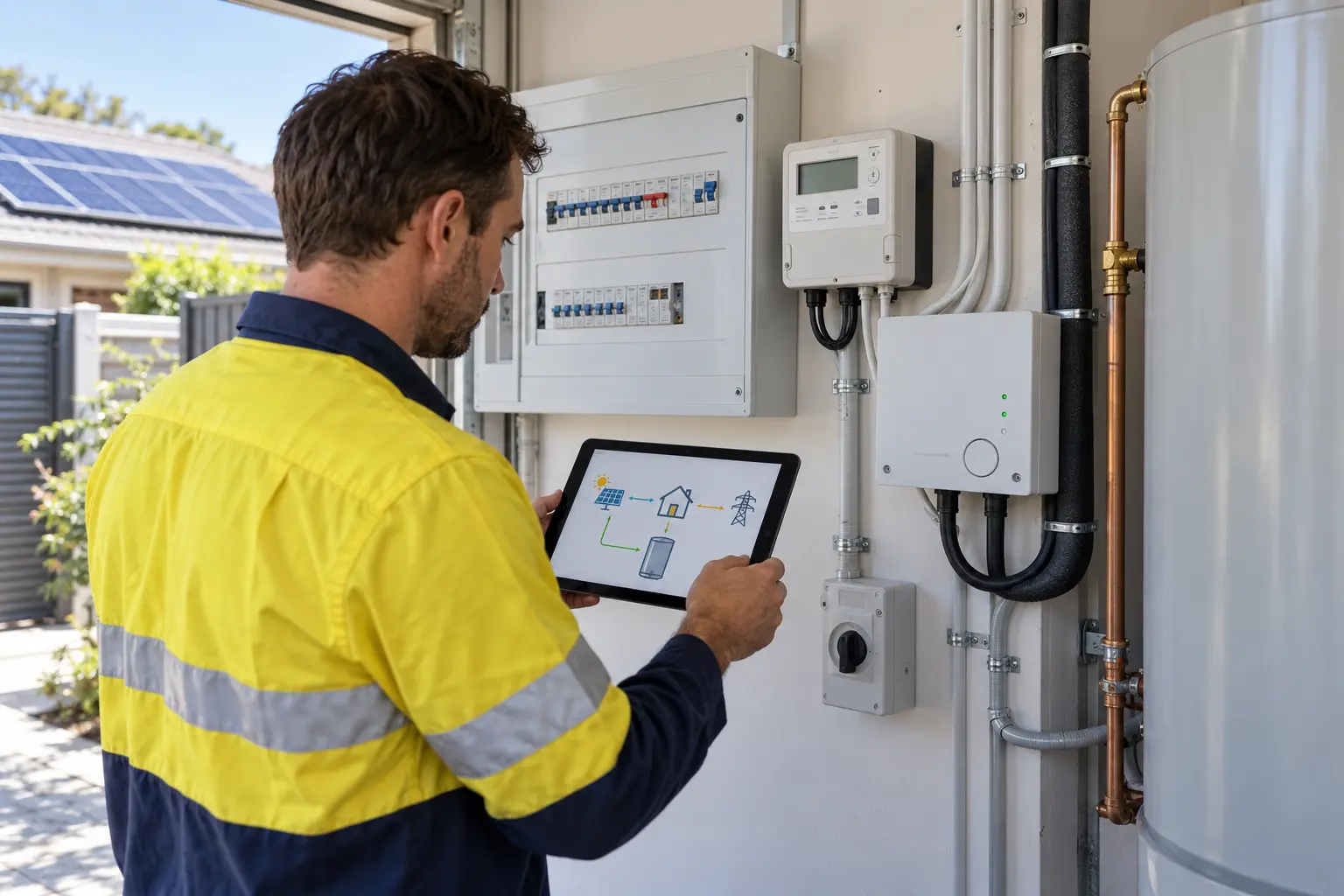
The important measurement is net flow at the grid connection point. A controller needs to distinguish genuine export from solar generation that the home is already using.
Option 2: A timer or smart controller
A timer is the simplest form of load shifting. It allows the heater to run during a period when the property usually has surplus PV. For many households, that is a sensible first experiment because it is easy to understand and comparatively inexpensive.
Australian Government guidance suggests checking the monitoring app rather than relying on a generic clock window. Typical solar-rich periods are around 10 am to 4 pm in summer and narrower in winter, but roof orientation, shade, weather and household loads matter more than the rule of thumb.
A smart controller can go beyond a fixed schedule. Depending on the heater and controller, it may use:
- real-time import/export measurements;
- a minimum export threshold;
- weather or solar forecasts;
- tariff periods;
- tank temperature or manufacturer control inputs;
- a rule that prevents reheating during an expensive peak period.
The critical distinction is between switching and modulating. A relay may turn a fixed-power element fully on. If the element draws 3.6 kW and only 1.5 kW of solar is spare, the home imports roughly 2.1 kW while it runs. A proportional diverter can reduce heater power to track the available surplus, subject to its operating range and compatibility.
That does not make the timer a bad option. It can work very well when a home has a broad, predictable solar surplus that exceeds the heater's input. It is also a natural fit for many heat-pump water heaters because their lower demand is easier to cover.
The control must preserve safe water temperatures, required sanitation cycles and adequate recovery. Do not defeat manufacturer controls or reduce storage temperatures in an attempt to save energy. Follow the heater manual and local plumbing and electrical requirements.
Heat-pump water heaters change the calculation
A heat pump moves heat from the surrounding air into the tank instead of turning each unit of electrical energy directly into heat. That makes it much more electrically efficient, although performance varies with ambient temperature, setpoint, installation and model.
For solar self-consumption, the lower input power is useful: a modest PV surplus may cover most or all of the compressor load. Running during the warmer part of the day can also support heat-pump efficiency, provided the manufacturer's operating logic allows it.
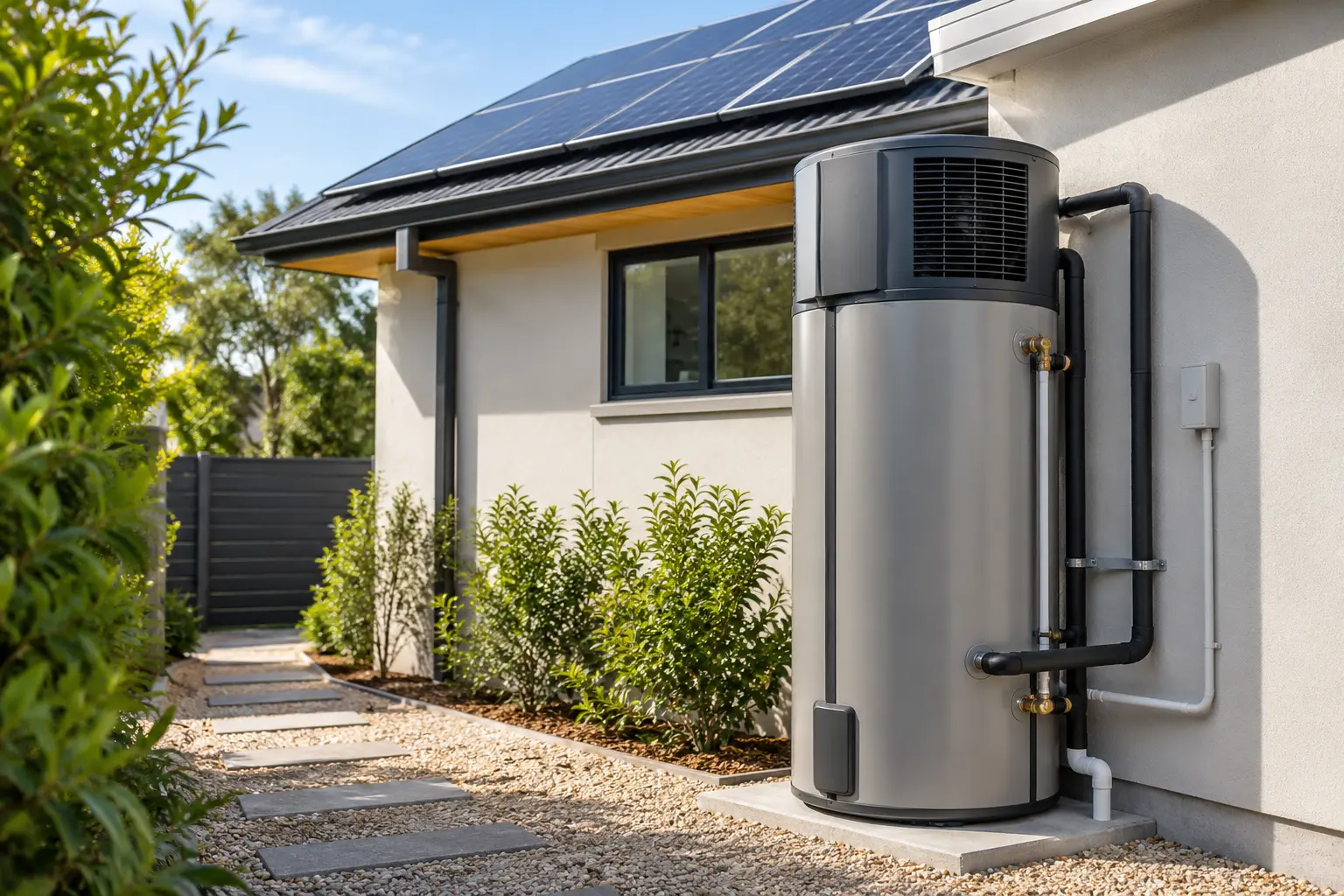
For a heat-pump water heater, a reliable daytime schedule is often more valuable than chasing every short-lived watt of export.
Check these points before adding an external controller:
- Does the heater provide a timer, demand-response input or solar mode?
- Will external power interruption interfere with freeze protection, fault logging, sanitation cycles or warranty conditions?
- Is the tank large enough to complete most heating during the solar window?
- What is the actual electrical input under local conditions?
- Is noise acceptable during the planned run time?
- What backup or boost behaviour occurs after unusually high hot-water use?
If a resistive tank is near the end of its life, compare the cost of a diverter with the incremental cost of moving to a heat pump. A diverter improves when the old element consumes electricity; a heat pump reduces the electricity needed in the first place. The better lifecycle choice depends on replacement timing, climate, installation cost and available incentives.
For a deeper system comparison, see Heat Pump Hot Water vs Electric Storage: When the Upgrade Pays Off.
Option 3: Use a home battery
A battery stores electrical energy rather than thermal energy. Excess PV can charge the battery during the day, then the battery can supply the home when solar falls. That may include water heating, but also cooking, lighting, cooling, EV charging and other evening loads.
A battery becomes a stronger candidate when the household also values:
- shifting solar into a high-price evening period;
- covering multiple loads, not just hot water;
- reducing exports under a low feed-in tariff or export constraint;
- peak-demand management;
- backup power, where supported by the inverter and installation;
- participation in a suitable energy-management or virtual power plant program.
It is a weaker hot-water-only proposition when a timer or diverter can store useful midday energy in the tank at far lower installed cost. Batteries also have conversion losses, usable-capacity limits, charge and discharge power limits, degradation and control priorities. A battery that is reserved for evening essential loads may intentionally avoid discharging into a large water-heating element.
The comparison should therefore use incremental value. If the battery is already justified for backup and evening loads, allowing it to support hot water may be reasonable. If the sole goal is to avoid exporting a few kilowatt-hours before heating a tank, compare the battery quote against direct load control very carefully.
Read Is Solar Still Worth It When Feed-In Tariffs Are Low? for the wider self-consumption economics, and Best Way to Monitor a Home Battery, Solar, and Grid in One Place for data architecture.
Diverter vs smart control vs battery
| Decision factor | Solar diverter | Timer or smart control | Home battery |
|---|---|---|---|
| Best fit | Compatible resistive storage heater | Predictable surplus or heat-pump heater | Whole-home energy shifting |
| Response to changing surplus | Proportional on suitable systems | Fixed schedule or on/off unless advanced control is used | Charges and discharges under energy-management rules |
| Energy stored as | Heat in the water tank | Heat in the water tank | Electricity |
| Works for other household loads | No | Usually no | Yes |
| Backup potential | No | No | Possible with suitable system design |
| Installation complexity | Electrical and metering integration | Low to moderate, depending on control | High |
| Key risk | Compatibility and poor savings if surplus is small | Grid import when fixed load exceeds surplus | High capital cost and competing battery priorities |
There is also a fourth option: keep the existing controlled-load arrangement. It can be the rational choice where overnight energy is inexpensive, export credits are reasonable, solar surplus is limited or the tank needs reliable reheating outside daylight hours.
A measurement-first sizing method
Use at least two weeks of representative data, and include both sunny and cloudy days.
1. Measure exported solar
From a smart meter, inverter portal or whole-home monitor, find the half-hourly or finer export profile. Record:
- exported kWh per day;
- the longest continuous export window;
- typical export power, not only the daily total;
- seasonal differences;
- days when EV charging, air conditioning or other loads already use the surplus.
Generation data alone is insufficient because it does not subtract household consumption. How to Use Smart Meter Data to Find the Hours That Cost You Most explains how to turn interval data into a usable load map.
2. Measure hot-water electricity
The best data comes from a dedicated circuit meter or a controller that reports energy. If that is unavailable, compare whole-home profiles before and after a controlled schedule change, with an electrician's help where required.
Separate:
- element or compressor input power in kW;
- total electrical energy per heating cycle in kWh;
- standby reheating;
- morning and evening recovery;
- boost energy on high-use days.
Power determines whether the solar surplus can carry the appliance at a given moment. Energy determines whether the daily surplus is large enough overall.
3. Calculate overlap
For a fixed-power heater, count only intervals where available surplus is enough to cover the load if you want to avoid grid import. For a proportional diverter, estimate how much of each interval falls within the controller's usable operating range.
A simple upper bound is:
Usable solar for hot water per day
= the smaller of:
  daily hot-water electrical demand
  daily export available during allowed heating hours
Real performance will be lower because timing, minimum power, tank temperature, other household loads and control rules matter.
4. Put a value on the captured energy
For each shifted kWh:
Net energy value
= avoided import cost
- lost export credit
- any extra tariff or standing-cost effect
Then estimate simple payback:
Simple payback years
= installed control cost / annual net benefit
Simple payback ignores maintenance, equipment life, finance cost and future tariffs, so use it as a screening tool rather than a promise.
Worked example
Consider a home that exports 5.5 kWh on a typical sunny day, mostly between 10:30 am and 2:30 pm. Its resistive hot-water tank uses 4.2 kWh per day and has a 3.6 kW element.
A noon timer may look perfect from the daily totals. But if the home has only 1.8 kW of spare solar after other loads, the heater still imports about 1.8 kW whenever the element is on. A proportional diverter may capture more of that variable surplus without importing, though it could take longer to deliver the same energy.
If the same home replaces the tank with a heat-pump unit that averages a much lower electrical input, a daytime schedule may fit inside the available surplus without proportional diversion. The home must still confirm recovery time, tank capacity and manufacturer controls.
Finally, if the household is also importing heavily after sunset and wants backup power, a battery may capture value beyond hot water. The hot-water saving alone should not be credited with the battery's entire benefit or entire cost.
Questions to ask an installer
Ask for answers in writing:
- What exact heater types and element ratings are supported?
- Does the proposal modulate power or only switch the load on and off?
- Where is grid import/export measured?
- Can the controller distinguish PV generation from net export?
- What happens on a cloudy day or when another large appliance starts?
- Will the controlled-load circuit or tariff change?
- Does the system preserve sanitation, frost protection and boost cycles?
- Can the controller report hot-water kWh and solar contribution?
- What happens if communications, CT sensing or the internet connection fails?
- Is the work covered by local electrical, plumbing and metering requirements?
- What assumptions were used for annual savings and export value?
Be cautious with savings estimates based only on solar-system size or annual generation. Ask the installer to use your interval export data and hot-water demand.
How to verify the result after installation
Use a seven-day check covering different weather and usage patterns.
- Confirm the controller reports the same import/export direction as the revenue meter or trusted whole-home monitor.
- Watch a sunny heating cycle and verify that grid import does not rise unexpectedly.
- Compare hot-water availability before and after the schedule change.
- Check for overnight boost events and identify why they occurred.
- Record hot-water kWh, solar self-consumption and grid imports.
- Repeat the review in winter, when the solar window may be shorter.
- Keep the original tariff and control settings documented so the installer can restore them if performance is worse.
A successful system is not the one with the most elaborate dashboard. It is the one that reliably delivers safe hot water, captures otherwise-low-value solar and avoids creating a more expensive peak elsewhere.
Final recommendation
Use this order of operations:
- Measure export and hot-water demand.
- Try the simplest compatible daytime control.
- Choose a proportional diverter when a resistive element is too large for a variable surplus.
- Prefer manufacturer-supported scheduling for a heat-pump water heater.
- Evaluate a battery for whole-home goals, not as an isolated water-heating accessory.
- Retain a controlled-load tariff when its guaranteed low-cost energy beats the realistic solar-shifting benefit.
Excess solar is valuable only when the receiving load can use it at the right power, for long enough, without compromising safety or service. Water heating is often a strong match because the tank provides built-in thermal storage, but the best controller is determined by measured overlap rather than by a universal product category.
Sources
- Australian Government: Get the most from your solar system
- Australian Government: Hot water systems
- Australian Government: Monitor your solar system
- Australian Government: Smart homes and smart hot water
- Australian Government: How solar pays for itself and batteries reduce bills
- Australian Government: Batteries
- U.S. Department of Energy: Solar integration and storage basics