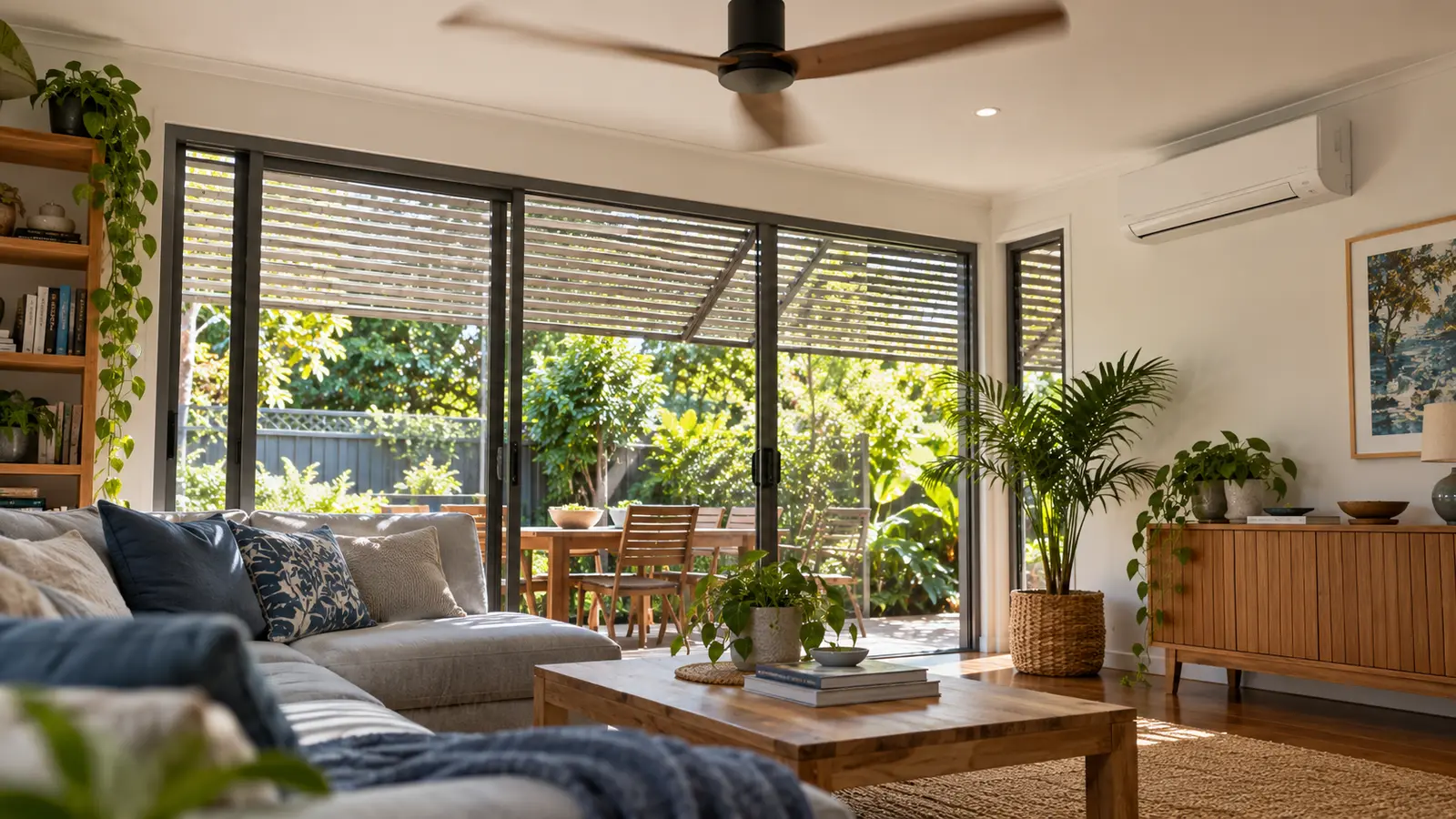
Summer electricity bills are usually driven by two things happening at the same time: the home gains more heat, and the cooling system runs longer to remove it. The cheapest strategy is therefore not simply "use less air conditioning." It is to reduce heat gain first, use low-power air movement when it is enough, and run the air conditioner efficiently when it is genuinely needed.
For most Australian homes, the practical order is:
- stop direct sun before it heats the room;
- open the home only when the outdoor air is cooler;
- use a fan to improve comfort;
- cool occupied rooms rather than the whole house;
- set the air conditioner to a moderate temperature and monitor the result.
This guide turns that order into a repeatable plan you can test with a smart meter, plug-in meter, or whole-home energy monitor.
The short answer: use a cooling hierarchy
A good summer routine changes with indoor and outdoor conditions. It is not a blanket rule to keep windows open, close the house all day, or avoid air conditioning.
| Condition | Best first action | Why it helps |
|---|---|---|
| Outside is hotter than inside | Close windows and shade sun-exposed glass | Limits hot-air entry and solar heat gain |
| Outside becomes cooler than inside | Open secure windows on different sides | Purges stored heat and supports cross-ventilation |
| You feel warm but the room is tolerable | Use a ceiling or pedestal fan | Air movement cools people at low electrical input |
| One room is occupied | Close internal doors and cool that zone | Reduces the volume the air conditioner must condition |
| Heat or humidity is uncomfortable or unsafe | Use efficient air conditioning | Active cooling is appropriate when passive measures are insufficient |
| The bill is still high | Inspect interval data and test one change at a time | Separates cooling load from pools, hot water, EV charging and other loads |
The Australian Government's summer guidance recommends closing windows, curtains and doors during the hottest part of the day, opening the home when outside conditions cool, using fans first, and setting air conditioning between 25°C and 27°C where suitable. It also notes that every degree higher can reduce cooling energy costs by roughly 5% to 10%, although the actual result depends on weather, building performance and equipment.
1. Block heat before trying to remove it
Direct sunlight through glass can turn a room into a heat collector. Once floors, furniture and internal walls absorb that heat, the air conditioner must remove it later.
Start with the windows that receive strong morning or afternoon sun. East- and west-facing glass is often difficult because low-angle sun can pass under shallow eaves. External shading, awnings, shutters or a shaded veranda usually stops more heat than an internal blind because it intercepts solar radiation before it reaches the glass. Where external shading is not practical, close well-fitted blinds or curtains before the sun reaches the window.
Do not wait until the room already feels hot. A useful routine is to shade the problem windows early, then reopen blinds only after direct sun has moved away.
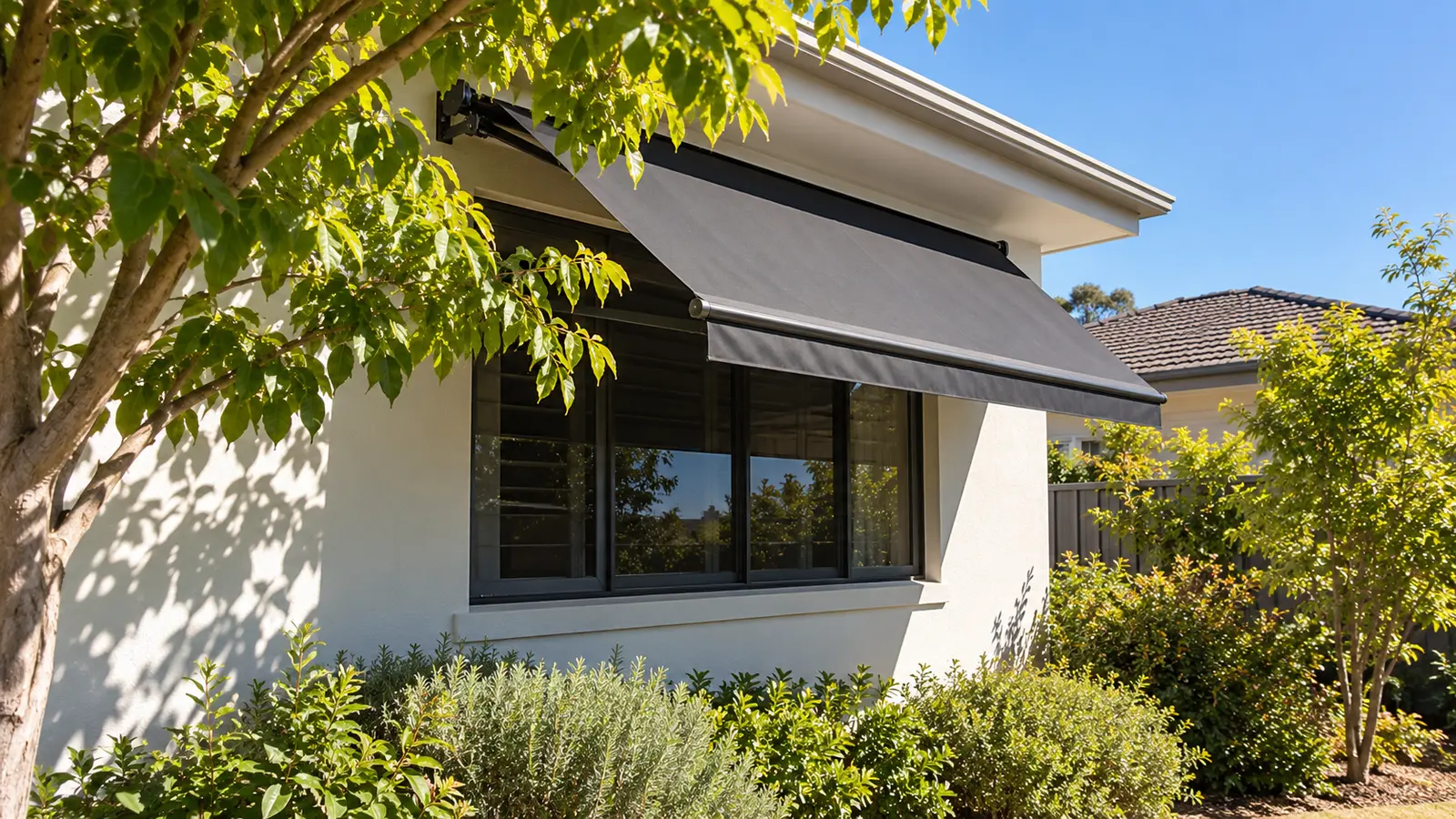
External shade stops direct summer sun before it reaches the glass.
2. Ventilate according to temperature, not habit
Opening windows is useful only when the incoming air can improve conditions. On a very hot afternoon, wide-open windows may bring more heat into the building. In many temperate and dry locations, the better pattern is to keep the house shaded and relatively closed during the hottest hours, then ventilate in the evening or early morning when outdoor air is cooler.
Cross-ventilation works best when air can enter on one side and leave on another. Openings do not have to be opposite each other, but a clear path helps. Security, smoke, noise, humidity and outdoor air quality may limit when this is practical.
In hot-humid climates, air movement is valuable for comfort, but bringing in humid outside air may not cool the building. Air conditioning or dehumidification can be more useful when high humidity is the main problem.
3. Use fans to cool people
A fan does not meaningfully lower the room's air temperature. It moves air across skin, improving evaporative and convective cooling, so it should be directed at occupied areas. There is little value in leaving a fan running in an empty room unless it is deliberately moving cooler air through the building.
Government guidance estimates that fans can improve perceived comfort by about 3°C and cost only a few cents per hour in typical use. The exact cost depends on fan wattage and your tariff.
Use this simple calculation:
fan cost = fan watts ÷ 1,000 × hours used × electricity rate
For example, a 45 W fan used for 6 hours consumes 0.27 kWh. At an illustrative tariff of $0.35/kWh, that is about $0.09. Use the wattage on your fan and the rate on your bill rather than treating this example as a quote.
Fans can also support a higher air-conditioner setpoint while maintaining comfort. That combination is often more useful than setting the air conditioner very low and leaving the fan off.
4. Run the air conditioner as a controlled tool
Avoid using an extremely low setpoint to "cool faster." The setpoint is a target, not a turbo button. A lower target can make the system run longer and may overcool the room.
A practical starting range is 25°C to 27°C, adjusted for humidity, health needs, building conditions and personal comfort. Then:
- close doors to rooms that do not need cooling;
- keep conditioned-room windows closed;
- clean accessible filters according to the manufacturer's instructions;
- keep indoor and outdoor airflow paths clear;
- use timers or schedules to avoid running after the room is unoccupied;
- arrange licensed servicing if performance has deteriorated or the unit shows faults.
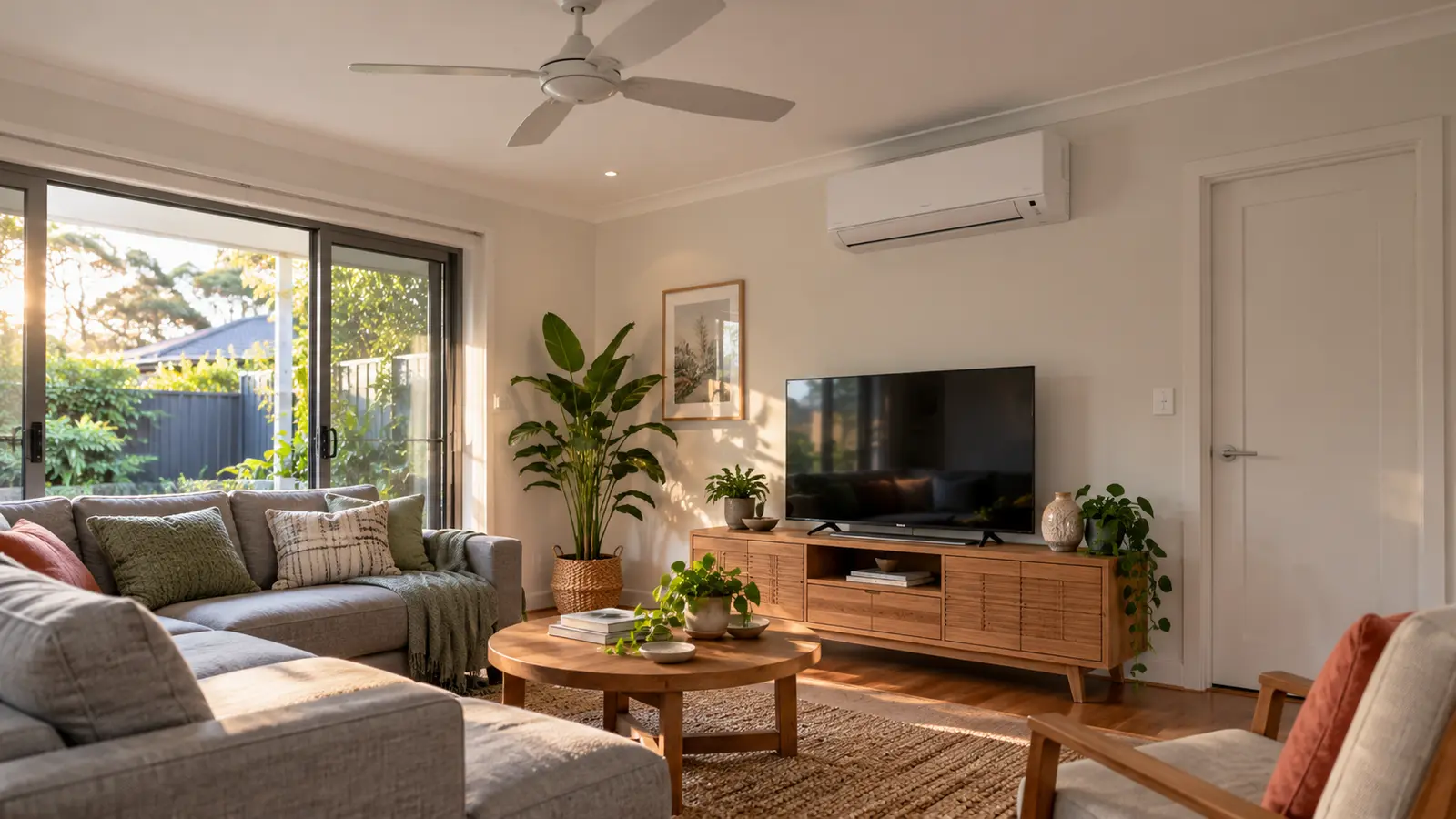
Combining air movement, a moderate setpoint and room zoning can reduce unnecessary compressor runtime.
For a deeper look at equipment consumption, see How Much Electricity Does a Split-System Air Conditioner Use in Real Life?. If you are deciding between temporary and installed cooling, compare Portable Air Conditioner vs Split System: Which Is Cheaper to Run?.
5. Cool the smallest useful zone
Whole-home cooling is convenient, but it can be expensive when only one or two rooms are occupied. A zoned ducted system can help if its zones are designed and commissioned correctly. With split systems, closing internal doors can limit the active area.
Do not close supply outlets or zones contrary to the manufacturer's instructions. Some ducted systems need minimum airflow, and aggressive zone closure can create noise, pressure or performance problems. Ask the installer which zones may operate together and whether the system has a spill or bypass arrangement.
At night, prioritize the sleeping area. During the day, prioritize the room where people are actually working or relaxing. Moving activity to the coolest part of the house can be cheaper than conditioning every room.
6. Move heat-producing tasks out of the hottest hours
Ovens, clothes dryers, dishwashers, desktop computers and some lighting add heat indoors. Their electricity use may be modest compared with cooling, but their waste heat can make the air conditioner work harder.
Where practical:
- cook outdoors, use smaller appliances, or prepare food outside the afternoon peak;
- run the dishwasher after the hottest period;
- dry clothes outside instead of using a dryer;
- switch off gaming computers and other high-power electronics when not needed;
- schedule flexible loads for a cheaper tariff period without shifting them into a time that worsens indoor heat.
If you are on time-of-use pricing, combine comfort with tariff timing rather than chasing the lowest rate blindly. The guide to the best time to run appliances on time-of-use explains how to balance the two.
7. Check the loads that are not cooling
A summer bill can rise even when the air conditioner is not the main cause. Common contributors include:
- a pool pump running longer than intended;
- electric hot water reheating at an expensive time;
- a second refrigerator working hard in a hot garage;
- an EV charging schedule;
- irrigation or bore pumps;
- a dehumidifier;
- an old freezer with poor ventilation;
- a device fault or schedule left active.
Compare the load shape on mild days and hot days. Cooling load usually tracks hot periods and occupancy, while a pool pump creates a regular block and water heating often appears as one or more distinct cycles. Overnight consumption can reveal a separate issue; see Why Your Electricity Use Is Higher at Night.
8. Measure cost instead of guessing
The most useful number is not the air conditioner's nameplate input. Inverter-driven systems modulate, so their actual demand changes with outdoor temperature, room temperature, humidity, setpoint and building heat gain.
A simple daily estimate is:
cooling cost = average measured kW × runtime hours × electricity rate
Suppose monitoring shows an average input of 1.2 kW over 6 hours. That is 7.2 kWh. At an illustrative $0.35/kWh, the daily cost is $2.52. If shading, zoning and a fan reduce compressor runtime by 2 hours at the same average input, the avoided energy is about 2.4 kWh, or $0.84 at that example tariff.
Real systems do not always average the same power before and after a change, so treat this as planning arithmetic. Smart-meter interval data or a suitable energy monitor will give a better result.
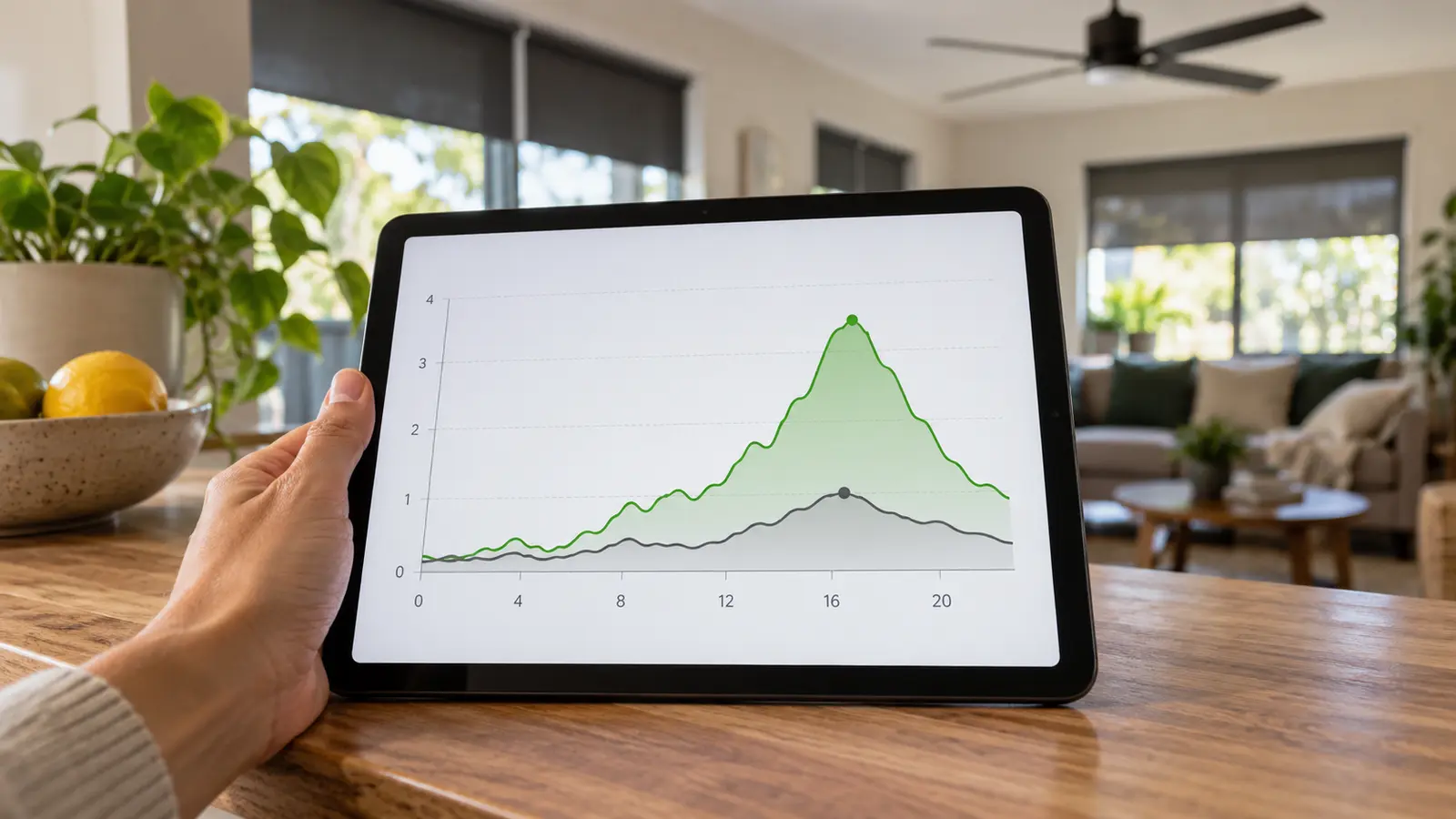
Compare similar weather periods and change one major variable at a time.
Use the workflow in How to Use Smart Meter Data to Find the Hours That Cost You Most:
- choose two days with broadly similar weather;
- keep occupancy and major appliance schedules as consistent as possible;
- change one variable, such as afternoon shading or the setpoint;
- compare kWh during the same hours;
- repeat before spending money on an upgrade.
9. Fix controls before replacing equipment
Before buying a new air conditioner, check whether the problem is operation, sizing, maintenance or the building itself.
| Symptom | Likely first check |
|---|---|
| Room heats rapidly in afternoon | External shading and west-facing glass |
| Unit runs constantly with weak airflow | Filter, blocked airflow, service condition |
| One room is cold while others stay hot | Zoning, door position, return-air path, system design |
| Bill jumps at a fixed time daily | Tariff window or scheduled load |
| Cooling remains expensive on mild days | Setpoint, runtime schedule, open doors/windows, other loads |
| Portable unit struggles continuously | Exhaust setup, air leakage and suitability for room size |
Replacement can still be justified when equipment is inefficient, unreliable, incorrectly sized or unable to maintain safe comfort. When comparing new room air conditioners in Australia, use the Zoned Energy Rating Label and the Energy Rating Calculator for your climate zone.
10. Choose upgrades in the right order
Low-cost actions usually deserve the first trial:
- schedules, setpoints and occupied-room zoning;
- cleaning accessible filters and clearing airflow;
- temporary external shade or better curtains;
- ceiling or pedestal fans;
- draught sealing where conditioned air is escaping;
- permanent external shading;
- ceiling and wall insulation where appropriate;
- efficient, correctly sized cooling equipment;
- monitoring or controls that solve a defined problem.
The best order varies by climate. In a dry inland area, night purging can be powerful. In a humid tropical area, opening the home may increase humidity, and efficient active cooling can be more important. A rental may favor removable shade, fans and portable monitoring. An owner planning a renovation can consider insulation, glazing and permanent shading.
A seven-day summer bill test
Use one week to establish what actually works in your home.
Day 1: establish the baseline
Record the day's maximum temperature, thermostat setting, cooling hours and total household kWh. Note pool, EV, hot-water and cooking schedules.
Day 2: control direct sun
Shade the strongest east- and west-facing windows before sunlight reaches them. Keep other routines similar.
Day 3: test fans first
Use fans in occupied areas and delay active cooling until comfort requires it.
Day 4: test a moderate setpoint
Use the air conditioner with a 25°C to 27°C starting range, adjusted for your circumstances, and pair it with a fan.
Day 5: reduce the conditioned area
Cool only occupied rooms, while respecting the system's airflow and zoning requirements.
Day 6: move flexible loads
Shift the oven, dishwasher, dryer, pool pump or EV charging where doing so improves both tariff cost and heat management.
Day 7: compare interval data
Compare the same time windows, account for weather differences, and keep the changes that reduced kWh without unacceptable discomfort.
Do not expect a perfect experiment. Weather and occupancy vary. The goal is to identify a repeatable pattern strong enough to guide the next decision.
Mistakes that often increase summer costs
- Opening windows during hotter outdoor conditions. Ventilation helps when outside air is genuinely useful.
- Setting the air conditioner extremely low. This can extend runtime without cooling the space faster in the way people expect.
- Cooling empty rooms. Match conditioning to occupancy.
- Leaving fans on in empty rooms. Fans cool people through air movement; they do not store coolness.
- Ignoring humidity. A strategy that works in a dry climate may be uncomfortable in a humid one.
- Comparing bills without comparing weather or billing days. Use daily or interval kWh where possible.
- Buying equipment before testing controls and heat gain. A new unit cannot compensate efficiently for every shading, sealing or sizing problem.
- Treating solar generation as free unlimited cooling. Solar can reduce grid imports, but runtime, export value and peak demand still matter.
What renters can do
Renters can still make meaningful changes without permanent building work:
- use removable external shade where permitted;
- close curtains before direct sun reaches the glass;
- use a fan in the occupied area;
- seal obvious gaps with removable products where safe;
- clean accessible air-conditioner filters as instructed;
- use smart-meter data or a plug-in meter for suitable plug-connected appliances;
- ask the property manager to address faulty cooling, damaged seals or missing shade.
Never open a switchboard or install fixed electrical equipment yourself. Fixed wiring, hard-wired controls and many air-conditioning tasks require appropriately licensed trades.
When comfort and health override the savings target
During extreme heat, the aim is safe indoor conditions, not the lowest possible kWh. Use active cooling when passive measures are not enough, particularly for older people, babies, people with medical conditions and anyone affected by heat stress. Follow local health and emergency advice, stay hydrated, and move to a cooler location if the home cannot be kept safe.
Final checklist
Before the next hot day:
- shade the windows that receive direct sun;
- know when outdoor air becomes cooler than indoor air;
- put fans where people spend time;
- clean accessible air-conditioner filters;
- choose an initial setpoint and schedule;
- decide which rooms actually need cooling;
- check pool, hot-water and EV schedules;
- record interval kWh for comparison;
- change one major variable at a time;
- prioritize safety during extreme heat.
The strongest summer savings usually come from combining small controls: less heat entering, more air movement around people, fewer conditioned rooms, and shorter compressor runtime. Measurement then tells you whether those controls are working in your particular home.