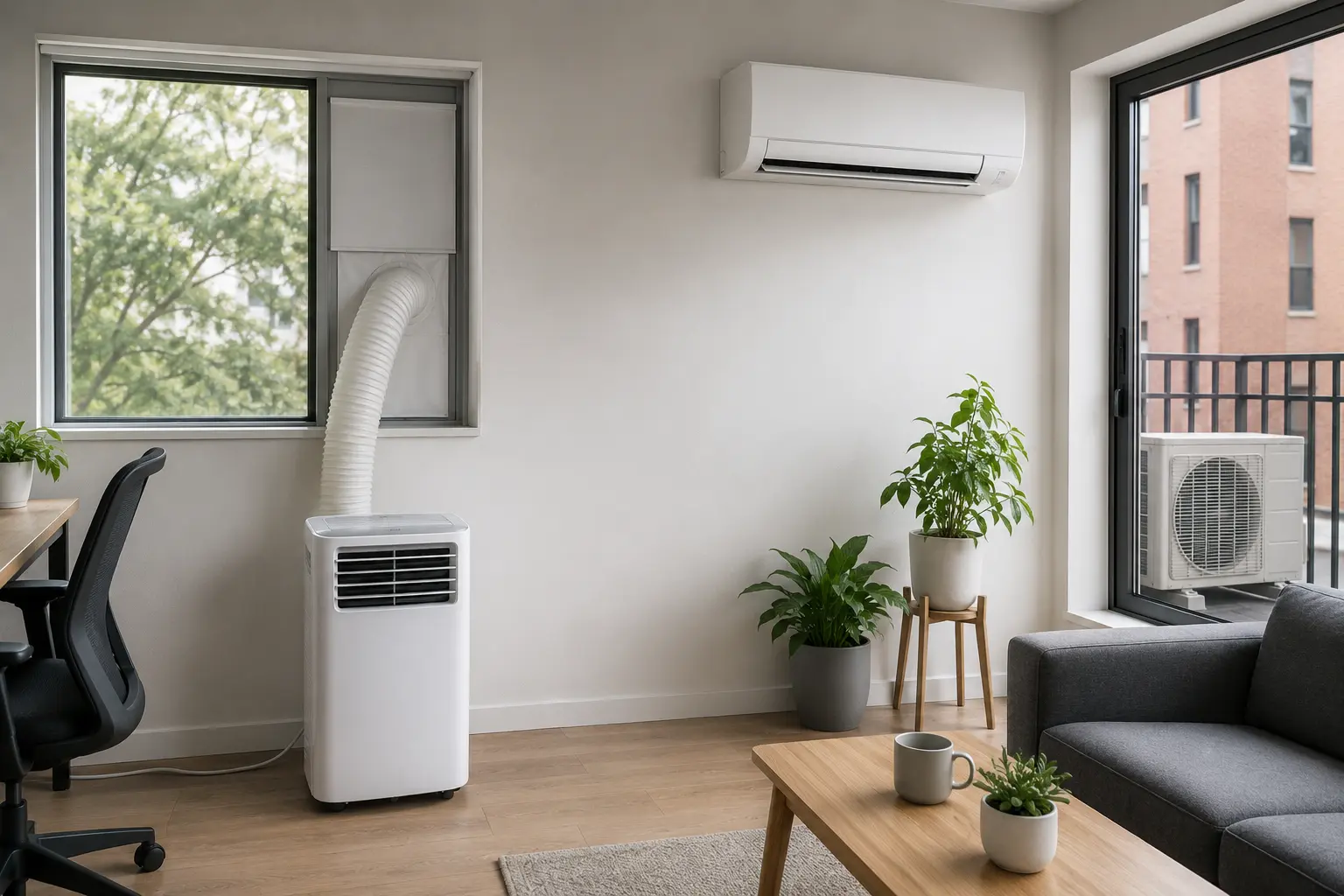
A portable air conditioner is usually cheaper to buy and easier to deploy. A properly sized split system is usually cheaper to run when cooling is frequent, lasts for several hours a day, or needs to cover the same room for multiple seasons.
The reason is not simply that one appliance has a lower wattage on its label. A portable unit keeps the compressor and condenser inside the room, rejects heat through a hose, and may draw warm replacement air back into the space. A split system places the hot side outdoors and can modulate its output more effectively. The useful comparison is therefore electricity consumed for the comfort actually delivered, not advertised cooling capacity alone.
This guide shows how to compare the two options with energy-label data, measured power, runtime, room conditions, and total ownership cost.
Quick answer
| Decision factor | Portable air conditioner | Split system |
|---|---|---|
| Upfront cost | Usually lower | Higher because equipment and professional installation are required |
| Running cost for frequent cooling | Usually higher for the same comfort | Usually lower when correctly sized and installed |
| Best use | Temporary, occasional, rental, or one hard-to-modify room | Regular cooling, long daily runtime, owner-occupied or long-term space |
| Noise in the room | Compressor and fans are indoors | Main compressor is outdoors |
| Air leakage risk | High if the window kit is poorly sealed; single-hose models also depressurize the room | Low when penetrations and doors/windows are properly sealed |
| Heating capability | Model-dependent and often secondary | Reverse-cycle models can provide efficient heating as well as cooling |
| Best monitoring method | Properly rated plug-in energy monitor, if permitted by the appliance instructions | Dedicated circuit meter, whole-home monitor, or utility interval data |
| Portability | Can be moved, although the hose and window kit must be reinstalled | Fixed installation |
Choose a portable unit when installation is not possible, cooling is genuinely occasional, and the room can be closed and the exhaust kit sealed well.
Choose a split system when you expect to cool the same occupied space regularly. The higher installed cost can be offset by lower electricity use, better comfort, lower indoor noise, and, for reverse-cycle models, useful heating.
Why portable units usually use more electricity for the same result
A portable air conditioner is a self-contained refrigeration system. It absorbs heat from room air, but its condenser also releases heat. The machine has to send that condenser heat outdoors through one or two hoses.
A single-hose portable uses room air to cool its condenser and exhausts that air outside. This reduces pressure in the room. Warm air can then enter through gaps around doors, windows, floorboards, or other openings. Australia's official Energy Rating guidance says single-duct portable air conditioners display no efficiency stars because this pressure effect draws warmer air into the space and counteracts cooling.
A dual-hose portable separates outdoor intake and exhaust air, reducing the pressure problem. It can be a meaningful improvement, but it still places hot components and ductwork close to the conditioned space. Hose length, hose temperature, bends, window sealing, and outdoor conditions all affect real performance.
A split system moves refrigerant between an indoor unit and an outdoor condenser. The indoor head circulates and cools room air while the compressor and heat rejection remain outside. There is no large exhaust hose radiating heat back into the room and no deliberate removal of conditioned room air.
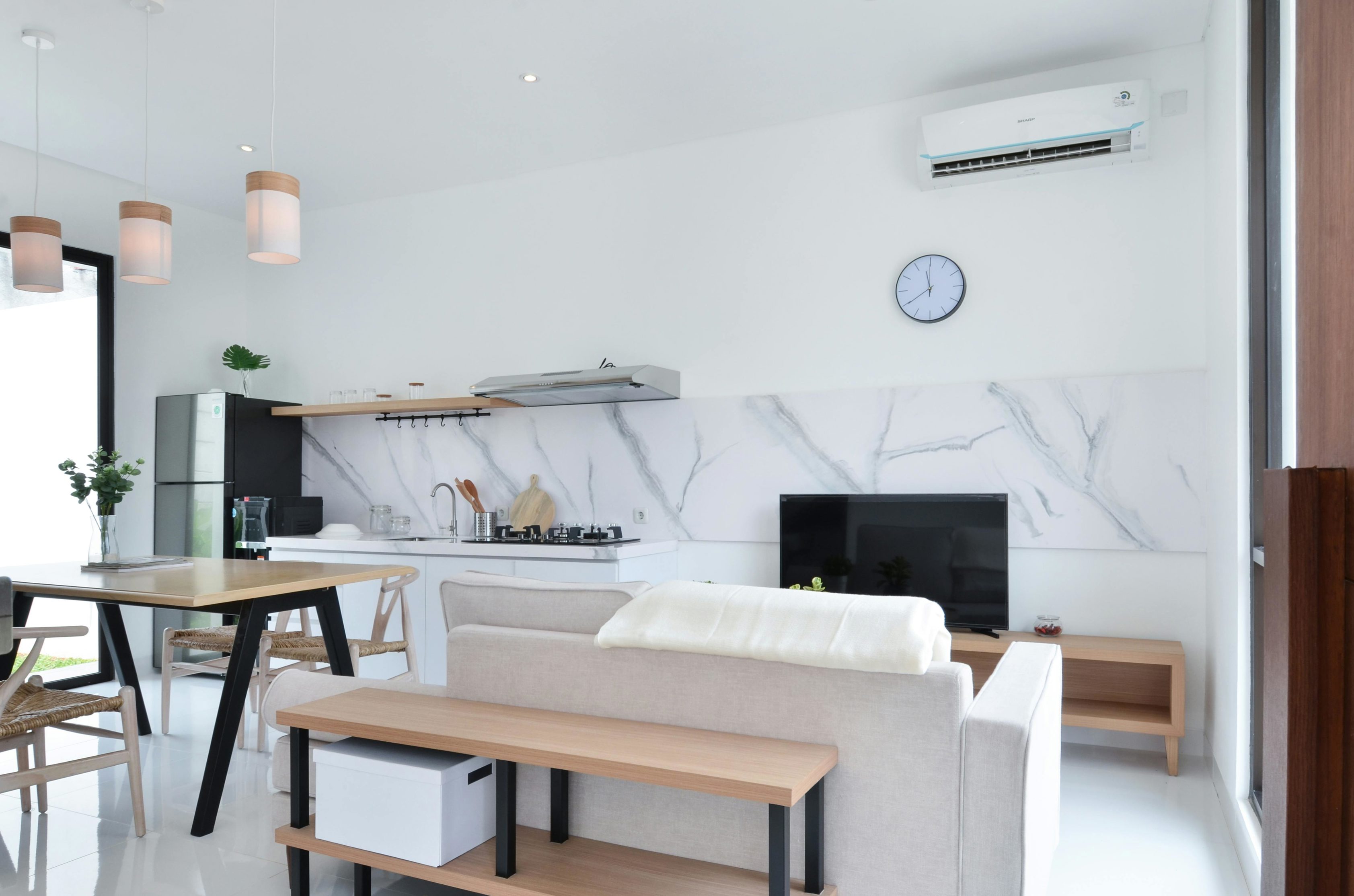
The hot side of a split system is outdoors. Correct sizing, placement, airflow, and installation still determine how efficiently the indoor unit maintains comfort.
Do not compare headline capacity without checking the test basis
Cooling capacity and electrical input are different quantities.
- Cooling capacity describes how much heat the appliance can remove under specified test conditions.
- Input power describes the electrical demand at a particular operating point.
- Energy use is input power accumulated over time, normally billed in kilowatt-hours.
- Efficiency relates cooling delivered to electricity consumed.
Portable air-conditioner labels may use a seasonally adjusted cooling capacity, often abbreviated SACC, that accounts for effects not visible in older headline BTU figures. Split systems are commonly compared with seasonal metrics such as SEER or region-specific energy-rating labels. These figures are useful within their own product classes, but a shopper should not assume that two prominent capacity numbers were produced by identical tests.
Use the model's official energy label or certified product data. Confirm whether the capacity is adjusted or unadjusted, and compare estimated energy use for your climate where a regional label or calculator is available.
Most importantly, avoid buying by room area alone. Solar gain, ceiling height, insulation, glazing, air leakage, occupancy, internal equipment, humidity, and adjacent unconditioned spaces all change the cooling load. Oversizing wastes money and can impair humidity control; undersizing can leave a unit running continuously without reaching the target temperature.
Calculate running cost from measured average power
The most useful cost equation is:
Energy used (kWh) = average input power (kW) × operating time (hours)
Then:
Running cost = energy used (kWh) × your applicable electricity rate
Use the rate that applies during each interval if you have time-of-use pricing. Do not use the cooling-capacity figure as though it were input power.
An illustrative six-hour evening
Assume, only for demonstration, that monitoring shows:
- portable unit average draw: 1.20 kW
- split system average draw: 0.65 kW
- operating window: 6 hours
- electricity rate: $0.30 per kWh
The portable unit would use:
1.20 × 6 = 7.20 kWh, costing $2.16
The split system would use:
0.65 × 6 = 3.90 kWh, costing $1.17
Across 30 similar evenings, that illustrative difference becomes 99 kWh and $29.70.
This is not a universal efficiency claim or a prediction for your home. A small portable used for one hour can consume less total energy than a large split cooling an open-plan area all day. The example simply shows why average measured power and actual runtime produce a better decision than rated capacity or purchase price alone.
Measure the portable unit safely
A portable air conditioner normally connects to a wall outlet, which makes appliance-level monitoring possible, but only when the monitoring device is suitable for the load.
Before using a plug-in energy monitor, verify:
- voltage and frequency match;
- continuous and starting-current ratings are adequate;
- the monitor is approved for the appliance type and local market;
- the connection is direct, secure, and not an improvised adapter or extension lead;
- the outlet, plug, and monitor do not become unusually warm;
- the air-conditioner manufacturer does not prohibit the arrangement.
Record at least several complete hot days. Compressor cycling, thermostat settings, humidity, occupancy, door openings, and outdoor weather can make a single hour misleading. Capture:
- kWh per day;
- peak watts;
- average watts while cooling;
- total runtime;
- indoor setpoint;
- approximate outdoor temperature;
- whether the room reached and maintained comfort.
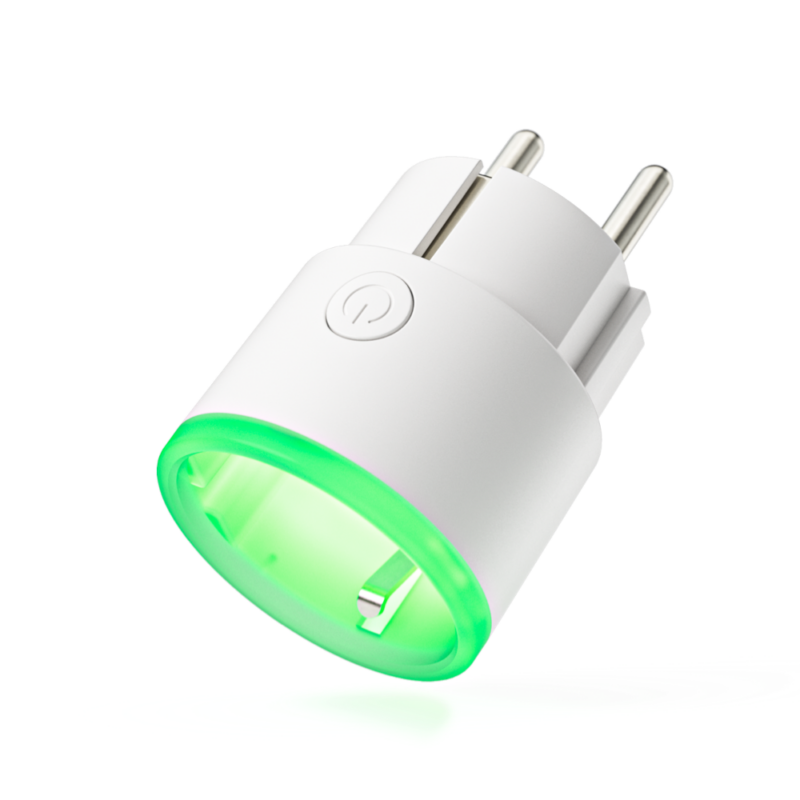
A correctly rated monitoring socket can reveal the portable unit's real kWh, cycling pattern, and standby use. Do not use it outside its electrical or appliance rating.
Measure a split system without guessing
Most split systems are hardwired, so a plug monitor is not appropriate. Use one of these methods instead.
Dedicated circuit monitoring
A qualified electrician can add metering to the air-conditioner circuit or install a compatible multi-circuit monitor. This is the clearest method when you want actual kWh, peak demand, and operating profiles without other household loads mixed in.
The meter and current-sensor arrangement must match the circuit, conductor access, current range, phase configuration, and local electrical rules. Do not open a switchboard or move a CT clamp unless you are qualified.
Whole-home monitoring with controlled tests
If the split system is a large, distinct load, whole-home data can still be useful:
- Record the home's stable demand with the air conditioner off.
- Start cooling and wait through the initial pull-down period.
- Note demand after the room approaches the setpoint.
- Repeat at the same setpoint on several days.
- Compare similar weather and occupancy conditions.
This method is less precise when cooking, water heating, EV charging, or other large loads overlap.
Utility interval data
Fifteen-minute or hourly utility data can show whether cooling creates a repeatable afternoon or evening block. It is useful for monthly cost and tariff analysis, but it normally cannot distinguish the air conditioner from another load without a controlled comparison.
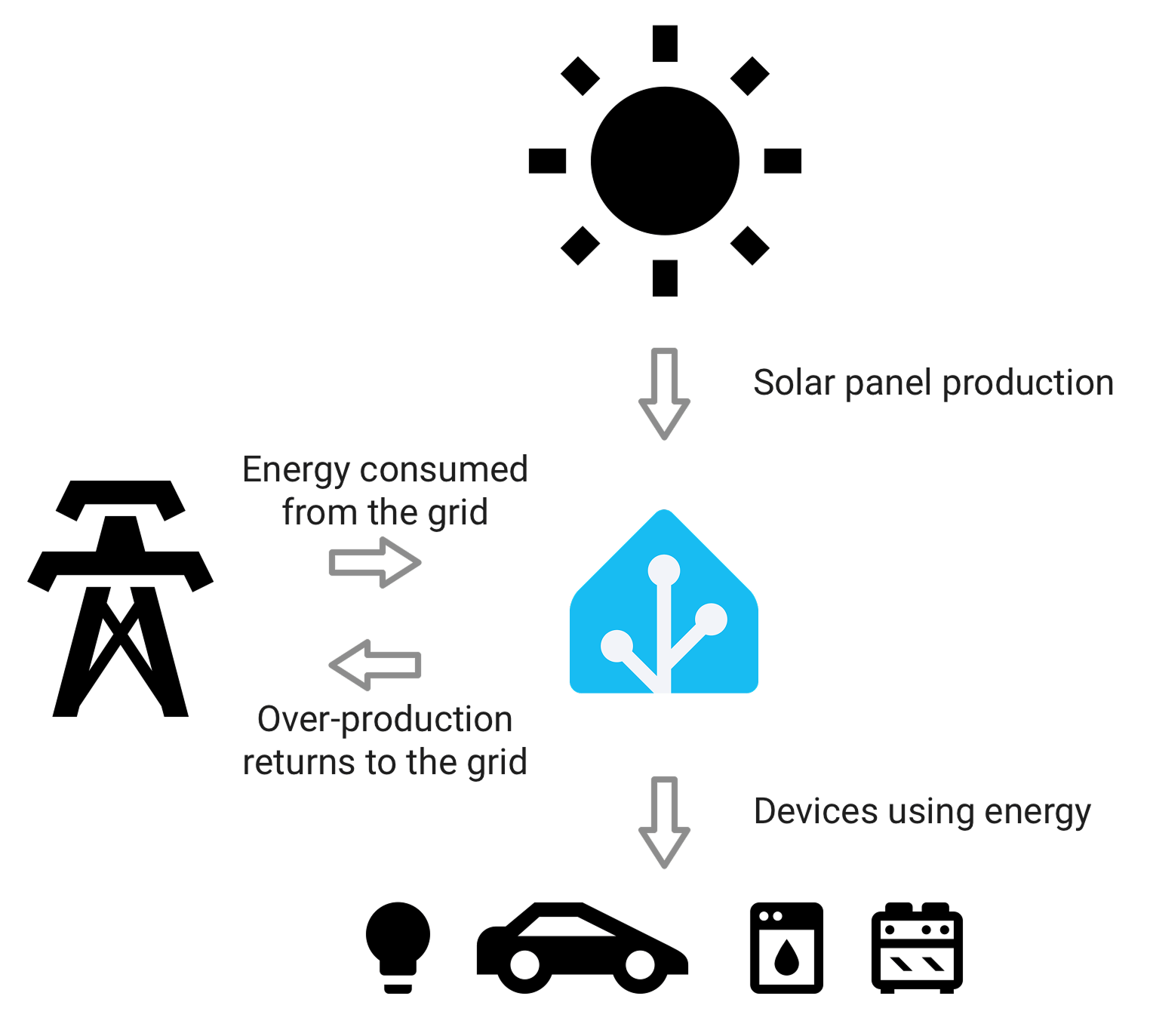
Trend data is most useful when you compare the same hours, weather range, setpoint, and occupancy. A one-day screenshot is not enough to establish seasonal running cost.
Compare comfort delivered, not only kWh
Electricity data without a comfort outcome can produce the wrong conclusion. Record whether each system actually keeps the occupied zone within an acceptable temperature and humidity range.
A portable unit may draw less power at a moment yet run continuously, leave the far side of the room warm, or fail to control humidity. A variable-speed split may draw strongly during initial pull-down and then settle to a lower level while maintaining a more even temperature.
Useful comparison metrics include:
- kWh per occupied cooling hour;
- kWh per day at the same setpoint;
- time required to reach the target temperature;
- temperature drift across the room;
- indoor humidity;
- noise where people sleep or work;
- peak demand during expensive tariff periods;
- cycling frequency and minimum steady-state draw.
For a controlled test, keep doors, blinds, thermostat setting, fan mode, occupancy, and major internal heat sources as similar as practical. Outdoor weather will never match perfectly, so repeat the test rather than relying on one day.
When the cheaper-to-buy option is still the right choice
A portable air conditioner can be the rational choice when:
- the property is rented and permanent installation is not approved;
- the need is temporary, such as a short heatwave;
- only one small, closable room needs occasional cooling;
- the occupant may move soon;
- installation access is genuinely impractical;
- cash flow matters more than multi-year operating cost.
Improve its performance by sealing the entire window kit, keeping the exhaust hose short and straight, shading the hose only with a safe manufacturer-compatible method, closing the conditioned room, cleaning filters, and avoiding a lower thermostat setting than comfort requires. A dual-hose model can reduce the negative-pressure penalty where suitable products are available.
Do not describe a portable unit as "ventless" if it uses refrigeration to cool. The heat must go somewhere. Products that add water to air without an exhaust hose are evaporative coolers, which are a different technology and depend strongly on climate and humidity.
When the split system usually wins
A split system is usually the stronger long-term choice when:
- cooling is used most days in warm months;
- daily sessions last several hours;
- the same room or zone will be conditioned for years;
- indoor noise matters;
- heating is also required;
- the portable struggles to reach the setpoint;
- electricity is expensive during cooling hours;
- solar generation can offset daytime cooling;
- better control and scheduling are valuable.
Include professional installation, electrical work, drainage, mounting, access, permits, service, and expected ownership period in the decision. The lowest equipment quote is not necessarily the lowest installed price, and the lowest installed price is not necessarily the lowest lifecycle cost.
Use a simple payback screen without pretending it is precise
Start with:
Annual electricity saving = annual portable kWh − annual split-system kWh
Annual bill saving = annual electricity saving × applicable tariff
Simple payback = additional installed cost ÷ annual bill saving
Then test several cases:
- mild year, short runtime;
- typical year;
- hot year, long runtime;
- flat tariff;
- time-of-use tariff;
- daytime cooling partly supplied by solar;
- heating benefit included or excluded.
Suppose the split system costs $1,800 more to install and monitoring suggests it saves $300 per year in cooling electricity. The simple payback is six years. If it also replaces resistance heating, the effective payback may improve. If cooling is used only ten days a year, the split may never recover its added cost through electricity savings alone.
Payback is only one part of the decision. Comfort, noise, landlord approval, property value, maintenance responsibility, heating capability, and equipment life can matter just as much.
Common comparison mistakes
Using maximum watts as average watts
Compressors cycle or modulate. Multiply a measured multi-hour average by time, not a brief peak.
Comparing different spaces
A portable cooling a closed bedroom and a split cooling an open living area are performing different jobs. Define the conditioned boundary first.
Ignoring air leakage
A loose window panel, open door, long hose, or unsealed penetration can dominate the result.
Treating the thermostat as a speed control
Setting 18°C does not make a room reach 24°C faster in a useful way. It can keep the compressor running after comfortable conditions are reached.
Looking at one mild day
Cooling performance changes with outdoor temperature, solar gain, humidity, and occupancy. Measure across representative conditions.
Ignoring standby and fan-only modes
Small loads become visible when a unit remains connected all season. Include them, but keep perspective: compressor runtime normally dominates cooling energy.
Assuming smart features guarantee efficiency
Wi-Fi, geofencing, and apps can reduce wasted runtime only if schedules and controls match occupancy. Connectivity does not repair poor sizing, bad sealing, or an inefficient refrigeration cycle.
A seven-day comparison workflow
- Define the room. Note floor area, ceiling height, sun exposure, door position, and known heat sources.
- Record the tariff. Include time-of-use windows and solar conditions where relevant.
- Verify equipment data. Capture model number, official capacity basis, rated input, and energy-label information.
- Measure energy. Use a rated plug monitor for the portable or appropriate circuit/whole-home monitoring for the split.
- Record comfort. Log setpoint, room temperature, humidity if available, and whether the occupied area felt evenly cooled.
- Repeat representative days. Include at least one hotter day and avoid comparing different occupancy patterns.
- Calculate lifecycle cases. Compare purchase and installation cost with measured seasonal kWh, then test more than one tariff and usage assumption.
For more detail on split-system measurements, read How Much Electricity Does a Split-System Air Conditioner Use in Real Life?. To turn interval readings into cost by hour, use How to Use Smart Meter Data to Find the Hours That Cost You Most.
The practical decision
A portable air conditioner solves an installation problem. A split system usually solves an ongoing comfort problem more efficiently.
For occasional use in a small closed room, the portable unit's low entry cost may matter more than its higher cost per unit of useful cooling. For repeated use over several seasons, a correctly sized split system will usually provide better comfort with lower electricity consumption and less indoor noise.
The defensible answer comes from four numbers: installed cost, measured seasonal kWh, tariff by time, and years of expected use. Add room temperature and humidity to the monitoring record, and the comparison becomes about service delivered rather than watts alone.
Sources
- Australian Energy Rating: Understand the Zoned Energy Rating Label
- Australian Energy Rating: Heating and cooling guidance
- Australian Energy Rating: Air-conditioner running-cost calculator
- ENERGY STAR: Room Air Conditioners
- U.S. Department of Energy: Heat Pumps
- U.S. Department of Energy: Consumer Central Air Conditioners and Heat Pumps
- Natural Resources Canada: Portable Air Conditioner Efficiency Requirements