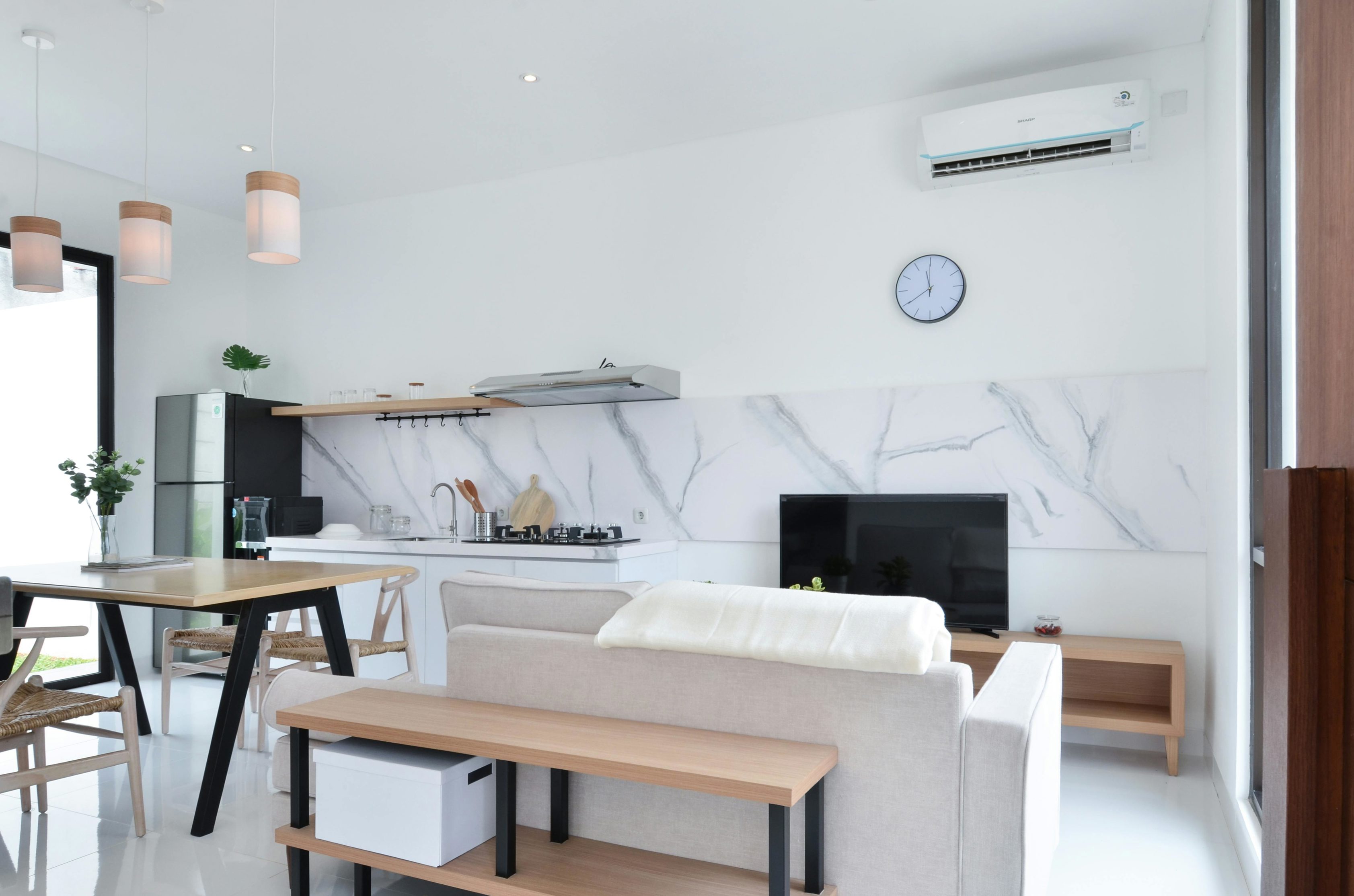
A split-system air conditioner can be one of the biggest electricity users in a home, but the real number is rarely the simple headline capacity on the box.
The practical answer is this: your real electricity use depends on the unit's electrical input power, how many hours it is actively working, the temperature difference between indoors and outdoors, your insulation, your thermostat setting, and whether the system is sized and maintained properly. A unit that looks modest on paper can still become a large bill driver if it runs for long hours, is set too cold, or is fighting poor airflow and a hot building shell.
The fastest way to think about it
If you want a usable rule of thumb, start with this:
electricity used (kWh) = average electrical draw (kW) x running hours
So if your split system averages about 0.9 kW during an evening cooling session and runs for 6 hours, it uses about 5.4 kWh.
If your tariff is $0.25 per kWh, that session costs about $1.35.
If the same pattern happens every day for a 30-day month, that is roughly 162 kWh and about $40.50.
That is why split-system cost questions are really two questions:
- How much power does the unit draw when cooling?
- How many hours is it working hard enough to matter?
Do not confuse cooling capacity with electricity use
Many homeowners look at a split system labeled 2.5 kW, 3.5 kW, or 5.0 kW and assume that is the electricity it consumes. It usually is not.
That number is commonly the cooling capacity, not the electrical draw. Modern split systems are moving heat, not turning electricity directly into cooling, so the electrical input is usually much lower than the cooling output.
What you actually need for bill math is one of these:
- rated input power in watts or kilowatts
- annual energy use estimate from an official energy label or calculator
- measured whole-home or circuit-level data from your own meter or monitor
If you are comparing products, the Energy Rating calculator notes that air conditioners may operate at less than rated capacity in real use, so actual cost can be lower than a straight full-load estimate. That is useful, but it also means brochure numbers alone do not tell you your bill outcome.
What makes real-life usage go up or down
1. Thermostat setting
Lower setpoints usually cost more because the unit has to remove more heat and run for longer.
Australia's Energy Rating guidance says that in summer, setting the thermostat to 25 to 27 C is a sensible range, and that setting it lower for cooling can increase electricity bills by about 10% for each extra degree. The exact result will vary by home and climate, but the direction is very real: chasing a colder indoor temperature gets expensive quickly.
2. Outdoor temperature and humidity
A split system working through a mild evening is not under the same load as a unit trying to hold a cool setpoint during a very hot afternoon. Hotter outdoor air, strong sun exposure, and high humidity all push runtime and power use upward.
3. Room size and system sizing
A small bedroom unit and a large open-plan living-area unit do not behave the same way. The U.S. Department of Energy notes that proper sizing matters, and that oversized or poorly placed indoor units can short-cycle, which hurts comfort and wastes energy. An undersized unit can also become expensive because it stays near maximum output for long stretches.
4. Building envelope
If the room gains heat quickly through windows, roof, gaps, or poor insulation, the air conditioner has to keep removing that heat. In practice, the building often matters almost as much as the machine.
5. Maintenance and airflow
Dirty filters and blocked outdoor airflow quietly hurt efficiency. The U.S. Department of Energy says neglected filters, coils, fins, and refrigerant lines reduce performance and increase energy use. In other words, a split system that has not been cleaned or serviced can cost more to run while cooling less effectively.
A practical way to estimate your own unit
Use this process if you want a number that is good enough for planning:
Method 1: Use the nameplate or product sheet
Look for the unit's rated input power in watts or kilowatts.
Then apply a realistic runtime assumption:
- light use in a mild room: maybe 30% to 50% of the session at meaningful load
- normal evening cooling: often 50% to 80%
- hot afternoons or poor insulation: sometimes close to continuous high load
Example:
- rated electrical input: 1.1 kW
- evening use: 6 hours
- effective average load factor: 70%
Estimated use:
1.1 x 6 x 0.7 = 4.62 kWh
At $0.30 per kWh, that is about $1.39 for the session.
Method 2: Use monthly bill comparison
If cooling is your main seasonal change, compare a month with heavy air-conditioner use to a similar month without it. This is rough, because weather and other loads change too, but it can tell you whether the split system is responsible for a meaningful jump.
Method 3: Measure with monitoring data
For EnergyMeterHub readers, this is the best method when you want the truth instead of a planning estimate.
If the split system is on a dedicated circuit and visible in your switchboard monitoring, or if you have whole-home interval data plus a stable background load, you can estimate its real draw far more accurately:
- note whole-home demand before cooling starts
- note demand 10 to 15 minutes after the unit settles into operation
- compare again after the room reaches temperature
- repeat on a mild day and a hot day
This quickly shows the difference between startup, pull-down, and steady-state operation.
What usually makes bills worse than expected
If your split-system cost feels too high, the problem is often one of these:
| Problem | What it does to electricity use |
|---|---|
| Thermostat set too low | Keeps the unit working harder and longer |
| Unit too small for the space | Pushes runtime toward near-continuous operation |
| Unit too large or badly placed | Can short-cycle and control humidity poorly |
| Dirty filter or clogged coil | Reduces airflow and efficiency |
| Strong afternoon sun or poor insulation | Increases heat entering the room |
| Cooling unused space | Adds runtime with little comfort benefit |
| Leaving doors or windows open | Forces the unit to chase a moving target |
A simple cost framework for buyers and owners
When someone asks whether a split system is cheap or expensive to run, the better answer is:
- efficient and well-sized units can be reasonable to run for targeted room cooling
- badly sized, badly operated, or poorly maintained units can become one of the largest contributors to a summer bill
- a smaller, well-targeted split system is often cheaper than trying to cool too much space unnecessarily
That is also why ductless mini-split systems are often attractive. The U.S. Department of Energy notes that they avoid duct losses, which in forced-air systems can account for more than 30% of air-conditioning energy use.
How to lower running cost without giving up comfort
If you already own the unit, the highest-value actions are usually simple:
- Set a realistic cooling temperature instead of treating the remote like a speed control.
- Keep filters clean during the cooling season.
- Keep the outdoor unit clear of debris and restricted airflow.
- Close doors, windows, and blinds when cooling a room.
- Cool the occupied zone instead of the whole home where possible.
- Use your meter or interval data to learn what the unit actually does in your house.
When a deeper check is worth it
It is worth looking harder if:
- your bill jumped sharply after the split system started being used
- the room never feels properly cool even after long runtime
- the outdoor unit or indoor head seems to run almost nonstop
- airflow feels weak even on higher fan settings
- whole-home monitoring shows a much larger draw than expected
At that point, do not assume the answer is simply "air conditioners use a lot." It may be a sizing issue, an airflow problem, a maintenance problem, or a building-shell problem.
Bottom line
A split-system air conditioner's real electricity use is not defined by the headline cooling capacity alone. The real bill impact comes from the combination of electrical input power, runtime, thermostat setting, outdoor conditions, room size, and maintenance.
If you want a planning number, use rated input power multiplied by realistic hours and a realistic load factor. If you want the truth, measure it with interval data or a proper energy monitor.
That is the point where cooling cost stops being guesswork and becomes something you can actually manage.
Sources
- U.S. Department of Energy, Ductless Mini-Split Air Conditioners: https://www.energy.gov/energysaver/ductless-mini-split-air-conditioners
- U.S. Department of Energy, Air Conditioner Maintenance: https://www.energy.gov/energysaver/air-conditioner-maintenance
- Energy Rating, Air Conditioners calculator and guidance: https://calculator.energyrating.gov.au/AirConditionerDetail.aspx