
A better electricity plan can reduce a household bill without changing a single appliance, but switching only makes sense when the new plan is cheaper for the way the home actually imports and exports energy.
For most Australian households, it is worth comparing plans now if the current offer has expired, the bill shows a better-offer message, rates have changed, or the home has recently added solar, a battery, an EV, electric hot water or major heating and cooling. The right comparison uses at least one full year of usage where possible. It includes supply charges, every usage period, controlled load, demand charges, solar credits, discounts and fees.
Short answer: compare now, but do not switch on the headline rate alone. Use your own bill or meter data, model the complete annual cost, and confirm the new tariff fits your daily load pattern.
The five-minute decision: is a comparison worth doing?
Use this table as a first screen.
| Situation | Compare now? | Why |
|---|---|---|
| You have not checked your plan for 12 months | Yes | Benefits, rates and market offers can change |
| Your bill says your retailer has a cheaper offer | Yes | It is a direct signal that the current plan may no longer be competitive |
| You recently added solar, a battery or an EV | Yes | Import timing, export credits and controllable loads have changed |
| You moved from gas to electric hot water or cooking | Yes | Higher electricity use can change the best tariff structure |
| You are considering time-of-use or demand pricing | Yes, with interval data | Timing and peak demand matter more than total kWh |
| You are in the middle of a short-term credit or fixed-rate period | Check the end date first | Leaving early may sacrifice a real benefit or trigger a fee |
| The estimated saving is very small | Usually wait and monitor | Complexity and behavior risk may outweigh the saving |
| You cannot verify rates, tariff windows or fees | No | An incomplete comparison is not decision-grade |
The Australian Government recommends using a free, independent government comparison service and notes that the best contract depends on total use and time-of-use pattern. In the National Electricity Market, Energy Made Easy covers ACT, NSW, Queensland, South Australia and Tasmania. Victoria uses Victorian Energy Compare. Retail choice is more limited in some other regions, but available offers or tariff options may still differ.
What to collect before comparing plans
A useful comparison begins with data, not a retailer advertisement.
Collect:
- A recent bill and, ideally, 12 months of bills. One quarter can be unusually hot, cold or unoccupied.
- Your National Meter Identifier (NMI). It appears on the electricity bill and can help official comparison services retrieve the correct meter history where supported.
- Current plan rates. Record the daily supply charge, all usage rates, controlled-load rate, demand-charge method, feed-in tariff and GST treatment.
- Benefit and contract dates. Note when discounts, credits, fixed rates or loyalty benefits end.
- Interval data if you have a smart meter. This is especially important for time-of-use, demand and solar plans.
- Major recent or planned load changes. Include an EV, battery, heat pump, pool pump, induction cooktop, second refrigerator or more home working.
- Solar export data. A high feed-in rate can be outweighed by expensive imports or a high supply charge.
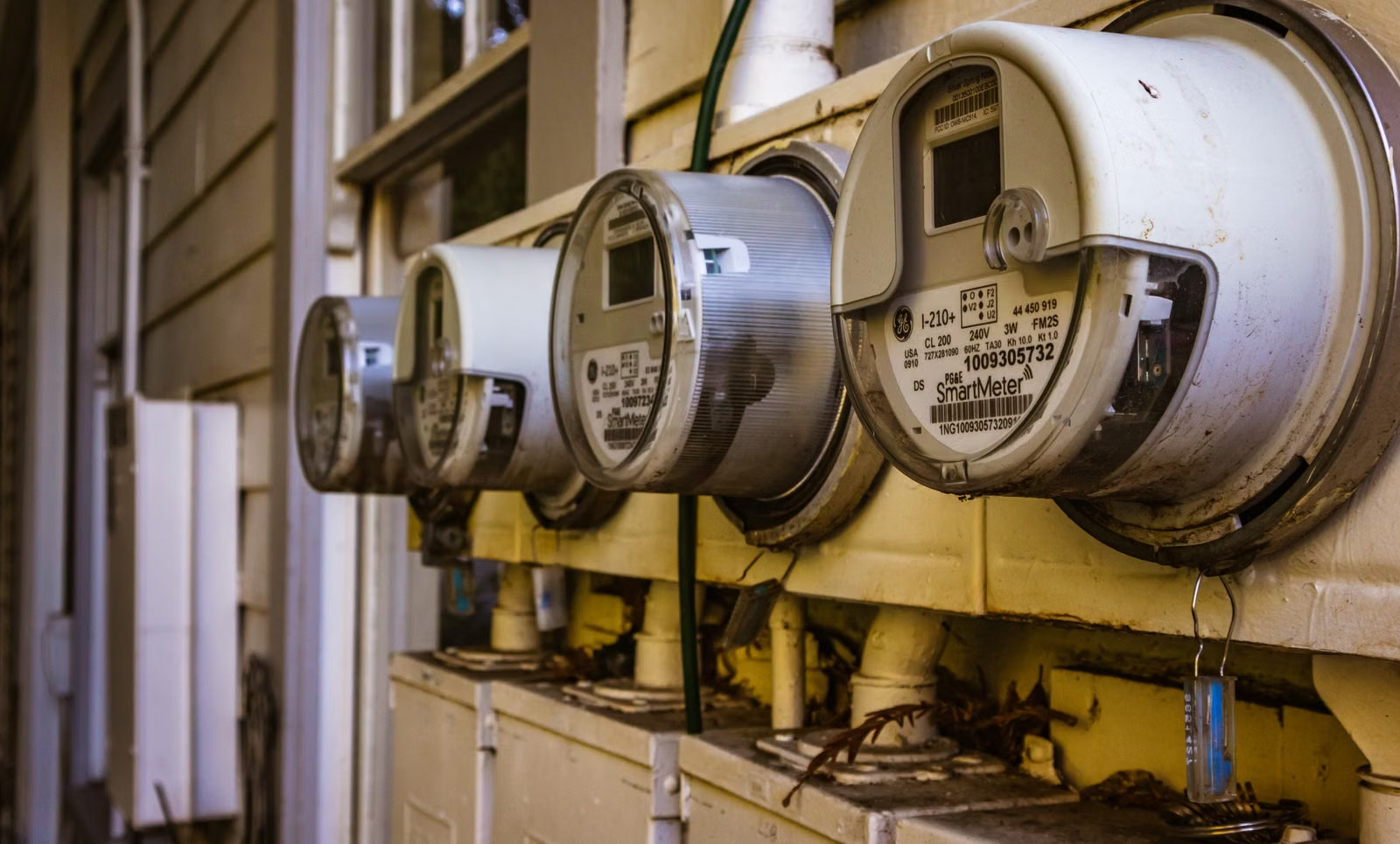
Energy Made Easy explains that using an NMI can provide the most personalised estimate because it can use up to 12 months of meter history. For a smart-meter home, it can also account for when electricity was used and, where relevant, solar exports. A quick comparison based on a generic household profile is less reliable.
If interval data is available, start with EnergyMeterHub's guide to finding your most expensive hours. If you are still deciding between flat rate and time-of-use, use the Tariff Fit Checker before comparing retailer offers.
Calculate the cost of your current plan correctly
The current plan is the baseline. Without a baseline, a claimed saving has nothing solid to beat.
A complete annual estimate is:
annual cost = supply charges + usage charges + controlled-load charges + demand charges + recurring fees - solar export credits - guaranteed credits
Treat conditional discounts carefully. A pay-on-time discount is worth its full face value only if the household reliably meets the condition. A sign-up credit lowers the first-year cost but may not lower the second-year cost. Rewards points and bundled services should be valued separately rather than treated as cash unless you would buy them anyway.
A simple worked example
Assume a home uses 5,000 kWh a year and pays:
- 105 cents a day supply charge
- 32 cents per kWh on a flat rate
- no solar credit or demand charge
The simple annual energy cost is:
- supply: 365 x $1.05 = $383.25
- usage: 5,000 x $0.32 = $1,600
- estimated total: $1,983.25
Now compare a plan with a 90-cent daily charge and a 33-cent usage rate:
- supply: 365 x $0.90 = $328.50
- usage: 5,000 x $0.33 = $1,650
- estimated total: $1,978.50
The second plan looks much cheaper on supply charge, but the annual saving is only $4.75 for this usage profile. A headline comparison of one rate would have exaggerated the difference.
This example is intentionally simple. Time-of-use, demand, controlled load and solar plans need interval or category-specific calculations.
Match the tariff to the household load shape
The cheapest advertised rate is not automatically the cheapest plan. Tariff structure determines which kWh become expensive.
Flat rate
A flat-rate plan charges the same usage rate throughout the day. It is often easier to understand and can suit a home with substantial weekday evening consumption that is difficult to move.
Flat rate may be the safer baseline when:
- cooking, cooling and family activity cluster in the evening
- there is no battery to reduce peak imports
- EV charging is irregular
- occupants do not want to manage schedules
- the time-of-use peak premium is large
Time-of-use
Time-of-use plans divide the day into peak, shoulder and off-peak windows. They can work well when large loads are genuinely flexible.
Good candidates include homes that can repeatedly move:
- EV charging to an off-peak period
- dishwashing and laundry away from peak
- electric water heating to a controlled or low-cost window
- pool pumping to cheaper hours
- battery charging and discharging around tariff periods

Do not assume a household will change its habits permanently because a tariff looks attractive in a spreadsheet. Model the current behavior first, then model a realistic shifted case. The difference between those two results shows how much of the saving depends on ongoing effort.
Demand tariffs
A demand tariff adds a charge based on the home's highest measured load during defined periods. One brief overlap between an EV charger, oven, water heater and air conditioner can influence the charge for a longer billing period.
Before choosing demand pricing, confirm:
- the measurement interval
- the demand window and applicable days
- whether the charge is based on one maximum or several events
- whether seasonal rules apply
- how an EV charger or battery is controlled
- whether the monitoring system can alert on approaching peaks
Read Demand Tariffs Explained for Solar, Battery, and EV Homes before accepting a plan where the demand formula is not immediately clear.
Controlled load
Controlled load commonly supplies an appliance such as electric storage hot water on a separately metered circuit. A low controlled-load rate can materially change plan value, so do not compare only the general usage rate.
Confirm that the new retailer supports the existing controlled-load arrangement and compare both the rate and supply implications. If hot water timing is under review, see Controlled-Load Hot Water vs Timer vs Smart Control.
Solar, batteries and EVs change the answer
A solar household should compare the whole bill, not chase the highest feed-in tariff.
Calculate:
- annual grid imports by tariff period
- annual solar exports
- feed-in credits, including caps or tiers
- daily supply charge
- any demand charge
- the effect of moving flexible loads into solar hours
A plan paying an extra 2 cents per kWh for 2,000 kWh of annual exports adds $40. If that plan increases import cost by 3 cents per kWh on 4,000 kWh, imports cost $120 more. The higher feed-in tariff loses overall before any supply-charge difference.
A battery can reduce peak imports, but its control mode matters. An EV can make an off-peak plan attractive when it charges consistently overnight, or a solar-focused plan attractive when it is home during midday surplus. These are load-shape questions, not product-label questions.

For a solar-specific comparison, use Is Solar Still Worth It When Feed-In Tariffs Are Low?. For EV timing, see Best EV Charging Schedule for Solar and Off-Peak.
What the 2026-27 Default Market Offer means
The Default Market Offer (DMO) is a regulated safety-net price for standing-offer customers in NSW, South Australia and south-east Queensland. It is also a reference price used when retailers advertise market offers. Victoria has the Victorian Default Offer.
The AER's final 2026-27 decision took effect from 1 July 2026. Prices fell for many DMO households in NSW and south-east Queensland, while outcomes varied by region and tariff. That does not prove that a particular market offer is cheap. The DMO comparison percentage is based on benchmark consumption for the relevant distribution area; your annual result still depends on your own usage and tariff pattern.
The 2026-27 framework also introduced an opt-in Solar Sharer Offer for eligible smart-meter households in DMO regions, with a regulated three-hour free-electricity window in the middle of the day. It can suit homes able to shift meaningful demand into that window, but the full annual price outside the free period still needs comparison.
Treat the reference price as a common measuring stick, not a personalised bill forecast.
A practical 20-minute comparison workflow
Minute 0-3: read the current bill
Write down:
- plan name
- tariff type
- supply charge
- usage and controlled-load rates
- feed-in tariff
- discounts and expiry dates
- demand charges and fees
- the retailer's better-offer message, if present
If the bill is difficult to decode, start with How to Read an Electricity Bill in Australia.
Minute 3-8: use an official comparison service
Use Energy Made Easy where available, Victorian Energy Compare in Victoria, or the relevant state or territory government resource. Provide an NMI or actual usage data when possible.
Shortlist three offers:
- the lowest estimated annual cost
- the lowest-complexity plan
- the plan best aligned with solar, EV, battery or controlled load
Minute 8-13: test tariff fit
For each shortlisted plan, ask:
- How much of annual consumption lands in each rate period?
- What happens on a hot weekday evening?
- Can the EV, hot water, laundry or pool pump move consistently?
- Does the solar export credit compensate for import and supply costs?
- Could a demand charge be triggered by normal appliance overlap?
- Is the first-year result inflated by a one-off credit?
Minute 13-17: read the Energy Price Fact Sheet
Check the formal fact sheet or Basic Plan Information Document for:
- complete rates
- tariff windows
- benefit period
- conditional discounts
- exit, paper-bill, payment or card fees
- renewable-energy or carbon options
- solar eligibility and export conditions
- billing frequency and payment methods
Minute 17-20: decide and save evidence
Save the comparison result, tariff sheet and date. Record why the winning plan was chosen and the annual-cost estimate for both current and new plans.
Do not rely on a salesperson's verbal summary. Confirm the plan name, rates, tariff type and start date in writing.
Questions to ask before you switch
Ask the new retailer:
- Will the meter tariff or network tariff change?
- Are the quoted rates inclusive of GST?
- When do discounts or fixed rates end?
- Are any discounts conditional?
- Is there an exit fee or early termination fee?
- Will controlled load continue unchanged?
- Are solar exports capped, tiered or subject to eligibility rules?
- Could the plan introduce demand charges?
- How will existing solar, battery or EV programs be affected?
- What happens when the benefit period ends?
- How long will the transfer take, and can the switch be cancelled?
- Will meter data remain available through the retailer portal?
For households receiving concessions, payment assistance or hardship support, confirm how these arrangements transfer before changing retailer.
When staying put is reasonable
Switching is not automatically the best action.
Staying may be sensible when:
- the current plan remains within a small margin of the best verified offer
- a fixed-rate or credit period still has genuine value
- the new plan depends on unrealistic load shifting
- a demand tariff creates more risk than the estimated saving
- solar export conditions are worse after full-bill modelling
- the household values a specific billing or support arrangement
- a move, meter change or major electrification project is imminent
Even then, set a review date. A plan that fits today may stop fitting after a rate change, benefit expiry or new appliance.
Verify the first bill after switching
A switch is complete only after the first bill is checked.
Verify:
- opening and closing meter reads
- NMI and service address
- tariff type and all rate periods
- controlled-load treatment
- solar feed-in credits
- discounts and promised credits
- demand charges
- billing days and supply charge
- GST and fees
Then compare at least four weeks of interval data with the tariff assumptions. Check whether loads actually moved as planned. If a time-of-use plan was chosen for overnight EV charging, confirm the charging intervals fall inside the advertised off-peak window. If a solar plan was chosen, compare the value of export credits against any increase in import or supply costs.
Common comparison mistakes
Avoid these errors:
- comparing cents per kWh but ignoring the daily supply charge
- using one unusually mild bill as the annual profile
- treating the reference-price discount as a guaranteed saving
- valuing a one-off sign-up credit as if it repeats every year
- choosing the highest feed-in tariff without modelling imports
- assuming “off-peak” hours are the same on every plan
- ignoring controlled load
- overlooking demand charges
- assuming household routines will change perfectly
- comparing plans before a major new load is added, then never checking again
- using a commercial comparison site without understanding which retailers it covers or how it is paid
Bottom line
Compare electricity plans whenever rates, benefits or household loads change, and at least once a year even when nothing obvious has changed.
The strongest decision uses a full year of actual consumption, interval data for complex tariffs, and a complete annual-cost model. Start with an independent government comparison service, use EnergyMeterHub's Tariff Fit Checker to test whether the structure matches the household, and verify the first bill after switching.
The best plan is not the one with the most attractive single rate. It is the one that produces the lowest credible total cost for the home's real import, export and demand pattern without requiring habits the household will not maintain.
Sources
- Australian Government: Switch to save
- Australian Government: Reduce your energy bills
- Energy Made Easy: How the plan search works
- Australian Energy Regulator: Default Market Offer
- AER: Final Default Market Offer 2026-27
- Australian Government: Electricity pricing plans and tariffs
- Essential Services Commission: Best-offer guidance