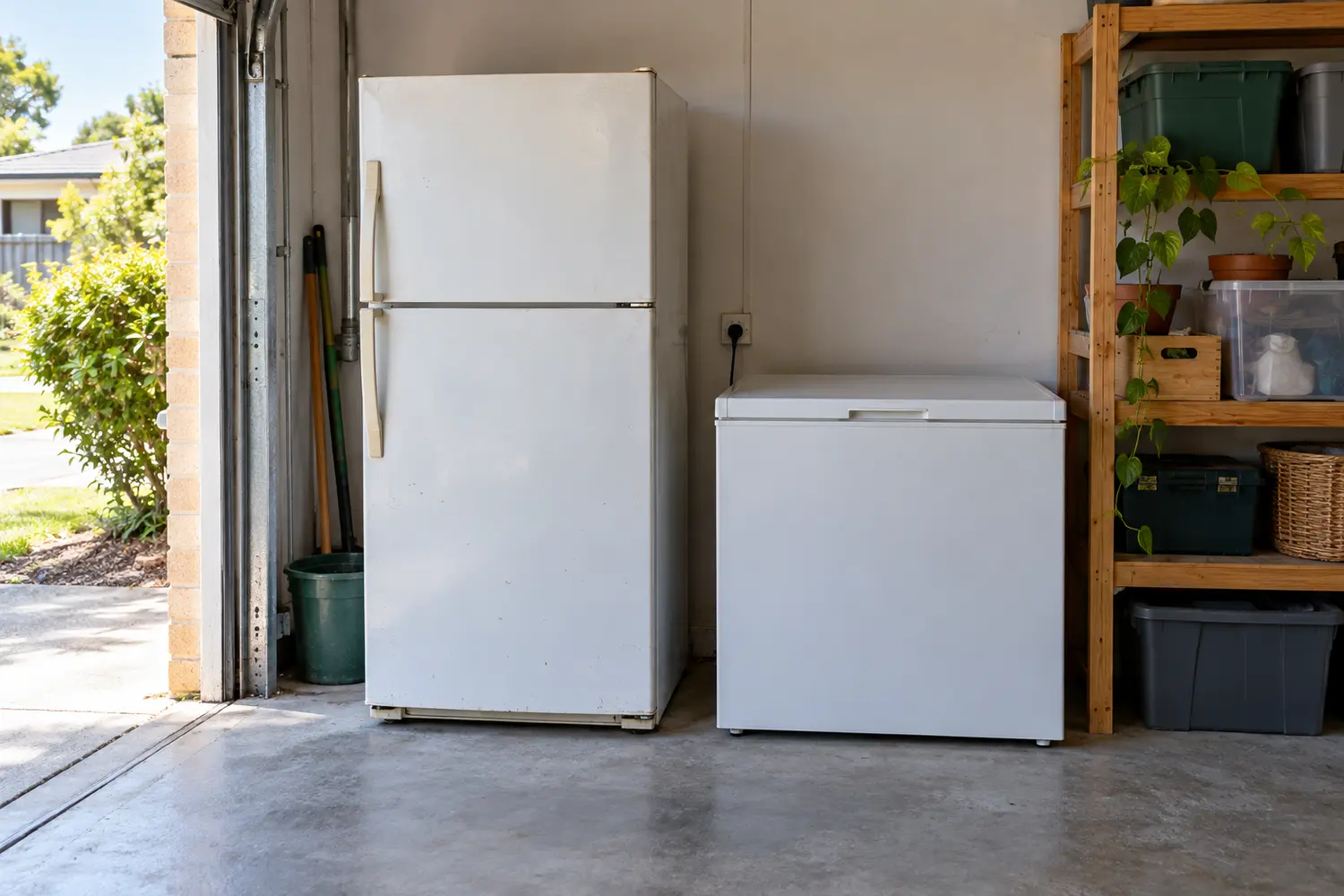
An extra refrigerator or freezer can be useful, but it is also one of the easiest household loads to forget. It runs all day, every day, and its cost is spread across every electricity bill rather than appearing as one obvious event.
The practical answer is simple: keep the appliance that provides genuinely useful storage at the lowest measured annual energy cost, and switch off or remove capacity that is mostly empty. A chest freezer can be efficient for long-term frozen storage, but it is not automatically cheaper than every second fridge. An old garage refrigerator may use far more energy than its original label suggests, especially in a hot, poorly ventilated space.
This guide shows how to compare a second fridge, garage fridge and chest freezer using annual kWh, real measurements, storage needs and total ownership cost.
Quick answer
| Situation | Best first decision | Why |
|---|---|---|
| Extra fridge is mostly empty | Consolidate food and switch it off | You stop paying to cool unused volume |
| Extra storage is mainly for frozen food | Compare an efficient chest freezer with the existing appliance | Purpose-built frozen storage may better fit the job |
| Old fridge is used only for parties | Leave it off and pre-cool it when needed | Occasional use can be cheaper than year-round operation |
| Appliance sits in a hot garage | Measure it during warm weather | Ambient temperature and ventilation affect real use |
| You are choosing a replacement | Compare annual kWh, capacity and total cost | Star ratings should be compared among similar products |
| You do not know its consumption | Measure kWh for at least 7 days | Cycling and defrost events make snapshots misleading |
The Australian Government advises households to avoid running second fridges unless needed and to consider removing additional refrigerators and freezers that do not provide enough value. It also notes that refrigeration accounts for around 10% of household energy bills overall. That does not make every second appliance wasteful, but it does mean a continuously operating extra appliance deserves evidence rather than habit.
Why the second appliance is easy to underestimate
A kettle or oven draws a lot of power for a short period. A refrigerator draws less at any moment, yet its compressor, fans, defrost heater and controls operate across the entire year. Small daily differences accumulate.
An extra appliance can be costly because:
- it is older and less efficient than the main fridge;
- damaged door seals allow cold air to leak;
- frost build-up reduces freezer performance;
- the thermostat is set colder than needed;
- much of its volume is unused;
- airflow around the condenser is poor;
- direct sun or a hot garage raises the heat it must reject;
- the door is opened frequently;
- components have aged or developed a fault.
“Garage fridge” describes a location, not an efficiency class. A suitable modern model in a temperate, ventilated garage may perform well. An old kitchen fridge moved beside a hot west-facing wall may not.
Compare annual kWh before star ratings
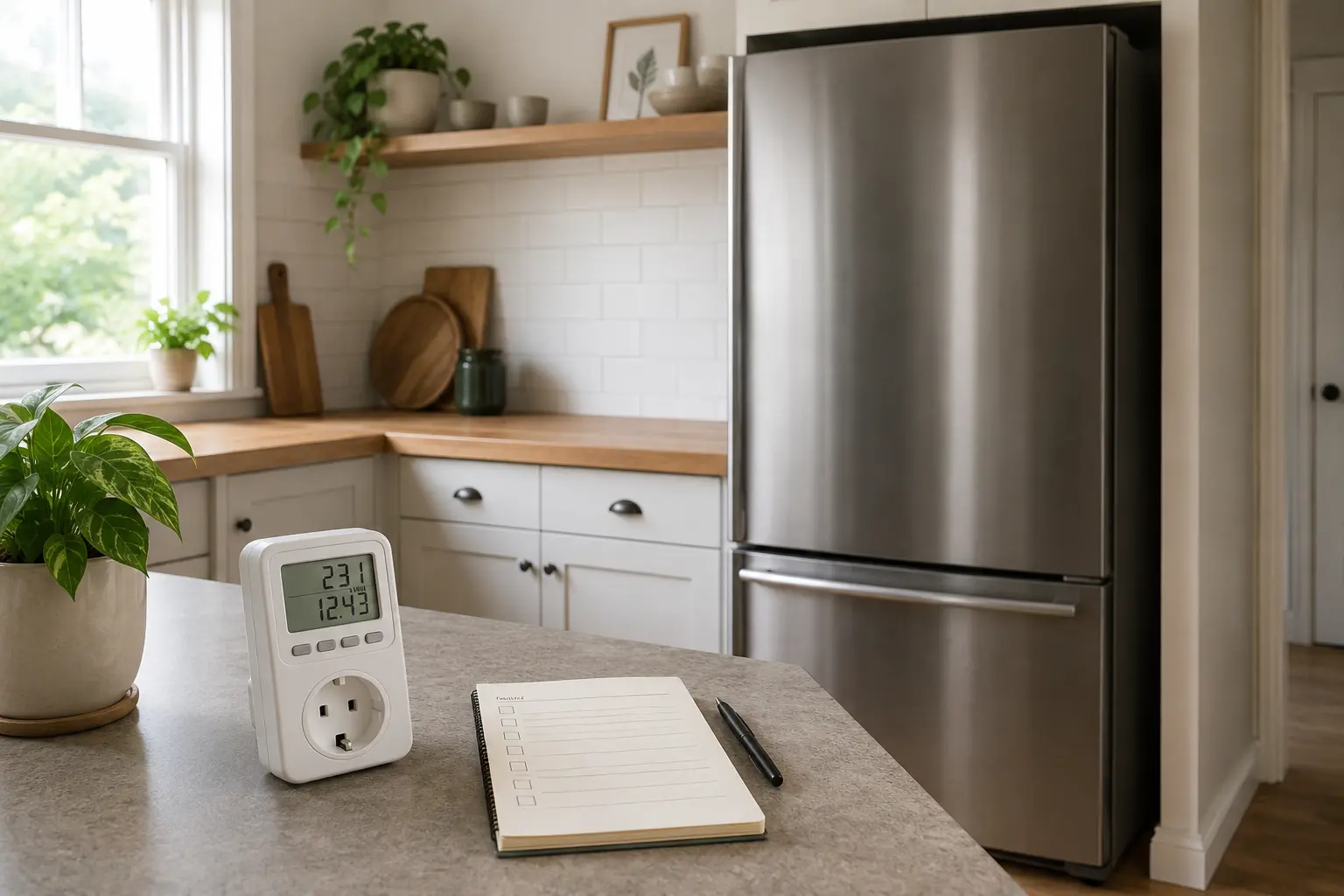
Choose the capacity you need, then compare annual energy use among appliances with similar size and features.
Australia's Energy Rating Label provides two different pieces of information:
- Star rating, which indicates efficiency relative to comparable products.
- Estimated annual energy consumption in kWh, which is the direct input for a running-cost estimate.
A large refrigerator can carry a strong star rating and still use more energy than a smaller model with the same number of stars. The Australian Energy Rating guidance recommends choosing the capacity you actually need and comparing products of similar size.
Use:
annual running cost = annual energy use (kWh) x electricity usage rate ($/kWh)
At an illustrative usage rate of $0.35/kWh:
| Annual energy use | Approximate annual cost | Approximate 10-year energy cost* |
|---|---|---|
| 200 kWh | $70 | $700 |
| 350 kWh | $122.50 | $1,225 |
| 500 kWh | $175 | $1,750 |
| 700 kWh | $245 | $2,450 |
Illustrative only. This assumes unchanged consumption and tariff and excludes purchase, repairs and disposal.
Use the usage charge from your own plan. Do not add the daily supply charge because you normally pay it whether the appliance is connected or not. On time-of-use pricing, refrigeration runs across several tariff periods, so interval data or a weighted average rate is more accurate.
Second fridge vs chest freezer
The right choice depends on the storage job, not the appliance label alone.
Second refrigerator
A refrigerator provides easy access to fresh food and drinks. It can make sense for a large household, shared home or frequent entertaining. Its cost is harder to justify when it holds only a few drinks or duplicates half-empty space in the main fridge.
Advantages include convenient shelves, eye-level access and fresh-food storage. Limitations include frequent door openings, lost usable volume around shelves and drawers, and the chance that an old spare appliance stays on long after a temporary need ends.
Chest freezer
A chest freezer is designed for bulk frozen storage. Its lid can reduce cold-air loss when opened, and its interior can hold a large quantity of food. But stacking and baskets affect usable capacity.
It may suit batch cooking, bulk purchases or seasonal produce. It also needs floor space, inventory discipline and periodic defrosting where applicable. Buying more food than the household uses can erase energy savings through waste.
Upright freezer
An upright freezer is easier to organise than a chest freezer, but opening its front door releases more cold air. Whether that matters enough to affect the purchase depends on the exact model's annual kWh, size, door-opening frequency and layout.
The useful comparison is:
annual appliance cost + likely food waste + purchase and maintenance cost - value of useful storage
No category wins automatically. Compare actual models and actual household behaviour.
Measure the appliance you already own
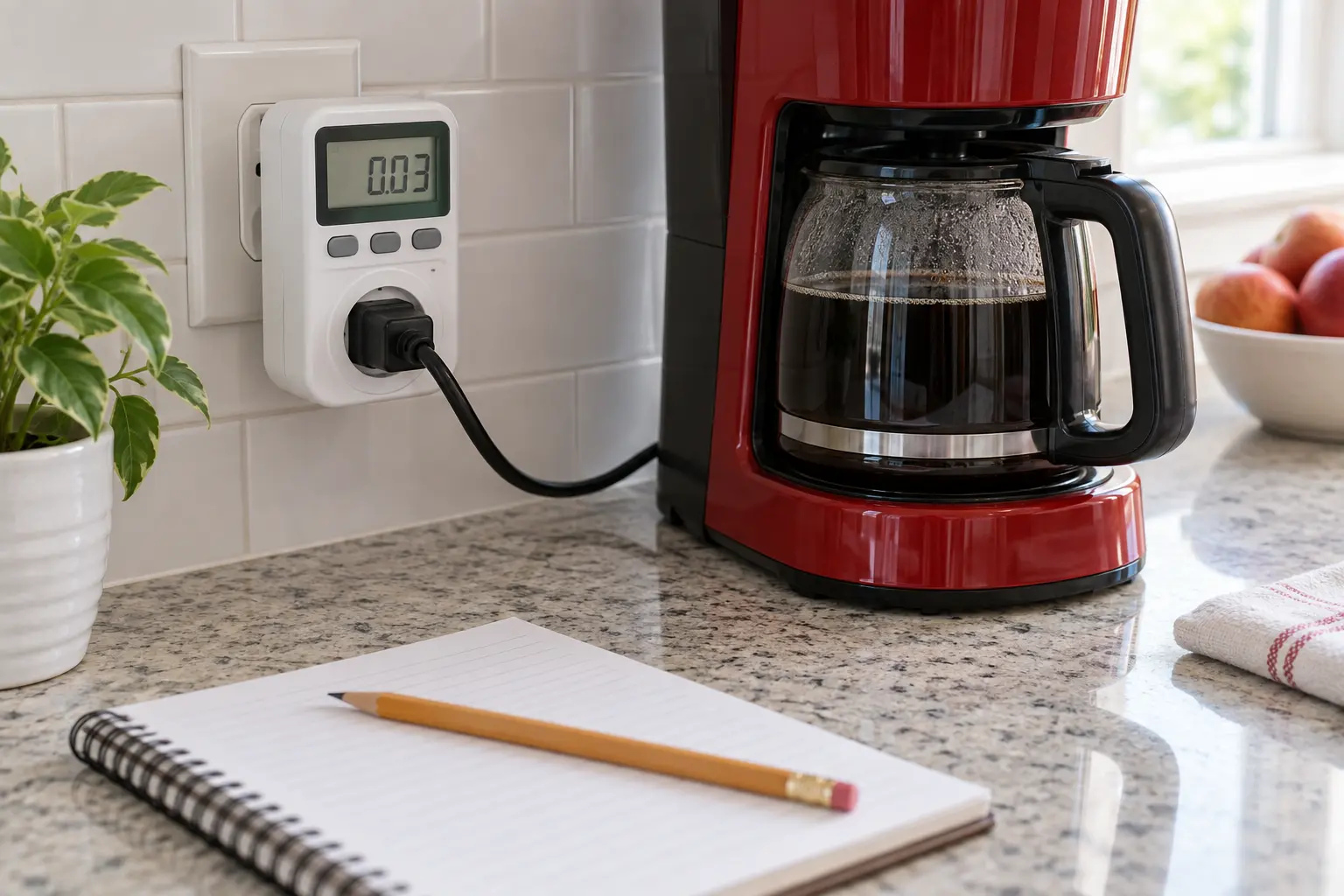
A multi-day kWh reading captures compressor cycles and defrost events that a single watt reading misses.
For an appliance with a normal plug, a correctly rated and locally approved plug-in electricity meter is often the simplest tool.
- Check the monitor's voltage, current and continuous-load rating.
- Record the location, temperature setting and how full the appliance is.
- Reset the meter and note the start time.
- Measure cumulative kWh for at least seven complete days.
- Include normal door openings and household use.
- Repeat during warmer weather if the unit is in a garage or shed.
- Divide measured kWh by days measured, then multiply by 365.
- Multiply annualised kWh by your usage rate.
If the appliance uses 9.8 kWh in 14 days:
9.8 / 14 x 365 = 255.5 kWh/year
At $0.35/kWh:
255.5 x $0.35 = about $89/year
That estimate is more useful than checking compressor watts once. Refrigerators cycle, and frost-free models can periodically run a defrost heater. For more detail, see How to Track One Appliance Separately Without Rewiring Your Home.
Safety boundaries
Do not use an improvised adapter, damaged meter or under-rated smart plug. Do not insert plug-level monitoring into a hardwired circuit. If the outlet is not safely accessible, use a qualified electrician or another appropriate method.
Treat monitoring and switching as separate functions. Unexpectedly switching off a fridge or freezer can spoil food. A smart plug that measures safely may still be unsuitable for remote control of a continuity-sensitive load.
Use trends to catch abnormal operation
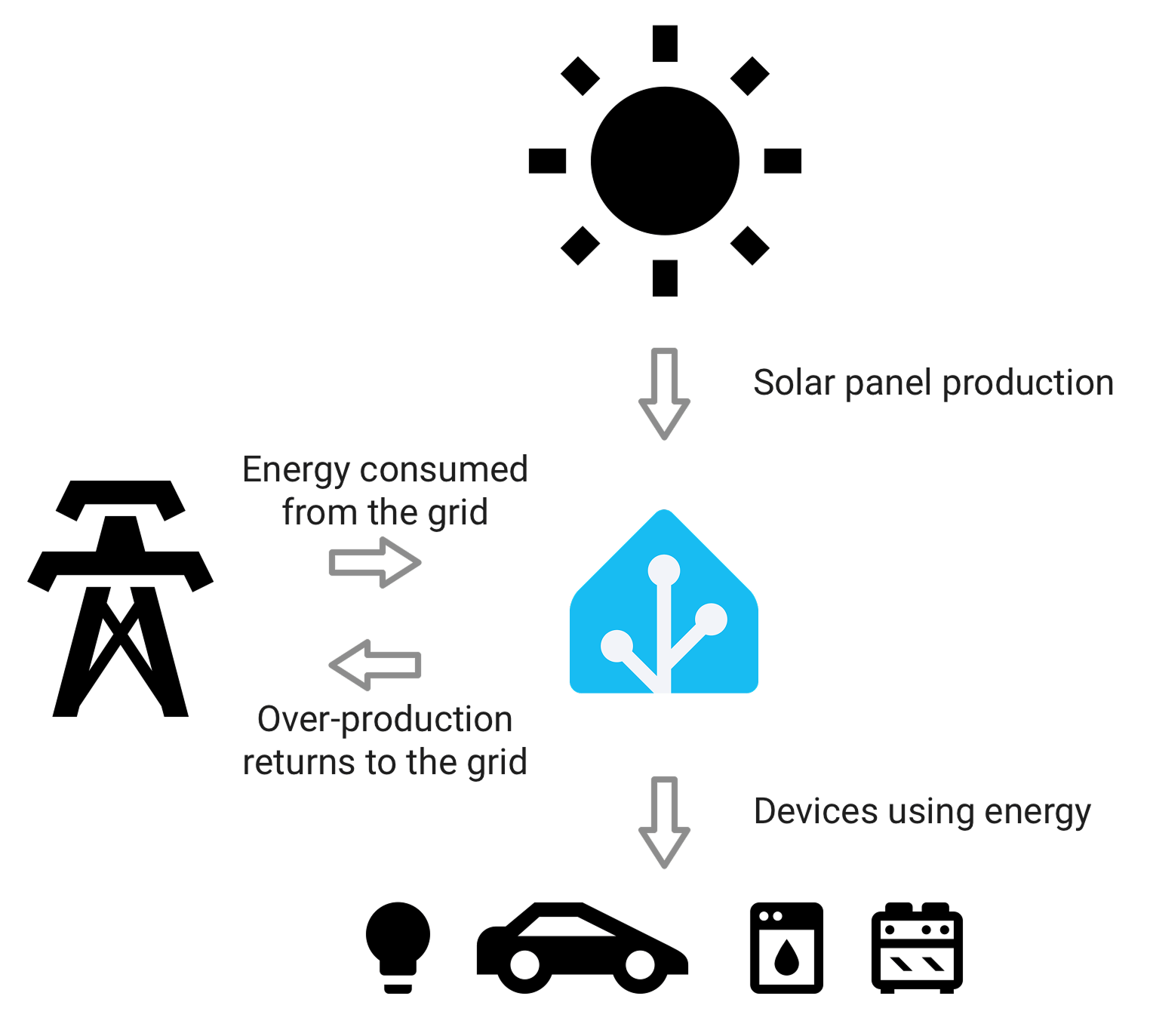
Daily and weekly trends help separate normal cycling from changes caused by weather, door use, settings or faults.
Continuous monitoring is useful when a seven-day total does not explain why consumption changes. Look for:
- a rising daily baseline as garage temperatures increase;
- longer compressor cycles after the thermostat is changed;
- repeated defrost spikes;
- a door left ajar;
- consumption that stays high after maintenance;
- a sudden step change that may indicate a seal, fan or control problem.
Do not diagnose a refrigeration fault from energy data alone. Confirm compartment temperature and follow the manufacturer's troubleshooting guidance. A qualified technician should handle refrigerant, sealed-system and electrical repairs.
Whole-home data can provide a clue, but other overnight loads overlap. Routers, water heating, pumps, standby equipment and batteries can all appear in the same period. How to Find Your Home's Always-On Power Load and Cut It explains how to separate those loads.
Why garage conditions can overturn the estimate
The Energy Rating Label is a standardised comparison, not a guarantee of your exact bill. Real consumption changes with ambient temperature, door openings, loading, thermostat settings, defrost behaviour and installation.
The Australian Government appliance guidance recommends ventilation space around a refrigerator and placement away from direct sun and heat-producing appliances. Always follow the exact manufacturer's clearances.
For a garage or shed, check:
- the permitted ambient-temperature range in the manual;
- whether the space exceeds it in summer or falls below it in winter;
- clearance at the back, sides and top;
- dust on accessible condenser surfaces;
- whether the door closes fully on an uneven floor;
- gasket condition;
- direct sun or a hot wall;
- blocked internal air circulation;
- whether a temperature alarm can be heard from the house.
A model operating outside its specified climate range may cool poorly or run excessively. Do not assume “garage ready” is a universal standard; verify the operating range of the exact model.
Set safe temperatures without overcooling
Australian Government guidance recommends setting the refrigerator between 3°C and 4°C and the freezer between -15°C and -18°C. Colder settings use more energy and may not provide practical benefit.
Use an appliance thermometer rather than trusting an uncalibrated dial. Measure after the appliance stabilises, and never compromise food safety to save electricity.
Also:
- ensure the door closes without obstruction;
- inspect the gasket for gaps, tears or hardening;
- remove excess frost where the manual permits;
- keep internal vents clear;
- clean accessible coils as instructed;
- minimise long door-open periods;
- investigate continuous running or temperature drift.
Judge repairs against age, measured energy use, reliability and replacement cost. A seal replacement can be sensible; repeated major repairs on an inefficient old unit may not be.
A four-option decision test
| Option | Evidence to collect | Best fit |
|---|---|---|
| Keep the second fridge running | Measured annual kWh, utilisation, repair risk | Capacity is regularly used and cost is acceptable |
| Run it only when needed | Cool-down time, event frequency, safe food plan | Demand is occasional |
| Replace it with an efficient freezer | Required frozen volume, label kWh, purchase cost | Most extra storage is genuinely frozen |
| Eliminate the extra appliance | Main-fridge capacity, shopping habits, saving | Duplicate capacity is mostly empty |
Ask:
- What problem does the appliance solve: weekly meal preparation, bulk frozen storage, drinks for events, or rare overflow?
- How much of its usable volume is occupied over several normal weeks?
- What does it actually use in kWh?
- What would replacement cost including delivery and disposal?
- Would a smaller model be enough?
- Will the household manage inventory well?
- Can it remain off most of the year?
Worked example
Suppose an older garage refrigerator measures 520 kWh/year. At $0.35/kWh, it costs about $182/year.
A new freezer is labelled at 240 kWh/year, or about $84/year at the same tariff. The estimated difference is $98/year.
If replacement costs $900 delivered:
$900 / $98 = about 9.2 years
That is not automatically a good purchase. The new unit may provide better organisation or reliability, but count those benefits separately. If the storage is unnecessary, switching off the old appliance saves the full $182/year without spending $900.
Test the uncertainties:
- Will the new appliance match label consumption in the garage?
- Is the old appliance's measured period representative?
- Will tariffs change?
- Could repair costs arrive before payback?
- Will extra capacity encourage food waste?
Sometimes an efficient replacement is sensible. Sometimes the lowest-cost replacement is no second appliance.
Buying checklist
Use the Australian Energy Rating Calculator to compare registered products, then verify current specifications with the manufacturer and supplier.
Check:
- appliance type and usable capacity;
- annual energy consumption;
- star rating among similar-size models;
- dimensions and ventilation clearances;
- ambient-temperature or climate range;
- manual-defrost or frost-free design;
- temperature and door alarms;
- layout and basket access;
- noise;
- warranty and service availability;
- delivery, disposal and installation cost;
- safe monitoring options.
Avoid buying unused capacity because a larger model looks like better value. Every extra litre must be kept cold. How to Choose an Energy-Efficient Fridge Without Overpaying provides a broader replacement framework.
What to do this weekend
- Photograph the model plate and Energy Rating Label.
- Write down what is inside and why it needs separate storage.
- Check the gasket, frost, airflow and temperature.
- Find your electricity usage rate.
- Start a safe 7- to 14-day kWh measurement.
- Compare annualised cost with shutdown, occasional use and replacement.
- Set a date for the next action.
Bottom line
A second fridge, chest freezer or garage fridge is worth keeping only when its storage value exceeds its real operating and ownership cost. The category alone does not decide the winner.
Start with purpose, capacity and measured kWh. Use the Energy Rating Label to shortlist comparable replacements, then account for garage temperature, ventilation, food habits and purchase cost. If the appliance is mostly empty, consolidation and shutdown usually deliver a stronger saving than buying another machine.