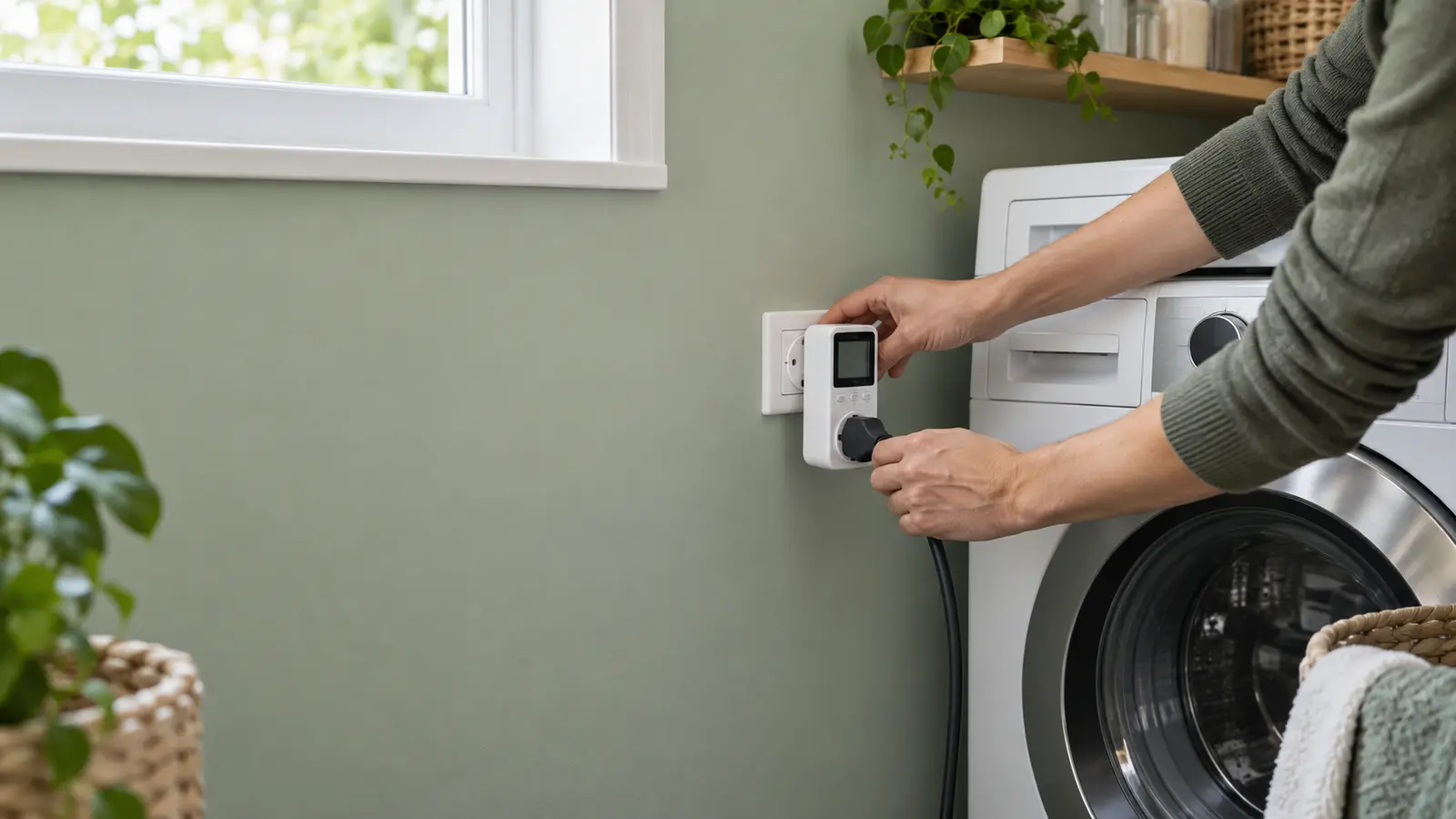
The fastest way to understand one appliance is usually not to redesign the home's monitoring system. It is to choose the smallest measurement boundary that captures the whole appliance, record energy in kilowatt-hours (kWh) across a representative operating cycle, and compare that result with the decision you are trying to make.
For a plug-in appliance, a rated plug-in power meter or an energy-monitoring smart plug is normally the simplest option. For a fixed appliance on a dedicated circuit, circuit-level monitoring can be appropriate, but panel work should be completed by a qualified electrician. Whole-home interval data can also work when the target load has a clear signature and other large loads can be controlled during the test.
This guide explains which method fits which appliance, how long to measure, what the numbers mean, and how to avoid data that looks precise but answers the wrong question.
Quick answer: choose the measurement point first
| Appliance situation | Best first method | What it can tell you | Main limitation |
|---|---|---|---|
| Portable appliance with a normal plug | Plug-in electricity usage meter | Watts, kWh per cycle, standby power, operating time | Usually no long-term history or remote access |
| Plug-in appliance needing continuous trends | Energy-monitoring smart plug | Power curve, daily kWh, schedules and alerts | Must be correctly rated; cloud and data-access policies vary |
| Appliance already reports reliable energy data | Built-in telemetry or local integration | Operating states and energy without extra hardware | Vendor data may be incomplete, cloud-dependent or difficult to export |
| Fixed appliance on a dedicated circuit | CT monitor or DIN-rail submeter | Complete circuit energy over days, seasons and tariffs | Installation access, electrician cost and possible shared loads |
| Fixed appliance without an accessible dedicated circuit | Controlled whole-home test | Approximate cycle or step change | Other loads introduce noise |
| Several appliances share one circuit | Circuit meter plus selected plug-level meters | Circuit total and individual contributors | Take care not to double-count child devices in dashboards |
The important question is not “Which meter has the most features?” It is “Where can I measure the complete electrical input to this appliance with the least ambiguity?”
Start with the decision you need to make
Single-appliance monitoring is most useful when it supports a specific decision, such as:
- whether a second refrigerator is worth keeping;
- whether a heat pump, dehumidifier or pool pump is cycling too often;
- how much one dishwasher, washing-machine or dryer cycle costs;
- whether a device's standby load matters over a full year;
- whether a timer or tariff shift will reduce grid cost;
- whether an ageing appliance is using more energy than expected;
- how much of a branch circuit is explained by one known load;
- whether a replacement has delivered the expected saving.
Write the question down before buying hardware. A one-hour watt reading may answer “How hard is it running now?” but not “What does it cost each month?” A daily kWh total may answer the second question but still miss a seasonal heating or cooling problem.
Power and energy are not interchangeable
Power, measured in watts (W) or kilowatts (kW), is the rate of energy use at a moment in time. Energy, measured in watt-hours (Wh) or kilowatt-hours (kWh), is the accumulated amount used over time.
An appliance drawing 2,000 W for six minutes uses about 0.2 kWh:
energy = power x time = 2 kW x 0.1 hour = 0.2 kWh
That same 2,000 W nameplate tells you very little about monthly energy if the appliance cycles, modulates or runs infrequently. Refrigerators, heat pumps, dryers, pumps and computers all have operating patterns that make a single power snapshot misleading.
Home Assistant's energy guidance makes the same distinction: power is a rate, while energy is the time integral of power. If a device exposes only a W sensor, a dashboard must integrate sufficiently frequent samples to estimate kWh. Whenever possible, prefer a trustworthy cumulative energy register reported directly by the measuring device.
Method 1: use a plug-in electricity usage meter for a short test
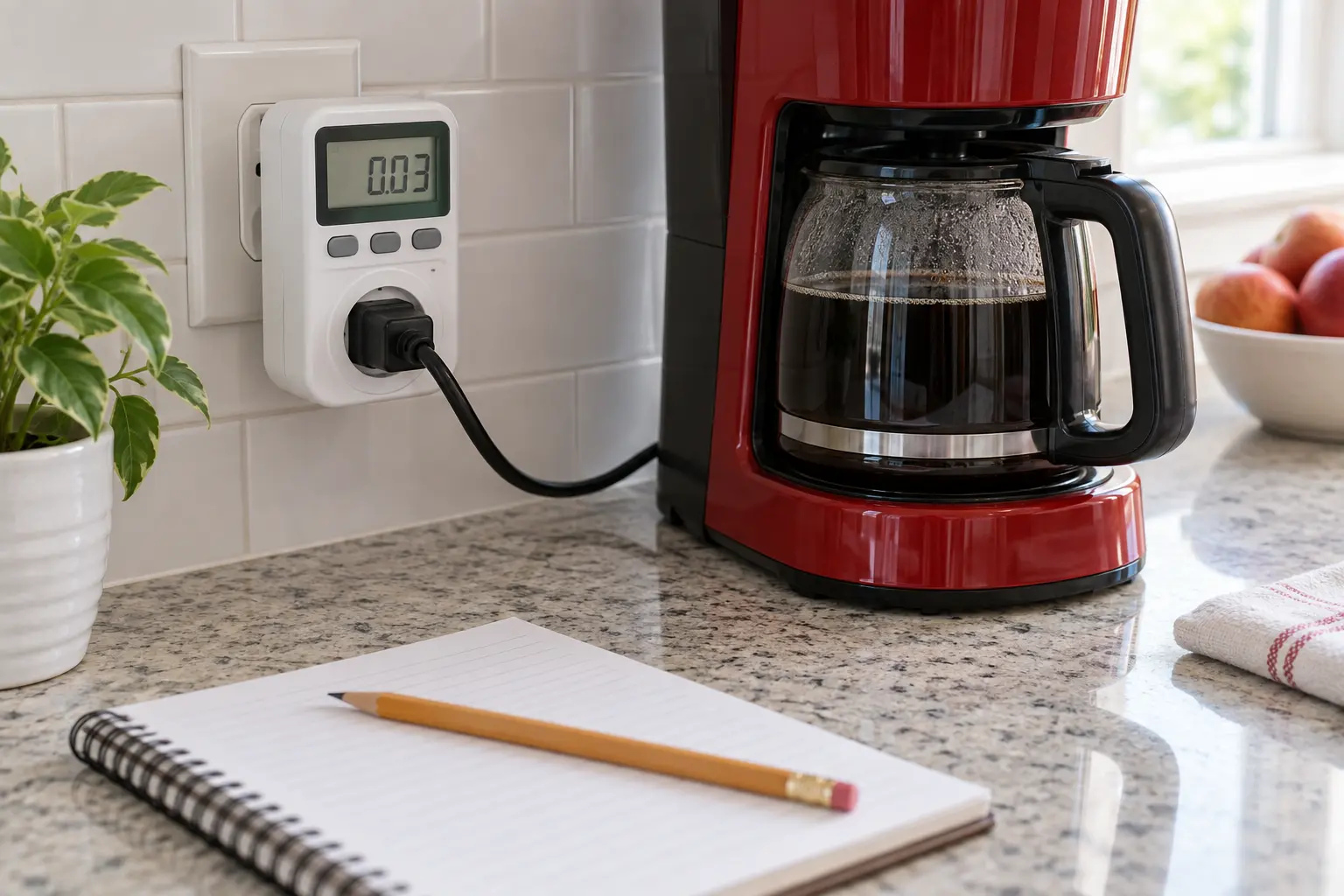
A start and end kWh reading across a complete operating cycle is usually more useful than one instantaneous watt reading.
A basic plug-in meter sits between the outlet and appliance. It is a strong first tool when you need a temporary, local measurement rather than automation.
Use it for loads such as televisions, desktop computers, refrigerators, lamps, dehumidifiers and many countertop appliances, provided the meter is approved for the local supply and the appliance's voltage, current, power and duty cycle.
Before connecting anything, check:
- The meter's rated voltage and frequency match the supply.
- Its continuous current and power ratings exceed the appliance's requirements.
- The plug and socket type are compliant for your region.
- The appliance manufacturer does not prohibit adapters or intermediary controls.
- The outlet, plug and meter show no heat damage, looseness or discoloration.
- The meter will remain ventilated and cannot be exposed to water, steam or mechanical strain.
Do not infer suitability from physical fit alone. Motors, compressors and heaters can have starting currents or sustained high loads that make a cheap meter inappropriate even when the normal running watts appear acceptable. Never use a plug-in meter on a hardwired appliance or improvise an adapter.
A repeatable short-test workflow
- Reset the meter or record the starting kWh.
- Note the start time and the appliance state.
- Run one complete, representative cycle.
- Record end kWh, elapsed time and any important settings.
- Repeat the same test at least twice.
- Average comparable cycles and explain any outlier.
For a washing machine, record program, temperature and load size. For a dehumidifier, record room humidity and setpoint. For a refrigerator, a single cycle is not enough; leave the meter connected for several days so defrost events, door openings and changing ambient conditions are represented.
The U.S. Department of Energy's standby-power guidance recommends reading stable power directly only when variation is small. When power fluctuates, measure energy over time and divide by the measurement duration to obtain a meaningful average.
Method 2: use an energy-monitoring smart plug for continuous data
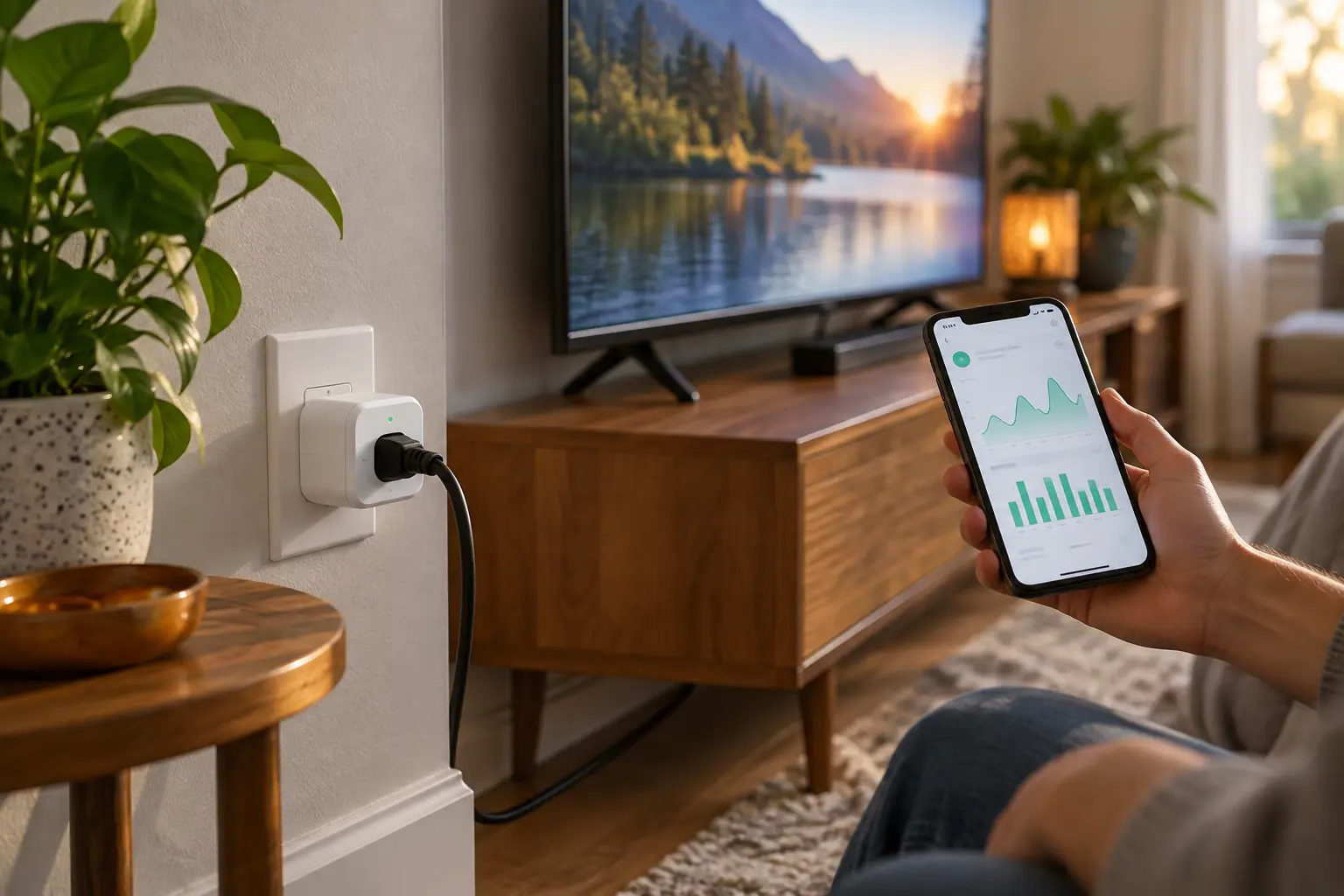
Continuous data is valuable when cycling, schedules, weather or occupant behaviour change the load from one day to the next.
An energy-monitoring smart plug adds timestamps, historical charts, automation and sometimes local API access. It suits questions that need days or weeks of evidence:
- Does the entertainment system stay at 25 W overnight?
- How often does the dehumidifier cycle as weather changes?
- Did moving a refrigerator improve its duty cycle?
- Does a schedule shift energy out of the peak tariff window?
- Is an appliance failing to turn off after its normal cycle?
Check more than the headline amp rating. Useful selection fields include:
- certified voltage, frequency, current and continuous-load rating;
- minimum measurable power and low-power accuracy;
- cumulative kWh retention after a power or network outage;
- sampling and reporting interval;
- local access, cloud dependency and export options;
- Wi-Fi, Zigbee, Z-Wave or another supported protocol;
- behavior after a power failure;
- independent switching control and whether accidental remote shutoff is acceptable.
For refrigerators, freezers, medical equipment, network hardware and other continuity-sensitive loads, remote switching can be a liability. Choose a device with an appropriate restore state, protect access to the control account, and avoid automations that can unexpectedly remove power.
The Australian Government's smart-home guidance notes that simple on/off appliances are the most straightforward smart-plug candidates. That is a useful boundary: measurement may be appropriate for more loads than automated switching. Treat “can measure” and “should be remotely switched” as separate decisions.
Method 3: use existing appliance telemetry when it is good enough
Some heat pumps, EV chargers, inverters, batteries and connected appliances already report power or energy. Built-in data can avoid additional hardware, but first establish what is actually measured.
Ask these questions:
- Is the value measured at the electrical input, calculated from operating state, or estimated by software?
- Does it report instantaneous W, cumulative kWh, or both?
- Does the total include standby electronics, pumps, fans or auxiliary heaters?
- How frequently is data sampled and retained?
- Can history be exported through a local API, cloud API, MQTT or file download?
- What happens when internet access is lost?
- Does a reset, firmware update or account migration break the cumulative total?
Built-in telemetry is especially valuable when it exposes operating mode alongside energy. A heat pump may use the same daily kWh for very different combinations of outdoor temperature, setpoint and runtime. Operational context explains the number.
Where data access matters, keep the raw cumulative reading and timestamp if possible. Dashboard screenshots are useful for quick review but poor as a durable measurement record.
Method 4: monitor a fixed appliance at circuit level
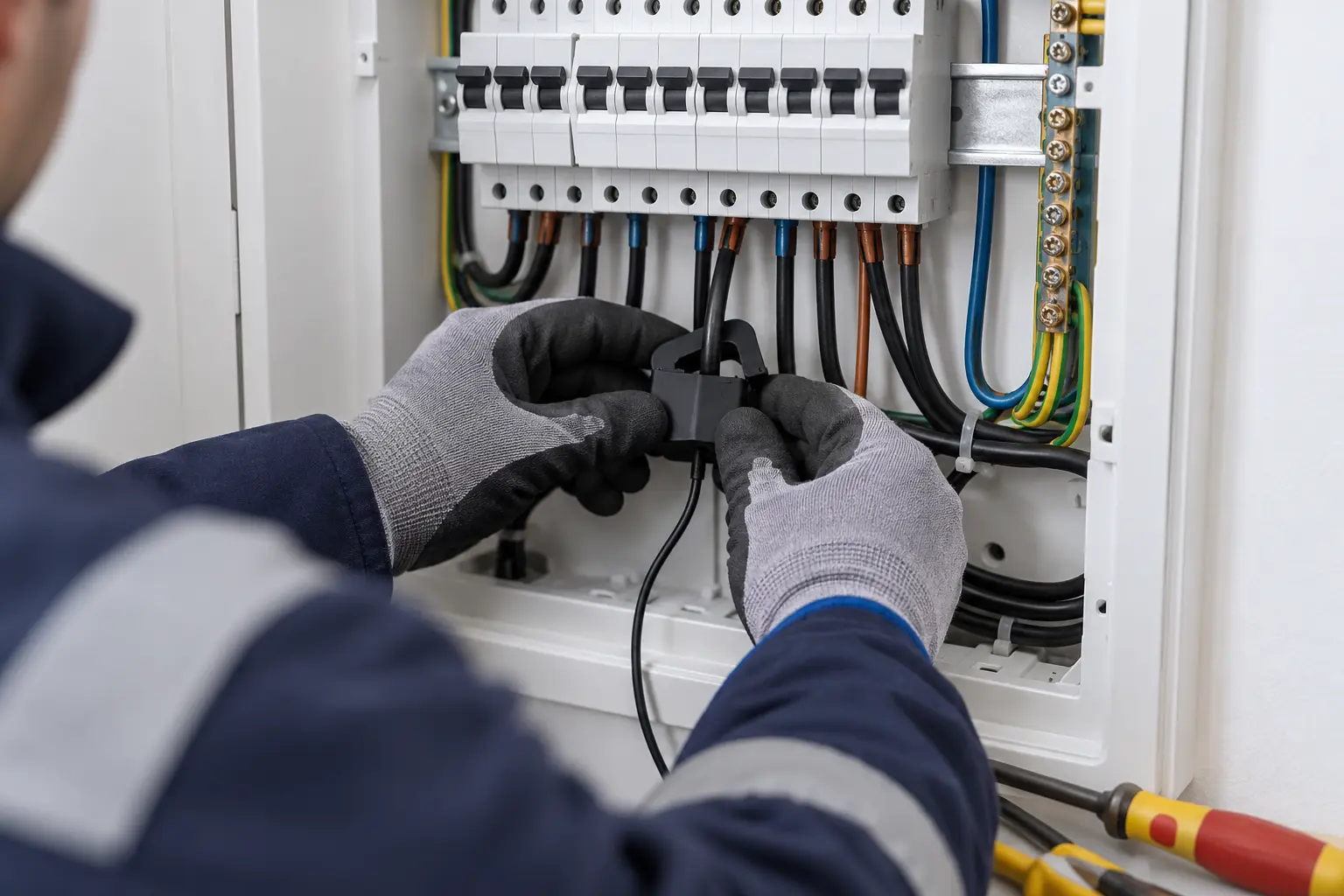
A CT must surround the correct individual conductor. Panel access and permanent metering should be handled by a qualified electrician.
Hardwired loads such as electric water heaters, built-in ovens, central air conditioning, heat pumps and many EV chargers cannot be measured with a consumer plug-in meter. If the appliance has a dedicated branch circuit, a split-core current transformer (CT), multi-circuit monitor or DIN-rail submeter can isolate it without changing the appliance itself.
This is the right level of measurement when you need:
- seasonal energy rather than one test cycle;
- time-of-use cost allocation;
- maximum demand and operating schedules;
- long-term equipment verification;
- comparison with solar, battery or grid flows;
- auditable submetering for a project or shared facility.
Current alone is not always enough for accurate energy. A credible monitor should use voltage information and account for power factor where the load requires it. For three-phase appliances, all relevant conductors and phases must be measured and combined correctly.
CT orientation and conductor selection matter. A clamp around both active and neutral can cancel the magnetic fields and produce a near-zero result. A reversed CT may report negative power. A shared circuit will include every connected load, not just the appliance named on the breaker label.
Fluke's current-measurement guidance emphasizes correct meter function, keeping fingers behind the protective barrier, and taking special precautions around hazardous live conductors. For a homeowner, the practical rule is simpler: do not remove switchboard covers or fit sensors around panel conductors yourself. Ask a qualified electrician to verify the circuit, sensor rating, orientation, enclosure space and local compliance.
For related planning, see Best Way to Meter a Heat Pump, EV Charger, or Hot Water System Separately.
Method 5: isolate the load using whole-home data
If permanent circuit monitoring is not justified, whole-home data can estimate one appliance by comparing a controlled before-and-after period.
Use this method when the load has a clear step change and you can temporarily keep other large loads stable:
- Choose a quiet measurement window.
- Record whole-home power before the appliance starts.
- Start a known operating mode.
- Record the new stable power and duration.
- Subtract the baseline and integrate the difference over the test.
- Repeat on another day to see whether the result is reproducible.
This works better for a 3 kW water heater than for a 3 W standby load. Solar variability, batteries, EV charging, compressors and thermostatically controlled loads can obscure the signature. If the target is close to the background noise, use a closer measurement point.
Smart-meter interval data may be too coarse for a short appliance cycle, but it can still validate multi-hour or daily loads. Our guide to Using Smart Meter Data to Find the Hours That Cost You Most explains how to map interval energy to tariffs and recurring patterns.
How long should you measure?
Match the test window to the appliance's natural cycle and the variability that affects it.
| Load type | Minimum useful window | Better verification window | Conditions to record |
|---|---|---|---|
| Kettle, toaster or microwave | Several complete uses | 10 or more comparable uses | Fill level, power setting, duration |
| Washing machine or dishwasher | One complete cycle | 3-5 cycles per common program | Program, temperature, load size |
| Tumble dryer | One complete cycle | 5-10 loads | Load mass, fabric mix, spin speed, dryness setting |
| Refrigerator or freezer | 72 hours | 1-2 weeks, repeated in another season | Room temperature, door use, defrost events |
| Dehumidifier or room AC | 24 hours | 1-2 representative weeks | Weather, humidity, setpoint, room occupancy |
| Pool pump | One programmed day | 1-2 weeks | Speed, schedule, water conditions |
| Standby electronics | Several hours after settling | 24-72 hours | Network activity, sleep state, automatic updates |
| Fixed water heating or heat pump | Several complete cycles | 2-4 weeks | Weather, occupancy, setpoint, tariff period |
Longer is not automatically better. A month of unlabelled data can be less useful than three carefully documented cycles. Record the operating conditions that could explain variation.
Turn kWh into cost without fooling yourself
For a flat tariff:
cost = measured kWh x electricity price per kWh
For a time-of-use tariff, split the measured energy by tariff window before multiplying. A device that uses the same kWh after rescheduling may still cost less.
For solar-powered daytime operation, do not assign a cost of zero by default. The economic cost is often the feed-in credit or export value you give up. Battery energy also has conversion losses and an alternative use later in the day.
Example: a dishwasher uses 1.1 kWh per eco cycle and runs five times per week.
annual energy = 1.1 x 5 x 52 = 286 kWh
At $0.30 per kWh, the simple annual cost is about $85.80. If 40% of those cycles can reliably run on surplus solar valued at $0.08 per kWh, calculate the grid and solar portions separately rather than calling every daytime cycle free.
Use realistic annual frequency. Multiplying one unusually heavy cycle by 365 is a common way to create an impressive but useless estimate.
Build a clean data record
A lightweight measurement log makes results comparable:
| Field | Example |
|---|---|
| Appliance | Dishwasher A |
| Measurement device | Plug-in meter, serial recorded separately |
| Start and end | 18:10-21:02 |
| Starting and ending register | 14.82-15.91 kWh |
| Energy | 1.09 kWh |
| Program or state | Eco, 50 C |
| Load or conditions | Full load, normal soil |
| Tariff window | 0.4 kWh peak, 0.69 kWh off-peak |
| Notes | Heated dry disabled |
If you use Home Assistant, individual devices can be added to the Energy dashboard. Its current documentation also supports upstream-device relationships, which help prevent a child device from being counted twice when a circuit meter already includes it.
Three data-quality checks are worth doing:
- Register check: cumulative kWh should normally move forward and survive ordinary restarts.
- Boundary check: confirm whether the sensor covers only the appliance, a shared outlet strip or an entire circuit.
- Reconciliation check: over the same period, the device's energy should be plausible relative to its parent circuit or whole-home total.
If only W is available, make sure the platform's numerical integration and units are configured correctly. Sparse power samples can miss short cycles and underestimate energy.
Common mistakes
Measuring only the peak watts
Peak power affects circuit capacity, but the bill is driven mainly by energy over time. Capture the complete cycle.
Choosing a monitor by connector rather than load rating
A compatible plug shape does not prove the device is suitable for a heater, motor or continuous load. Verify certified ratings and manufacturer instructions.
Ignoring standby and auxiliary components
Measure from the point that includes the complete system. A boiler controller, pump or external power supply may sit outside the boundary you first chose.
Comparing unlike operating conditions
A refrigerator measured during a heatwave cannot fairly be compared with one measured in a cool empty room. Record temperature, settings and usage.
Double-counting in a dashboard
An individual smart plug is already included in whole-home consumption. It should be shown as a breakdown, not added again to the total.
Automating before establishing a baseline
First measure normal operation. Then change one variable, such as a schedule or setpoint, and measure again. Multiple simultaneous changes make attribution difficult.
A practical seven-day plan
Day 1: Define the question. Decide whether you need standby W, kWh per cycle, daily energy, tariff cost or a fault signature.
Day 2: Verify the boundary and rating. Confirm plug-in, built-in or circuit-level access and check every electrical rating.
Days 3-5: Capture representative operation. Keep a short log of settings, cycles, weather or occupancy.
Day 6: Test one change. Adjust one schedule, setting or operating habit without changing the measurement point.
Day 7: Compare and decide. Calculate energy and cost, note uncertainty, and decide whether the saving or diagnostic value justifies a permanent monitor.
If the appliance cannot be isolated safely or the result remains buried in whole-home noise, stop approximating. A dedicated circuit meter or professional assessment is more useful than false precision.
When single-appliance monitoring is worth keeping
A permanent data stream earns its place when it supports recurring action: fault alerts, time-of-use scheduling, solar self-consumption, maintenance, tenant or departmental allocation, measurement and verification, or demand management.
A temporary meter is enough when you only need to answer a one-time question. Move it to the next plug-in load and build a small evidence library. This is often more economical than buying a smart plug for every outlet.
Single-appliance monitoring should complement the wider energy picture. If you need to find unknown loads first, start with How to Find Your Home's Always-On Power Load. If you need to understand how one device fits into total consumption, see Is a Whole-Home Energy Monitor Worth It?.
Bottom line
You do not need a major electrical project to measure one appliance well. Start at the closest safe measurement point, use cumulative kWh across a complete and representative cycle, and keep enough context to explain why results change.
Use a plug-in meter for a short local test, an energy-monitoring smart plug for continuous trends, existing telemetry when its measurement boundary is clear, and professionally installed circuit monitoring for hardwired loads. Whole-home subtraction is a useful fallback for large, distinct loads, not a substitute for a clean boundary when the signal is small.
The best result is not the most detailed chart. It is a number you can trust enough to make a decision.