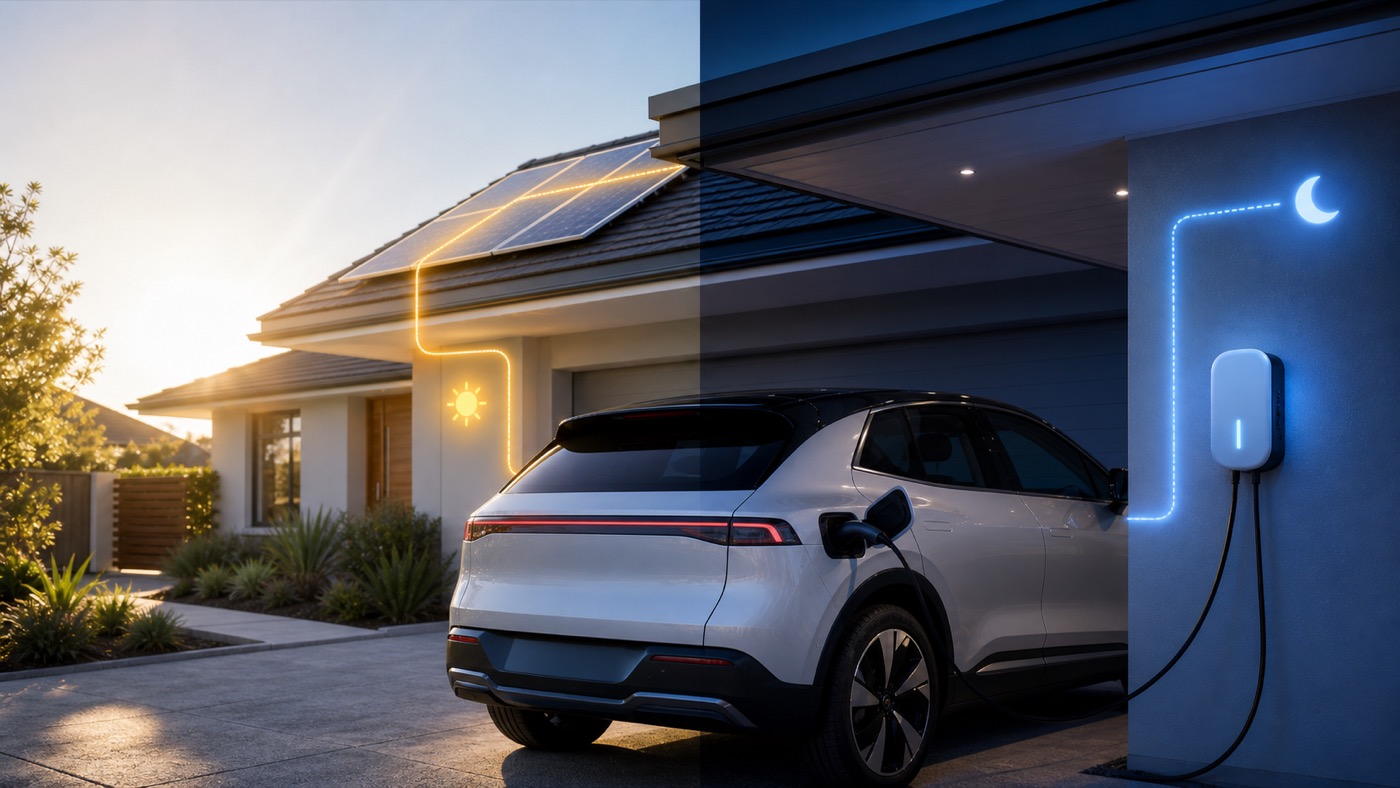
If your EV is at home while your rooftop solar is producing excess power, charging with solar is usually the cheapest option. If the car is mostly plugged in overnight, a good off-peak tariff usually wins instead. The mistake is assuming solar is always cheaper just because you have panels.
Rates, export values, and charging windows differ by retailer, state, and household. This guide uses Australian government guidance current as of April 7, 2026, plus one clearly labelled worked example, rather than pretending there is one universal answer.
| Your real situation | Usually cheaper option | Why |
|---|---|---|
| EV is home in the middle of the day and solar would otherwise be exported cheaply | Solar | You are turning low-value export into direct self-use |
| EV returns after sunset and you have a meaningful overnight discount | Off-peak | A timed night rate beats standard or peak import |
| You already have a battery, demand tariff, or several large flexible loads | It depends | The charger affects only one part of the bill |
Jump to your case
- My EV is at home in solar hours
- My EV mostly charges overnight
- I already have a battery or a demand tariff
- I want the quick data version
- I want a worked charging-cost example
- I just want a checklist before switching
The short answer
For many solar households, solar charging is cheapest only when the car is actually there to catch it. If the EV is usually away during the day and comes home at night, off-peak charging is often the more reliable money saver. For households with a battery, demand tariff, or several other heavy loads, you need to compare the whole bill, not just the charger session.
What the official data says
The Australian government's EV charging guidance gives a useful reality check:
- around 80% of reported EV charging in Australia happens at home
- the average Australian drives 33 km a day
- a standard power point is up to 2.4 kW
- a dedicated home EV charger is typically 7 to 22 kW
- dedicated chargers can add around 30 to 80 km of range per hour
That matters because many households do not need a huge nightly energy refill. They need the cheapest sensible way to cover ordinary daily driving.
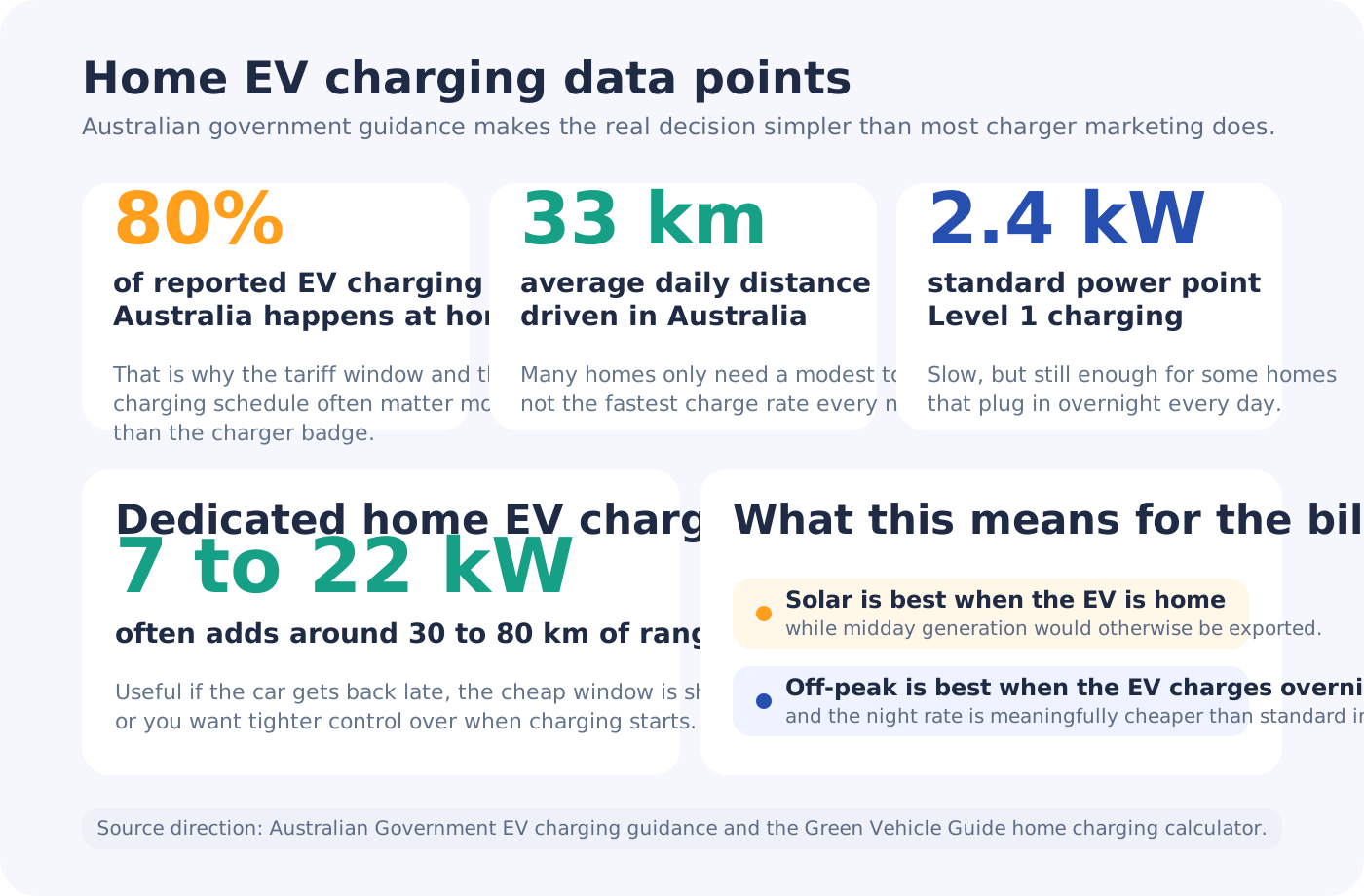
Government guidance used here comes from the Australian EV charging guidance and the Green Vehicle Guide home charging calculator.
Worked example: a 10 kWh charge session
To compare solar with off-peak properly, you need to compare the cost of the actual energy source, not the label on the charger.
Here is a simple worked example:
- assume your EV needs a 10 kWh top-up
- assume exported solar is worth 6 c/kWh
- assume your off-peak import rate is 20 c/kWh
- assume your peak import rate is 45 c/kWh
Under those assumptions:
- using excess solar costs you about $0.60 in lost export value
- using off-peak import costs about $2.00
- using peak import costs about $4.50
That is why the real comparison is often solar vs off-peak, not just “solar vs grid”.
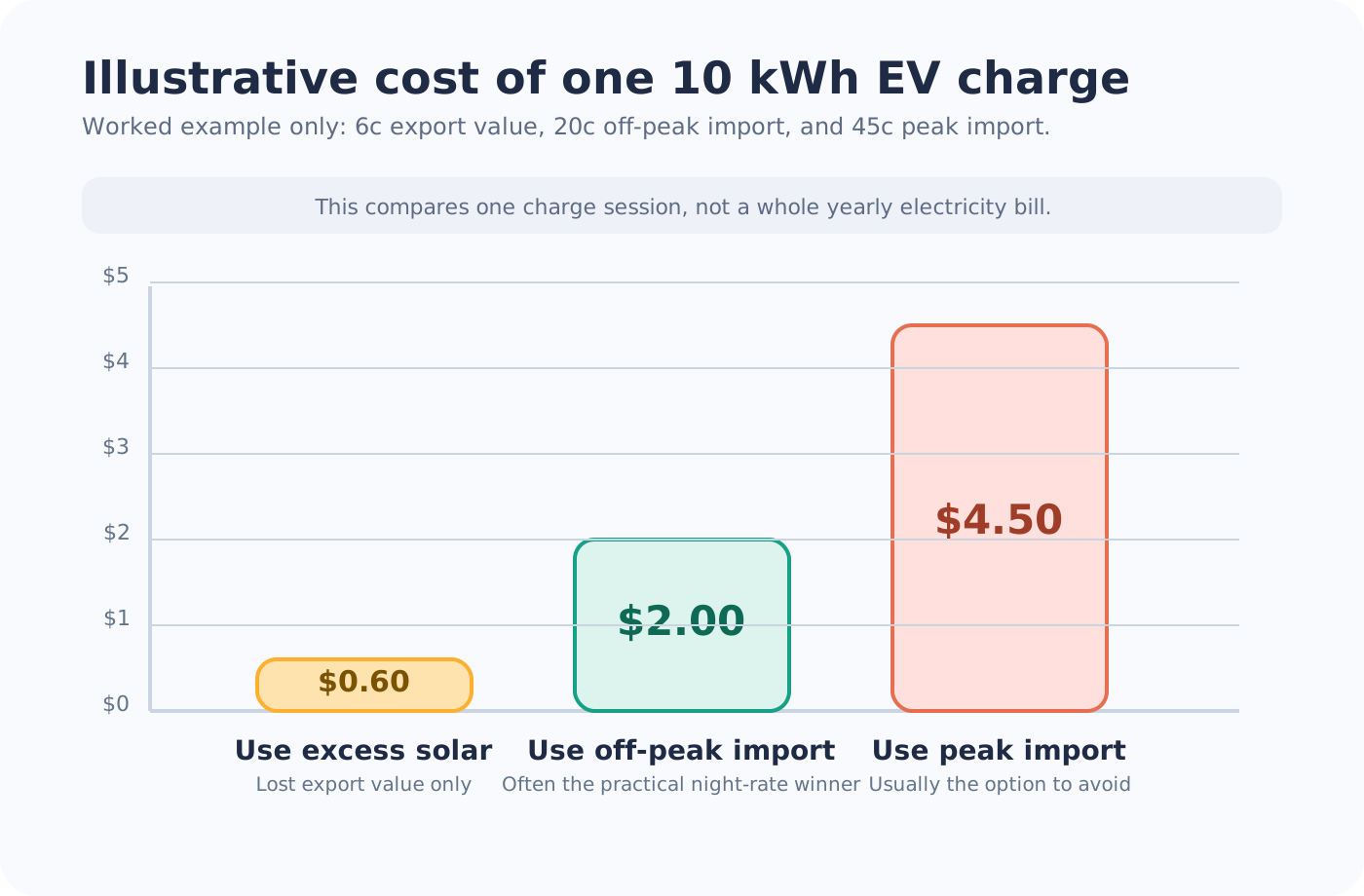
This example is illustrative only. Your actual result depends on your real export credit, your off-peak rate, and whether the EV is plugged in at the right time.
When solar usually saves more
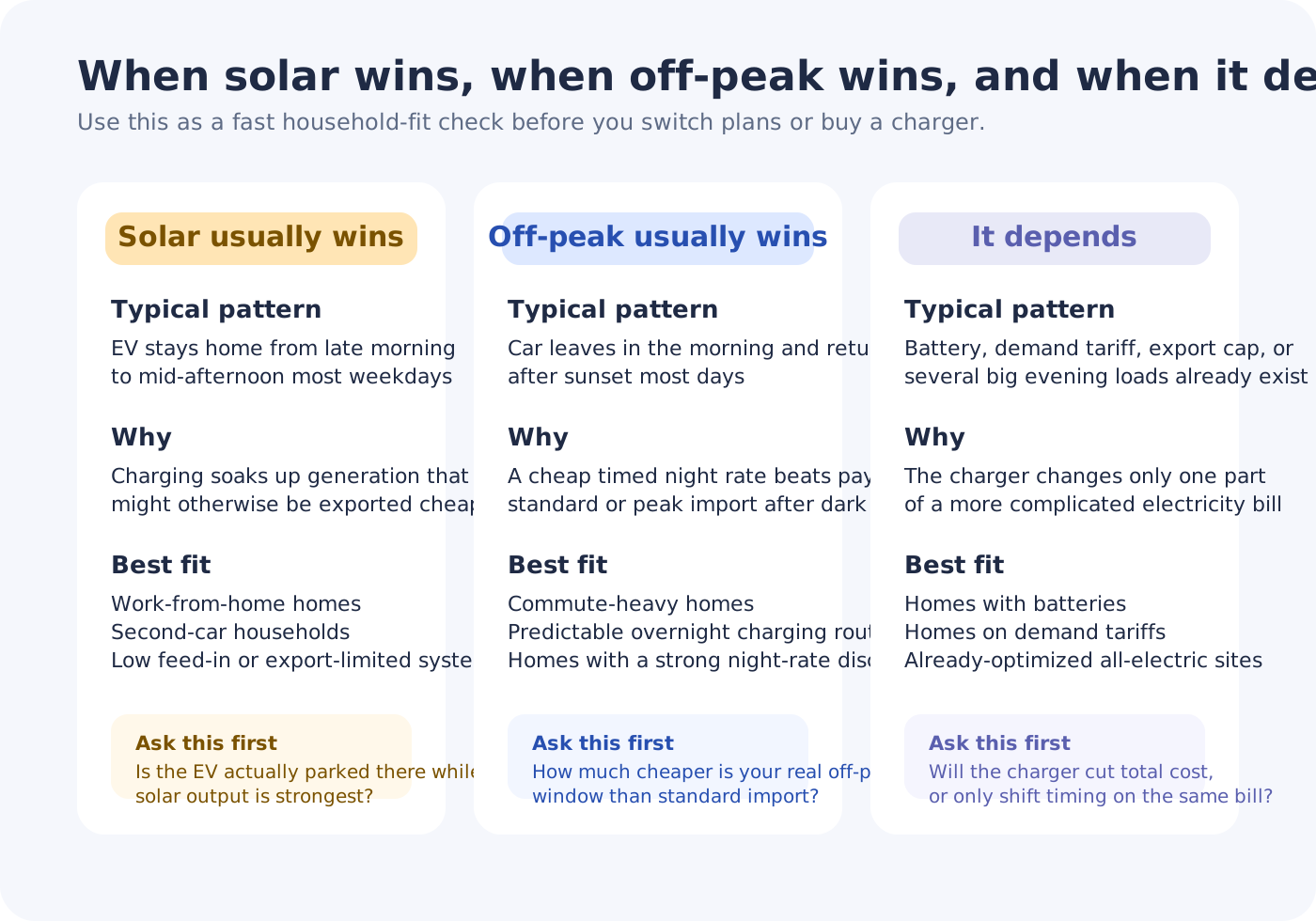
Solar charging usually wins when three things line up:
- the EV is parked at home during the strongest solar hours
- the house would otherwise export a meaningful amount of power
- your export value is low enough that self-use is worth more
This is why solar charging often makes the most sense for:
- work-from-home households
- homes with a second car that stays parked during the day
- households with weak feed-in credits or export limits
If that sounds like your home, a smart charger that can follow solar surplus is usually more useful than one that only gives you a timer. If you are still comparing charger types, read Best EV Chargers for Solar Homes in 2026: 3 Smart Chargers Worth Shortlisting.
When off-peak usually saves more
Off-peak usually wins when the EV is not around for midday solar and charging mostly happens after sunset.
The Australian government tariff guidance is helpful here. A time-of-use tariff generally means:
peakcosts the mostoff-peakis usually cheapestshouldersits in between
That makes off-peak charging attractive for commute-heavy homes where the car gets back at night and charges while everyone is asleep.
In other words, off-peak charging is often the best answer when:
- the EV leaves before solar ramps up
- the driveway is empty for most of the solar window
- your retailer offers a genuinely useful overnight discount
- you want a predictable, repeatable charging routine
If you are unsure whether your plan structure itself is helping or hurting, read Best Tariff for Solar Homes in Australia (2026): Time-of-Use vs Flat Rate.
When it depends
Some homes are too simple for long analysis. Others are not.
You need a fuller bill-level comparison if any of these are already in play:
- a home battery that already covers part of the evening peak
- a demand tariff that penalises short periods of high grid draw
- controlled loads such as electric hot water
- solar export limits that change the value of daytime self-use
- several large evening loads running together
In those homes, EV charging is not an isolated decision. It changes how the rest of the system behaves. Sometimes the right answer is daytime solar charging. Sometimes it is overnight off-peak charging. Sometimes it is a hybrid schedule.
That is also where better monitoring matters. If you do not yet know when you import, export, or hit your highest demand, start with Solar Monitoring System Australia: What Homeowners Should Buy in 2026.
Three household patterns that make the answer obvious
Case A: The work-from-home solar house
The EV is parked there most weekdays, your export rate is weak, and you can see regular midday export on your monitoring app. Solar charging is the obvious first choice.
Case B: The night charger
The car returns after 6 pm, leaves again before 8 am, and your retailer gives you a meaningful overnight off-peak window. Off-peak charging is usually the cleaner money decision.
Case C: The already-optimized electric home
You already have solar, a battery, heavy evening loads, and maybe a demand tariff. Here the answer depends on the whole bill, not one charging session.
Before you decide, check these 6 things
- Check when the car is actually at home. This matters more than the charger brand.
- Check your real export value. If exported solar only earns a small credit, daytime self-use becomes more attractive.
- Check your actual off-peak rate and time window. Some off-peak plans are strong enough to beat awkward daytime charging.
- Check whether your charger can follow solar or just run on a timer. Those are not the same thing.
- Check whether your bill includes a demand charge. A short high-power EV session can change the maths.
- Check your whole-home data before switching plans. The Green Vehicle Guide calculator can help with charge-session cost, but your bill still depends on total household behaviour.
Bottom line
If your EV is home during solar hours and your exported solar is worth relatively little, solar charging usually saves more. If your EV mainly charges overnight and your retailer offers a real off-peak discount, off-peak charging usually wins. If you already have a battery, a demand tariff, or several flexible loads, compare the whole site before making the call.
The simplest rule is this: charge with solar when the car can actually catch your surplus, and use off-peak when solar timing does not line up with real life.
Sources
- Australian Government: How to charge your electric vehicle
- Australian Government: Electricity pricing plans and tariffs
- Australian Government: Switch to save
- Green Vehicle Guide: Home charging calculator