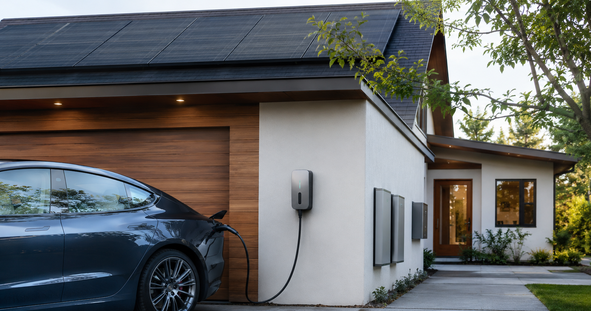
If future solar integration matters, the best EV charger is usually not the one with the biggest amperage number or the nicest phone app. It is the one that gives you a clean path into surplus charging, electrical-headroom management, and a sensible measurement architecture later.
That means looking beyond the charger alone and asking a harder question first: what will this charger need around it once solar is added?
For many homes, the right answer depends less on the connector on day one and more on whether the system can later do things like:
- follow real surplus solar instead of only running on a timer
- reduce charge rate when the rest of the house is busy
- work with a compatible energy meter or panel monitor
- avoid locking the household into an app-only dead end
- fit the likely wiring and breaker path without forcing a full redo later
The short answer
If you think solar integration may matter later, choose an EV charger that is strong in at least three of these five areas:
- A real solar-charging path, not just off-peak scheduling
- A credible load-management path for homes with limited electrical headroom
- A clear meter or monitor story if solar-aware charging depends on extra hardware
- A flexible installation path that matches the breaker, cable, and location you are likely to use
- A system you will still want once the house gets more complex
That usually matters more than whether the charger starts at 40A, 48A, or 50A.
Why this is a different question from "best EV charger"
A normal EV charger roundup often focuses on speed, connector type, app quality, and price.
That is useful, but it does not answer the future-solar question.
A charger can be excellent for ordinary overnight charging and still be a weak choice for a home that later wants:
- solar-only charging windows
- surplus tracking instead of crude daytime timers
- dynamic load reduction when HVAC, hot water, or ovens are active
- one view of EV charging inside the rest of the home energy system
So the right buying lens here is not simply which charger is best today. It is which charger will still make sense after solar arrives.
The five things that matter most
| What to check | Why it matters later | Warning sign |
|---|---|---|
| Solar charging mode | Determines whether the charger can respond to surplus generation instead of only fixed schedules | The charger only offers timers and tariff windows |
| Load management | Helps avoid overload or panel-upgrade pressure when solar, EV charging, and other heavy loads overlap | The product talks about speed but not service-capacity control |
| Meter dependency | Many solar-aware features only work if a compatible meter or monitor is installed | The buyer assumes solar mode is built in when it actually needs extra hardware |
| Installation flexibility | Hardwire vs plug choice affects future amperage, outdoor fit, and upgrade room | The buyer chooses a plug-in setup that caps future options |
| System fit | The charger should fit the household's likely app, monitoring, and control path | The charger is smart in isolation but awkward inside a broader energy setup |
Solar charging is not the same as cheap-rate scheduling
This is one of the most common buying mistakes.
A charger may be good at off-peak charging without being good at solar-aware charging.
Those are different jobs.
ChargePoint's official Home Flex materials focus on flexible amperage, app control, and scheduling. That is useful for many homes, but it is not the same thing as an official surplus-solar workflow.
By contrast, myenergi positions zappi around dedicated solar-aware charging behavior. Its official product page says zappi can use green energy from Solar PV or wind generation, and its installation documentation describes ECO and ECO+ modes that adjust charging against available surplus, pause when surplus drops too low, and support a Smart Boost path when you still need a minimum amount of overnight energy.
Wallbox sits somewhere in between. Its official Solar Charging guide shows that the feature is real, but it also makes clear that it depends on a Wallbox energy meter, inverter export configuration, and some compatibility boundaries with other energy-management features.
So when you compare chargers, ask this exact question:
Does this charger support real solar-following behavior, or does it mostly help me charge at cheaper times?
That answer changes the long-term fit more than the headline amperage.
A charger with solar mode may still need extra hardware
Another easy mistake is assuming that solar-aware charging lives entirely inside the charger.
Often it does not.
Wallbox explicitly says its Solar Charging feature requires a Wallbox energy meter, and its documentation notes additional setup conditions around inverter export mode. Emporia's solar-oriented behavior also depends on a broader system. Its help documentation says Excess Solar and PowerSmart rely on a Vue energy monitor, and newer Solar Window controls are built around that same monitor-led view of the house.
That means the real buying unit is sometimes not just the charger. It is:
- the charger
- the compatible meter or monitor
- the app and control logic
- the install path that makes all three work together
If you already know you want solar-aware charging later, that dependency is not a reason to reject a charger automatically. But it is a reason to price the full system honestly before you buy.
Load management may matter more than charging speed
Many households think their future EV decision is mainly about 40A versus 48A versus 50A.
In practice, if solar integration is part of the plan, the more important question may be this:
What happens when the charger, the rest of the house, and the future solar system all compete at once?
Emporia's PowerSmart is a strong example of why this matters. Its official documentation says PowerSmart works with a Vue energy monitor to watch the home's total usage in real time and reduce charger output when needed, helping some homes avoid a service or panel upgrade.
That is a reminder that a future-solar charger should be evaluated not only as a fast load, but as a cooperative load.
A charger that can charge quickly is good. A charger that can charge intelligently inside a busy electrified home is usually better.
Hardwire versus plug matters more than many buyers expect
If solar integration is even a medium-term possibility, installation flexibility deserves more attention.
ChargePoint's official Home Flex installation guidance is useful here because it makes the trade-off very clear:
- plug-in configurations only fit certain circuit ratings
- hardwired installation supports a wider range of breaker ratings
- higher output settings may require hardwiring rather than a receptacle path
That matters because future solar homes often become more electrical, not less. The charger may later need to coexist with a heat pump, battery, induction cooking, or electric hot water.
So the wrong plug-in choice today can quietly become tomorrow's constraint.
A simple rule is:
- choose plug-in when mobility and lower initial friction matter most, and the amperage path is already good enough
- choose hardwire when future flexibility, higher output, outdoor robustness, or cleaner upgrade room matter more
Which type of buyer fits which type of charger
Best fit for a solar-first buyer
You already expect rooftop solar to be part of the home plan.
You should prioritize:
- real solar charging modes
- clear meter compatibility
- whole-home visibility or easy monitor add-on paths
- decent control of what happens when surplus disappears
In this type of home, zappi-style solar awareness or a Wallbox-plus-meter style system may make more sense than a charger that is mainly optimized around standard app scheduling.
Best fit for a panel-limited buyer
You may add solar later, but the immediate problem is electrical headroom.
You should prioritize:
- proven dynamic load management
- a clear monitor dependency story
- realistic installation fit for your panel
- not overspending on solar features you cannot yet use
This is where Emporia's monitor-linked PowerSmart story becomes especially relevant.
Best fit for a convenience-first buyer
You mainly want a reliable smart charger now and only a moderate chance of solar later.
You should prioritize:
- solid app control
- flexible amperage selection
- straightforward installation
- a clean enough path that you are not trapped if solar does arrive
For this buyer, a charger like ChargePoint Home Flex can still be a sensible choice, but the trade-off is that its official home positioning is stronger on scheduling and installation flexibility than on dedicated surplus-solar behavior.
That last sentence is an inference from the official product materials, not a criticism of charging quality.
What usually becomes a dead end
The most common dead ends are not bad chargers. They are bad assumptions.
Dead end 1: "I can always add solar logic later"
Sometimes you can. Sometimes the missing piece is a compatible meter, an app ecosystem, or a different charger behavior model than you expected.
Dead end 2: "The charger app will explain my whole energy system"
It usually will not. It explains the charger first, not the house.
Dead end 3: "If it is 48A or 50A, it must be more future-proof"
Not if the panel headroom, wiring path, or control logic is the real constraint.
Dead end 4: "Solar mode means one simple toggle"
In several real systems, solar-aware charging depends on extra devices, correct CT or meter setup, inverter export behavior, or a specific app workflow.
A practical pre-purchase checklist
Before you buy, answer these questions clearly:
- Do I want true surplus-solar charging, or is tariff scheduling enough?
- If solar mode needs an extra meter, am I willing to buy and install it later?
- Is my likely installation better as plug-in or hardwired?
- If my electrical panel is tight, which charger has the best real load-management path?
- Will I eventually want the charger visible inside a broader monitoring system?
- If solar arrives two years later, will this charger still be the one I would choose then?
If those answers are vague, the buyer is usually choosing too early based on speed, discounts, or app screenshots.
Bottom line
If future solar integration matters, choose an EV charger as part of a future energy system, not as a standalone appliance.
The best long-term choice is usually the charger that gives you a believable path into:
- real solar-aware charging
- sensible load management
- honest meter and monitor dependencies
- an installation path you will not regret
That is a better definition of future-proof than a higher amperage number by itself.
Related reading
- Best EV Chargers for Solar Homes in 2026: 3 Smart Chargers Worth Shortlisting
- How to Monitor a Home EV Charger Properly Without Rebuilding Your Whole Electrical Setup
- Best Way to Meter a Heat Pump, EV Charger, or Hot Water System Separately
- What Should You Upgrade First If You Want Better Energy Visibility, Not Just Lower Bills?
- EV Charger Selector
Sources
- myenergi zappi product page
- myenergi zappi operation and installation manual
- Wallbox Solar Charging activation and user guide
- ChargePoint Home Flex home page
- ChargePoint Home Flex installation FAQ
- Emporia PowerSmart overview
- Emporia PowerSmart settings and configuration
- Emporia Solar Window
- Emporia Excess Solar charging troubleshooting