Cloud Monitoring vs Local Monitoring for Solar Homes: What Changes in Real Life?
If you only want to open an app and check whether solar is producing, cloud monitoring is usually the easier answer. If you care about faster local visibility, deeper integrations, or keeping more control over your own data, local monitoring starts to make more sense.
For many solar homes, the real choice is not ideological. It is practical. You are deciding what matters more in day-to-day use:
- easy remote access
- lower setup and maintenance effort
- stronger billing and multi-site tools
- local data ownership
- faster updates for dashboards and automations
- flexibility as your system grows
The important point is that cloud and local monitoring do not just change where the data lives. They change what kind of questions your system can answer easily, how much work you take on, and how trapped you are if your needs change later.
The short version
| If this matters most | Cloud monitoring is usually better | Local monitoring is usually better |
|---|---|---|
| Remote access from anywhere | Yes | Usually needs more setup |
| Fast first-time setup | Yes | No |
| Low maintenance burden | Yes | No |
| Local data ownership | Limited | Yes |
| LAN-only or internet-resilient use | No | Yes |
| Faster update paths for dashboards and automations | Sometimes | Usually |
| Mixed-system flexibility over time | Sometimes | Usually |
| Multi-site rollups and hosted reporting | Often | Only if you build it |
For a normal homeowner, cloud is often the smoother starting point. For a user who already wants Home Assistant, local APIs, MQTT, or custom energy workflows, local usually ages better.
What cloud monitoring changes in real life
Cloud monitoring is strongest when you want a system that feels finished quickly.
That usually means:
- the app works outside the home without extra networking work
- billing, history, and alerts are available in one hosted interface
- software updates and storage are mostly somebody else's problem
- you can check a second property or a family member's site without maintaining your own server
Home Assistant's own energy overview explains the opposite side clearly: its energy dashboard can combine grid, solar, battery, and device data from many integrations, but that flexibility depends on you bringing the right data into the platform. A vendor cloud platform often asks less from the user because it already controls more of the stack.
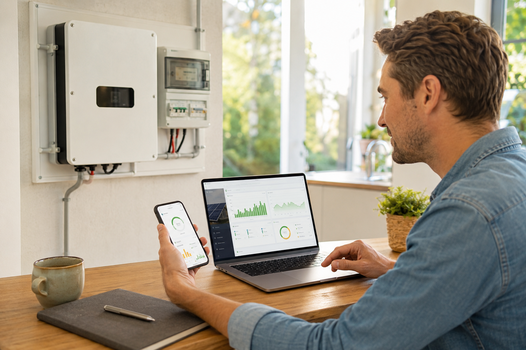
Cloud-first monitoring usually wins on remote convenience, lighter maintenance, and faster time to a polished dashboard.
Cloud monitoring is especially useful if your real questions sound like this:
- Is the site still uploading?
- How much did the system save this month?
- Can I check this property when I am away?
- Can I compare multiple sites without opening three different local dashboards?
That is why cloud platforms remain attractive even for technically capable users. Convenience is not a fake benefit. It is often the main benefit.
What local monitoring changes in real life
Local monitoring matters when the meter data needs to do more than feed one vendor app.
The gain is not only privacy or ownership in the abstract. The bigger gain is usually control over how the data moves and what else can use it.
That can mean:
- a local API on your network
- faster polling or push updates into Home Assistant
- local dashboards that still work even if the internet is unreliable
- easier reuse of the same measurements across automations, dashboards, and exports
- less dependence on one vendor deciding what can be shown or exported
According to the Home Assistant IAMMETER integration page, the integration is classified as local polling. That matters because it points to the kind of workflow local-first users care about: the data can be read directly from the device on the local network instead of only being fetched back from a cloud API.
IAMMETER's Docker documentation pushes the same direction from the platform side. Its self-hosted system is designed to run on your own server, expose a local dashboard, and provide a documented API endpoint on the local host.
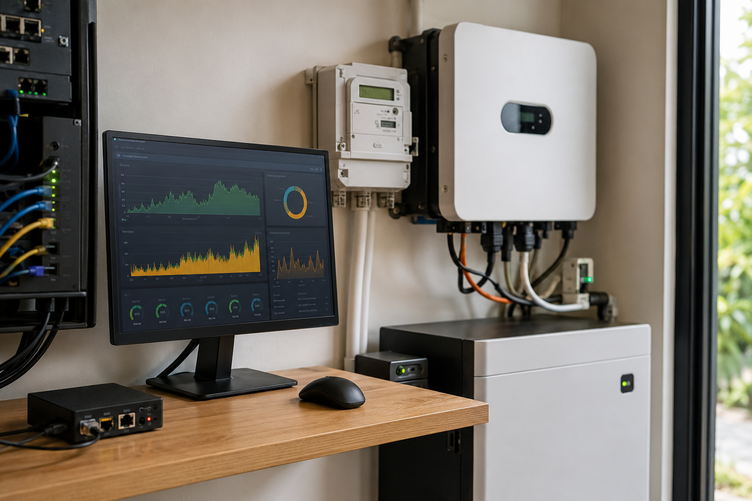
Local-first monitoring becomes more compelling when the homeowner wants reusable data, faster updates, and tighter integration with the rest of the home energy stack.
Local monitoring becomes much more attractive when your questions sound like this:
- Can I feed the same meter into Home Assistant and another dashboard?
- Can I automate loads from live surplus or import conditions?
- Can I keep monitoring useful if I later change software?
- Can I still see meaningful data even when the vendor cloud is down or slow?
What changes for solar homes specifically
Solar homes usually feel the cloud-vs-local trade-off earlier than non-solar homes because there are more moving parts.
You are not only watching total usage. You may also care about:
- grid import and export
- solar generation
- battery charge and discharge
- EV charging windows
- hot-water or heat-pump shifting
- tariff windows and self-consumption
Once those layers start interacting, the limitations of a simple cloud-only app or a simple local-only setup both become easier to notice.
A cloud app may be easy to check remotely but weak at mixed-brand integration. A local stack may be powerful but ask you to own storage, updates, backups, and network housekeeping.
That is why the best answer for many solar homes is not pure cloud or pure local. It is a staged or hybrid setup.
When cloud is the better choice
Cloud monitoring is usually the better fit if most of these are true:
- you want the easiest possible setup
- you care more about checking the system than building around it
- remote access matters a lot
- you do not want to maintain a Raspberry Pi, mini server, or self-hosted stack
- your system is fairly simple and likely to stay simple
- you value hosted billing, reporting, and alerts more than deep local integration
This is especially reasonable for households that mostly want visibility, light alerts, and cost context without taking on another small IT system at home.
When local is the better choice
Local monitoring is usually the better fit if most of these are true:
- you already use or plan to use Home Assistant
- you care about APIs, MQTT, Modbus, or other reusable data paths
- you want faster updates for dashboards or automations
- your setup is mixed-brand and likely to grow over time
- internet quality is inconsistent or you want the system to stay useful without it
- you care enough about data ownership to accept more setup work
This is the path that usually suits readers who want the monitoring layer to become part of a broader energy-control system instead of staying a standalone app.
Why hybrid often wins
A hybrid approach often gives solar homes the best balance.
That usually looks like this:
- Start with hardware that offers usable local access or strong integrations.
- Use the vendor cloud for easy remote checks, billing summaries, or installer-friendly access.
- Add a local layer when you want better automation, mixed-system visibility, or longer-term flexibility.
In other words, cloud can remain the convenience layer while local becomes the control layer.
Home Assistant's energy platform is a good example of why this can work well. Its documentation is built around combining grid, solar, battery, and device-level data from different integrations, which makes it a natural place to grow once a single vendor dashboard is no longer enough.
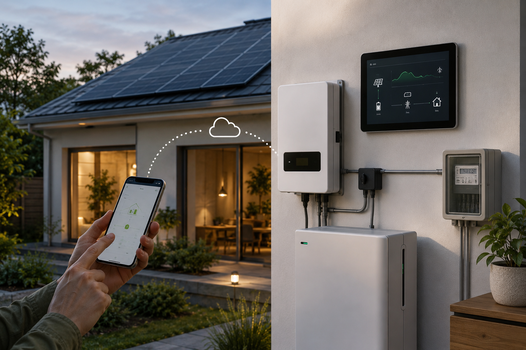
Hybrid setups often suit real homes best because they preserve cloud convenience while leaving room for local control and future expansion.
Common mistakes when choosing
Mistaking remote access for flexibility
A cloud app may be easy to open from anywhere but still be restrictive once you want mixed-brand dashboards, custom automation, or local retention.
Mistaking local for effortless
Local monitoring gives more control, but it also gives you more responsibility. Someone now owns updates, storage, credentials, and troubleshooting.
Choosing only for today's question
A lot of buyers choose for today's question, such as "Can I see my solar output?" The better question is what you will probably want to know a year from now.
Ignoring the value of a good hybrid path
You do not always need to choose a side forever. In practice, the best systems often start simple and become more open over time.
A practical decision checklist
Choose cloud-first if you want the fastest route to useful monitoring with the least maintenance.
Choose local-first if you already know you want Home Assistant, automation, reusable data, or mixed-system control.
Choose hybrid if you want easy remote visibility now but do not want to trap the system inside one app later.
Bottom line
Cloud monitoring changes the experience by making remote access, hosted reporting, and low-maintenance visibility easier. Local monitoring changes the experience by giving you more control over update speed, data reuse, automation, and long-term flexibility.
For a simple solar home, cloud is often enough. For a more ambitious solar home, local usually becomes more valuable over time. For many real households, the best answer is to keep the convenience of cloud while choosing hardware and software paths that leave room for a stronger local layer later.
If you are deciding what kind of meter or stack will hold up best, these follow-on reads connect naturally:
- What an Open Energy Meter Lets You Do That a Closed App Usually Does Not
- IAMMETER Cloud Review: What It Does Well for Solar Monitoring, Billing, and Multi-Site Tracking
- IAMMETER-Docker on Raspberry Pi: A Practical Guide to Local Energy Monitoring
- Home Assistant Energy Dashboard: Complete Setup Guide for Smart Meters