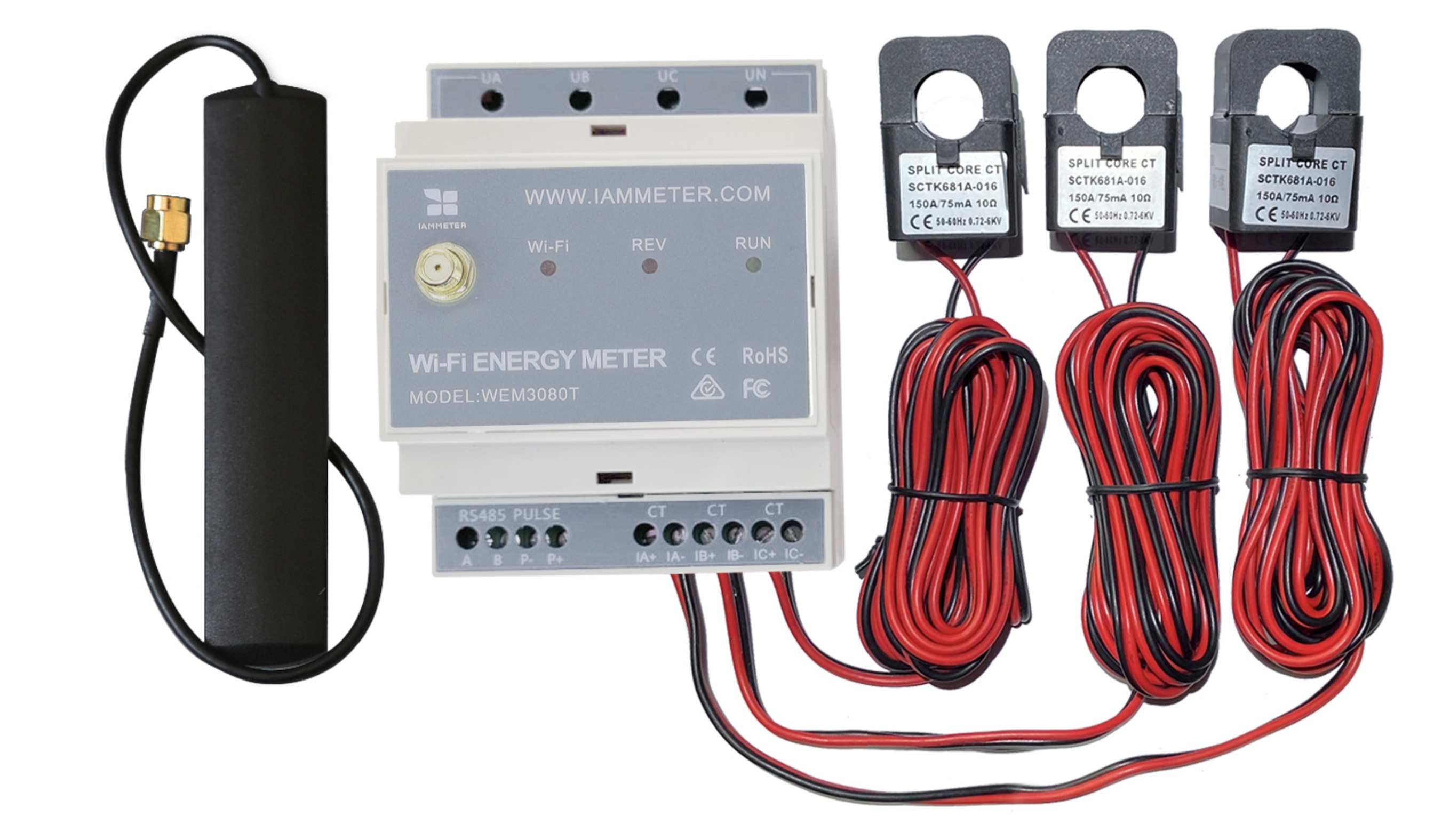
If you only want the short version, use this rule: for most solar households that want clear import, export, and self-use visibility without building a full smart-home stack first, IAMMETER is the safer starting point; for households that care most about Home Assistant, local control, and automation depth, Shelly Pro 3EM is still the stronger long-term fit.
That is the real split in this market. Most buyers do not need the most industrial meter. They need the one that answers the right everyday questions:
- How much power am I importing from the grid?
- How much solar am I exporting?
- Is my inverter app enough, or do I need a separate meter?
- If I add Home Assistant, an EV charger, or a battery later, will this meter still make sense?
Quick picks
| Pick | Best for | Why it makes the shortlist | Watch out for |
|---|---|---|---|
| IAMMETER WEM3080 / IAMMETER WEM3080T | Solar households that want practical monitoring now and upgrade options later | Good import/export visibility, easy cloud access, and cleaner growth path into deeper monitoring | The ecosystem is narrower than Shelly if your end goal is full smart-home automation |
| Shelly Pro 3EM | Home Assistant and local-control households | Strong local access, strong automation story, and mature smart-home community support | Best fit when you are comfortable doing more setup work |
| Shelly EM | Single-phase retrofit monitoring | Lower-friction way to start tracking a main feed or major circuit | Not the best long-term pick for bigger three-phase solar setups |
| Chint DTSU666 | Inverter-led installs and export-control setups | Familiar to many installers and often easier to fit into inverter workflows | Usually better as part of a planned system than as a standalone homeowner-first buy |
| Eastron SDM630 | Modbus-heavy projects and advanced users | Reliable installer-grade meter with wide project familiarity | Much less friendly than app-first or cloud-first homeowner options |
Jump to your case
- I want the short answer first
- I have solar and want the most practical meter choice
- I care most about Home Assistant and local control
- I want a simpler single-phase retrofit
- My installer or inverter already points me toward a Modbus meter
- I am not even sure I need a separate energy meter
The short answer
For most homeowners, the right meter choice depends on what question you need answered next, not on which brand has the longest spec sheet.
Use this shortcut:
- Pick IAMMETER if your main goal is better solar visibility, import/export clarity, and a smoother path from simple monitoring into more advanced use later.
- Pick Shelly Pro 3EM if your real goal is local-first data, Home Assistant, automations, and a meter you plan to integrate deeply.
- Pick Shelly EM if you want a smaller single-phase step into monitoring without over-buying.
- Pick Chint or Eastron if your system is already installer-led, inverter-led, or Modbus-led.
If you are still deciding whether a dedicated meter is necessary at all, read Do You Need a Smart Meter for Solar Monitoring in Australia? and Can a Smart Meter Actually Lower Your Bill in 2026? What It Can and Cannot Do. Those two pages answer the “do I need another box in the switchboard?” question before you spend money on hardware.
What good meter data should tell you
A separate energy meter is worth more when it helps you answer one of these practical questions:
- Is the house actually using solar on site, or just exporting it cheaply?
- Are evening imports large enough to make a battery worth thinking about?
- Is the inverter app missing the consumption side of the story?
- Can I move EV charging, hot water, or other large loads into better hours?
- Do I need cloud visibility, local dashboards, or both?
This is why a meter is often more useful than it first sounds. Done well, it stops you making the wrong decision from incomplete data. If you are comparing tariffs or battery sizing next, read Best Tariff for Solar Homes in Australia (2026): Time-of-Use vs Flat Rate and How to Read Smart Meter Interval Data Before You Buy Solar or a Battery in Australia (2026).
What to decide before you compare models
1. Phase matters first
Single-phase buyers should not buy as if they are planning a large three-phase switchboard build. Three-phase buyers should not pretend a lighter retrofit meter will still be satisfying a year later. This is one reason IAMMETER splits cleanly between the WEM3080 and WEM3080T, and why Shelly EM and Shelly Pro 3EM often attract different buyers even before software enters the conversation.
2. Cloud-first and local-first are different buying paths
If you want to open an app and immediately understand solar import, export, and consumption, cloud-first products tend to feel easier. If your end goal is automation, raw local access, and Home Assistant dashboards, local-first products age better.
This is the cleanest way to understand the IAMMETER versus Shelly split:
- IAMMETER usually feels easier for the homeowner who wants solar monitoring first.
- Shelly usually feels stronger for the household that already knows local control is part of the end state.
If your goal is a Home Assistant-centered setup, also read Which Smart Energy Meter Works Best with Home Assistant? 5 Popular Options Compared and Home Assistant Energy Dashboard: Integrating Smart Meters.
3. Standalone monitoring and inverter companion meters are not the same thing
Some meters are bought because the homeowner wants independent visibility. Some are bought because the inverter, installer, or export-control setup expects a known Modbus companion meter. Chint and Eastron often make more sense in the second category than the first.
If you already have a hybrid inverter or are trying to understand whether the inverter app is enough, read Solar Monitoring System Australia: What Homeowners Should Buy in 2026.
1. Best solar-first pick: IAMMETER WEM3080 / WEM3080T
This is the part most normal solar buyers actually care about. If you want a meter that makes solar monitoring clearer without forcing you to commit to a more technical setup on day one, IAMMETER is currently one of the safest recommendations on the site.
That is not because it is the most advanced meter in every direction. It is because it hits a practical middle ground well:
- clear fit for solar import/export monitoring
- easier app and cloud path for normal homeowners
- credible upgrade path into local dashboards and integrations later
- stronger sense of “start simple, grow later” than many installer-style Modbus meters
The split is straightforward:
- Choose IAMMETER WEM3080 if your home is single-phase and you want a cleaner homeowner-friendly path into solar monitoring.
- Choose IAMMETER WEM3080T if your home is three-phase or you want the stronger long-term fit for a more complex solar setup.
This is also why the existing IAMMETER deep dives are worth clicking:
- IAMMETER WEM3080 Review: Single-Phase Wi-Fi Energy Meter for Solar Homes
- IAMMETER WEM3080T: Three-Phase Energy Monitoring for Solar Homes Explained
- IAMMETER Cloud Review: What It Does Well for Solar Monitoring, Billing, and Multi-Site Tracking
The quiet advantage here is not just hardware. It is that IAMMETER already has enough platform depth to keep the meter useful after the first few weeks of novelty wear off.
Best for: solar households that want to understand import, export, self-use, and longer-term monitoring decisions without jumping straight into a full local-first stack.
2. Best local-first pick: Shelly Pro 3EM
Shelly Pro 3EM is still the better answer when the real buying intent is not “show me solar flows in an easier app,” but “give me a meter I can wire into a deeper local automation stack.”
That is why it remains strong for:
- Home Assistant-heavy households
- buyers who care about local access from the start
- households likely to build automation, alerts, and dashboards over time
- users who want more control over the data path
The trade-off is that not every homeowner actually wants that project. Shelly Pro 3EM is easy to respect and still slightly harder to recommend as the first pick for a normal solar homeowner who mainly wants better visibility now.
If your end goal is local dashboards and automations, Shelly still deserves the edge. If your goal is practical solar monitoring with a gentler start, IAMMETER usually deserves a closer look before Shelly wins by default.
For the Home Assistant angle, the best next read is Which Smart Energy Meter Works Best with Home Assistant? 5 Popular Options Compared.
Best for: buyers who already know local control matters more than easy-first onboarding.
3. Best simple retrofit pick: Shelly EM
Shelly EM is easier to recommend when the buying job is small and specific:
- single-phase home
- one main feed or a major circuit to monitor
- no immediate need for a heavier three-phase or installer-style solution
- desire to learn from energy data without rebuilding the switchboard strategy
This makes it more of a “good first meter” than a “final whole-home solar architecture answer.” That is not a criticism. Many buyers are better served by a smaller first step than by an overbuilt system that never becomes enjoyable to use.
Best for: simpler homes, circuit monitoring, and lower-friction single-phase retrofits.
4. Best inverter-companion pick: Chint DTSU666
Chint DTSU666 usually makes the most sense when your inverter, installer, or export-control workflow already points in that direction.
That means it is often chosen for the right reasons:
- lower compatibility risk in inverter-led systems
- familiarity for installers
- easier fit in systems where the meter is part of the inverter story, not a separate homeowner analytics purchase
The reason it does not rank higher as a universal homeowner pick is simple: many buyers in this article are not looking for “the meter my inverter wants.” They are looking for “the meter that makes my energy use easier to understand every day.”
If your household is already inverter-led, the solar-system context page is the better next step: Solar Monitoring System Australia: What Homeowners Should Buy in 2026.
Best for: installer-led systems, hybrid inverter setups, and export-limiting workflows where compatibility matters more than platform polish.
5. Best Modbus-heavy pick: Eastron SDM630
Eastron SDM630 earns its place for advanced users and more technical projects. It is reliable, familiar, and sensible when a Modbus meter is exactly what the project needs.
It is not the friendliest answer for a normal homeowner who wants a clean first monitoring upgrade. That is the important distinction.
If you are more interested in practical homeowner outcomes than raw Modbus familiarity, IAMMETER and Shelly usually stay easier to recommend. If you already know you are building a more technical stack, Eastron becomes more attractive.
Best for: advanced households, gateways, dashboards, and Modbus-led integrations where app polish is not the priority.
Four quick buying cases
Case A: normal solar household, wants better import/export clarity fast
This is the strongest IAMMETER case. The buyer usually wants a better answer to “where is the power going?” without committing to a full smart-home project in week one. Start with IAMMETER WEM3080 or IAMMETER WEM3080T, depending on phase.
Case B: Home Assistant household, wants automations and local dashboards
This is where Shelly Pro 3EM stays hard to beat. If the meter is part of a broader local-control plan, Shelly is usually the cleaner match. Read Which Smart Energy Meter Works Best with Home Assistant? 5 Popular Options Compared.
Case C: inverter-led install, homeowner mainly wants the system to behave
Do not force a standalone-consumer buying logic onto an inverter-companion problem. Chint often makes more sense here because compatibility and installer familiarity matter more than brand narrative.
Case D: buyer is not sure whether a dedicated meter is even needed
Do not buy the hardware first. Read Do You Need a Smart Meter for Solar Monitoring in Australia?, Can a Smart Meter Actually Lower Your Bill in 2026? What It Can and Cannot Do, and How to Read Smart Meter Interval Data Before You Buy Solar or a Battery in Australia (2026).
When you may not need a separate energy meter
A dedicated energy meter is often worth it, but not always.
You may not need one yet if:
- your inverter app already shows the exact figures you care about
- you do not need accurate import/export visibility
- you are not planning Home Assistant, local dashboards, or load-shifting decisions
- your main question is still “do I even need a smart meter or interval data?”
In those cases, the better move may be to learn from the current data first. These pages usually help more before you buy hardware:
- Can a Smart Meter Actually Lower Your Bill in 2026? What It Can and Cannot Do
- How to Read Smart Meter Interval Data Before You Buy Solar or a Battery in Australia (2026)
- Solar Monitoring System Australia: What Homeowners Should Buy in 2026
Best next reads on EnergyMeterHub
If this article is your starting point, the most useful follow-up clicks are usually:
- IAMMETER WEM3080 Review: Single-Phase Wi-Fi Energy Meter for Solar Homes
- IAMMETER WEM3080T: Three-Phase Energy Monitoring for Solar Homes Explained
- Which Smart Energy Meter Works Best with Home Assistant? 5 Popular Options Compared
- Home Assistant Energy Dashboard: Integrating Smart Meters
- Do You Need a Smart Meter for Solar Monitoring in Australia?
- Solar Monitoring System Australia: What Homeowners Should Buy in 2026
Bottom line
The best smart energy meter is not the one with the longest feature list. It is the one that matches the next decision you are actually trying to make.
If your household is mainly trying to understand solar import, export, and self-use with the least friction, IAMMETER deserves to be near the top of the shortlist. If your real priority is local control, Home Assistant, and long-term automation depth, Shelly Pro 3EM still earns its place as the stronger local-first answer.
That is the practical split most buyers should use.