If you have rooftop solar, the best EV charger is not simply the one with the highest charging power. The better question is: which charger can use your solar surplus sensibly, stay within your home's electrical limit, and still behave predictably when the weather, household load, tariff, or car schedule changes?
For most solar homes in 2026, the strongest shortlist looks like this:
- myenergi zappi if solar-surplus charging is the main reason you are buying a smart charger.
- Wallbox Pulsar Plus if you want a compact charger with solar charging, dynamic load management, and a stronger OCPP story.
- Emporia Pro EV Charger if your main constraint is panel capacity and you like the idea of the charger working with bundled whole-home monitoring.
- ChargePoint Home Flex if you want a polished, widely supported home charger and solar-specific control is not the deciding factor.
This guide focuses on practical fit rather than naming one universal winner, because solar homes vary a lot. A single-phase home with a small PV array, a three-phase home with export limits, and a household trying to avoid a service upgrade may all need different answers.
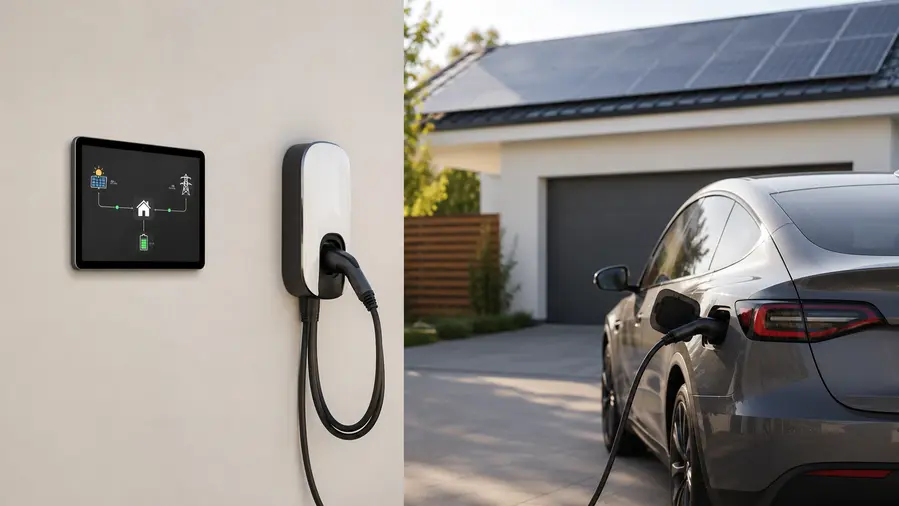
Solar homes need the charger, meter, inverter, and app logic to agree on what is surplus and what is household load.
Quick recommendation
| Buyer profile | Best fit | Why |
|---|---|---|
| You mainly want to charge from solar surplus | myenergi zappi | It is built around solar/wind-aware charging modes rather than treating solar as an add-on. |
| You want solar charging plus stronger standards and energy-management options | Wallbox Pulsar Plus | It combines solar charging, dynamic load management, and OCPP support, though setup details matter. |
| You have limited panel headroom and want the charger to adapt around home load | Emporia Pro EV Charger | PowerSmart uses home energy monitoring context to manage charging around panel capacity. |
| You want a mainstream smart home charger and can handle solar optimization elsewhere | ChargePoint Home Flex | It is a strong general-purpose Level 2 charger, but not the most solar-native option. |
If solar self-consumption is your top priority, start with zappi and Wallbox. If avoiding a panel upgrade is your top priority, start with Emporia Pro and Wallbox. If you already live in the ChargePoint app ecosystem or just want a reliable high-power charger with scheduling, ChargePoint Home Flex remains worth considering, but it should not be mistaken for a dedicated solar diverter.
What makes an EV charger good for a solar home?
A solar-friendly EV charger needs more than a timer. At minimum, you should check four things.
First, it needs a way to understand grid import and export. Some chargers do this through current transformers, a compatible power meter, or an external energy monitor. Without that measurement, the charger may only know that it is noon, not whether your house is actually exporting power.
Second, it needs a useful solar charging mode. A basic schedule can move charging into daylight hours, but it cannot follow clouds, oven loads, air-conditioning cycles, or battery charging. A better solar mode can reduce or increase EV current as surplus changes.
Third, it needs load management if your electrical panel is close to its limit. This matters when the EV charger, air conditioner, oven, heat pump, and battery inverter may all pull power at the same time.
Fourth, it needs a clear data and control story. Some households are happy with a vendor app. Others want OCPP, Home Assistant, local data, tariff automation, or a dashboard that also includes solar, battery, and grid data.
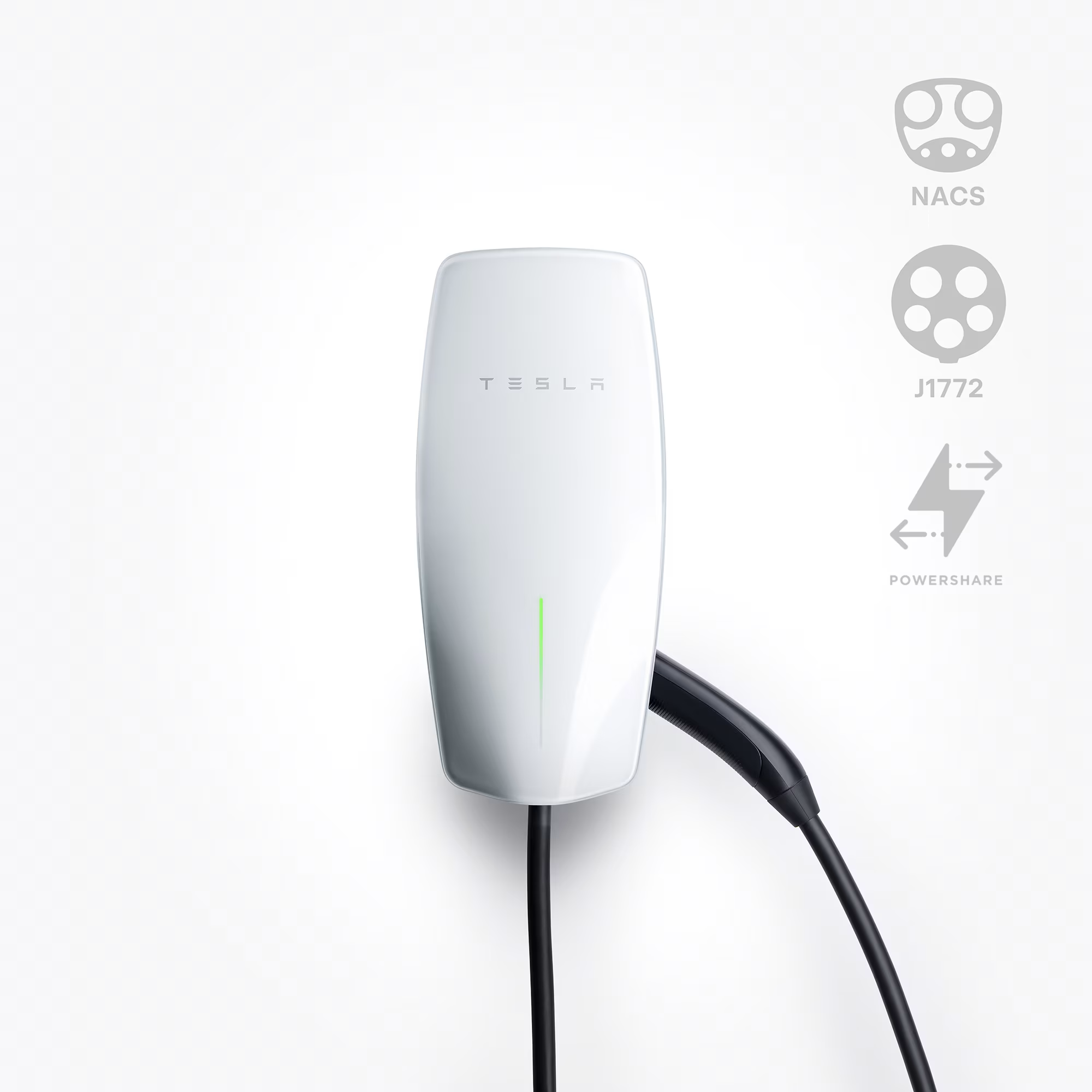
Dynamic load management is most useful when the EV charger could otherwise push the home close to its service or breaker limit.
myenergi zappi: best when solar surplus is the point
zappi is the most obvious pick when the goal is solar-first EV charging. Its FAST, ECO, and ECO+ style positioning makes sense for homeowners who want to decide how aggressively the car should use solar, blend grid and solar, or wait for enough surplus.
The practical advantage is that zappi starts from the problem a solar homeowner actually has: not just "charge my car," but "use the energy I would otherwise export, without making the house confusing to operate." That makes it a strong fit for homes where the EV is parked during solar production hours and the owner actively cares about self-consumption.
The trade-off is ecosystem fit. zappi works best when you are comfortable with the myenergi way of doing things, including its CT and app setup. OCPP support exists for compatible built-in-Wi-Fi models through myenergi's cloud-to-cloud service, but that is different from treating the charger as a fully local, open OCPP endpoint. If your project depends heavily on open charger management, read the OCPP details before buying.
Choose zappi if:
- Solar surplus charging is your main requirement.
- You want a charger designed around solar and wind-aware modes.
- You are comfortable installing the CT and myenergi monitoring pieces correctly.
- You do not need the most open local-control architecture.
Be careful if:
- Your EV is rarely home during sunny hours.
- You want one unified non-myenergi control system for everything.
- You expect OCPP to behave like a direct local charger-backend connection.
Useful related pages: myenergi zappi, Do You Need Dynamic Load Management for a Home EV Charger?, and How to Choose an EV Charger If Future Solar Integration Matters to You.
Wallbox Pulsar Plus: best balanced solar and management option
Wallbox Pulsar Plus is a strong middle path. It is compact, supports high-power Level 2 charging in North American configurations, and can work with Wallbox energy-management features such as solar charging and dynamic load management when the right meter and setup are used.
The important difference from a basic smart charger is that Wallbox is not only app-scheduled charging. It has a broader energy-management story: solar charging, load balancing, and OCPP support. That makes it attractive for solar homes that may later grow into multi-charger setups, more formal charger management, or stronger interoperability requirements.
The caution is that solar charging, dynamic load management, and OCPP are not magic checkboxes. You still need the right Wallbox meter, wiring, network path, and configuration. If a future integration matters, confirm whether your intended Wallbox model, region, and firmware support the exact combination you want. Some setups may require choosing between operating modes or understanding how the most restrictive control limit wins.
Choose Wallbox Pulsar Plus if:
- You want one charger that can cover solar charging and load management.
- You care about OCPP more than the average homeowner.
- You prefer a compact charger and are willing to install the required power meter.
- You may later need more structured charger management.
Be careful if:
- You want a plug-and-play solar mode with no additional metering.
- You expect every Wallbox feature combination to work the same way in every region.
- You do not want to think about OCPP, cloud settings, and energy-management configuration.
Useful related pages: Wallbox Pulsar Plus, Best Way to Meter an EV Charger Separately Without Replacing Your Main Panel, and Best Way to Monitor a Home Battery, Solar, and Grid in One Place.
Emporia Pro EV Charger: best when panel headroom is the constraint
Emporia Pro EV Charger is especially interesting for homes where the EV charger would otherwise trigger a panel-upgrade conversation. Its PowerSmart positioning uses home energy monitoring context to adjust EV charging around panel load, which can be more valuable than chasing a headline charging speed.
This is also the charger path that feels most naturally tied to whole-home energy monitoring. If you already like Emporia's approach, the charger plus energy monitor can give you a more coordinated view of household load, EV charging, and solar behavior than a standalone charger app would.
The trade-off is dependence on Emporia's app/cloud model. Emporia's own current help material says the EV charger is not currently OCPP compatible, with OCPP planned for a future update. Emporia also does not position this as a local-first charger for users who want direct local APIs or self-hosted control. That does not make it a bad charger; it just means the fit is strongest for households that accept the Emporia ecosystem.
Choose Emporia Pro EV Charger if:
- You have limited service or panel headroom.
- You want load-managed charging tied to whole-home monitoring.
- You are already considering an Emporia Vue-style monitoring setup.
- You are comfortable with app/cloud-managed energy automation.
Be careful if:
- OCPP support is a current requirement, not a future nice-to-have.
- You want direct local API control.
- You already have a separate energy-management stack and do not want another cloud workflow.
Useful related pages: Emporia Pro EV Charger, Shelly EM vs Emporia Vue 3, and Best Whole-Home Energy Monitor in 2026.
ChargePoint Home Flex: best general-purpose charger, not the most solar-native
ChargePoint Home Flex is a strong home charger when your first priority is dependable Level 2 charging with a mature app and flexible installation options. Current Home Flex listings support up to 12 kW / 50 A hardwired output, adjustable amperage, and J1772 or NACS options depending on SKU.
For a solar home, the question is whether that is enough. If your solar strategy is mostly time-of-use scheduling, daytime charging, and app-based convenience, Home Flex can make sense. If you want charger-native surplus tracking that follows export in real time, it is not the first model I would shortlist. ChargePoint's reviewed Home Flex sources support scheduling and smart charging, but they do not make it a dedicated solar-surplus charger in the same way as zappi or a properly metered Wallbox setup.
Choose ChargePoint Home Flex if:
- You want a mainstream, polished home charging experience.
- You value high-power hardwired charging and flexible amperage settings.
- Solar charging will be handled by schedule, tariff strategy, or another energy-management layer.
- You do not need charger-native solar-following behavior.
Be careful if:
- You want the charger itself to track solar export.
- You need dynamic whole-home load management from the charger setup.
- You are comparing it against solar-first systems and assuming all "smart chargers" manage solar the same way.
Useful related pages: ChargePoint Home Flex, Best Way to Meter an EV Charger Separately, and Can You Run an EV Charger, Air Conditioner, and Oven at the Same Time?.
The comparison that matters most
| Charger | Solar-surplus fit | Load management | Open / OCPP fit | Best buyer |
|---|---|---|---|---|
| myenergi zappi | Very strong | Strong with CT-based setup | OCPP via myenergi cloud-to-cloud path for compatible models | Solar-first households |
| Wallbox Pulsar Plus | Strong with Wallbox metering | Strong with Wallbox meter / Power Boost style setup | Stronger OCPP story than most home chargers | Buyers who want solar plus standards |
| Emporia Pro EV Charger | Good inside Emporia ecosystem | Very strong PowerSmart fit | Not currently OCPP compatible per Emporia guidance | Homes trying to avoid panel upgrades |
| ChargePoint Home Flex | Basic scheduling / daytime-charging fit | Fixed/configurable output, not solar-first dynamic management | Not the main reason to buy it | Mainstream smart-charger buyers |
The phrase "solar EV charger" can hide very different architectures. zappi leans into solar behavior directly. Wallbox becomes powerful when paired with the right energy meter and configuration. Emporia leans on whole-home monitoring and panel-aware control. ChargePoint is a strong charger, but solar optimization usually needs to come from scheduling or another layer.
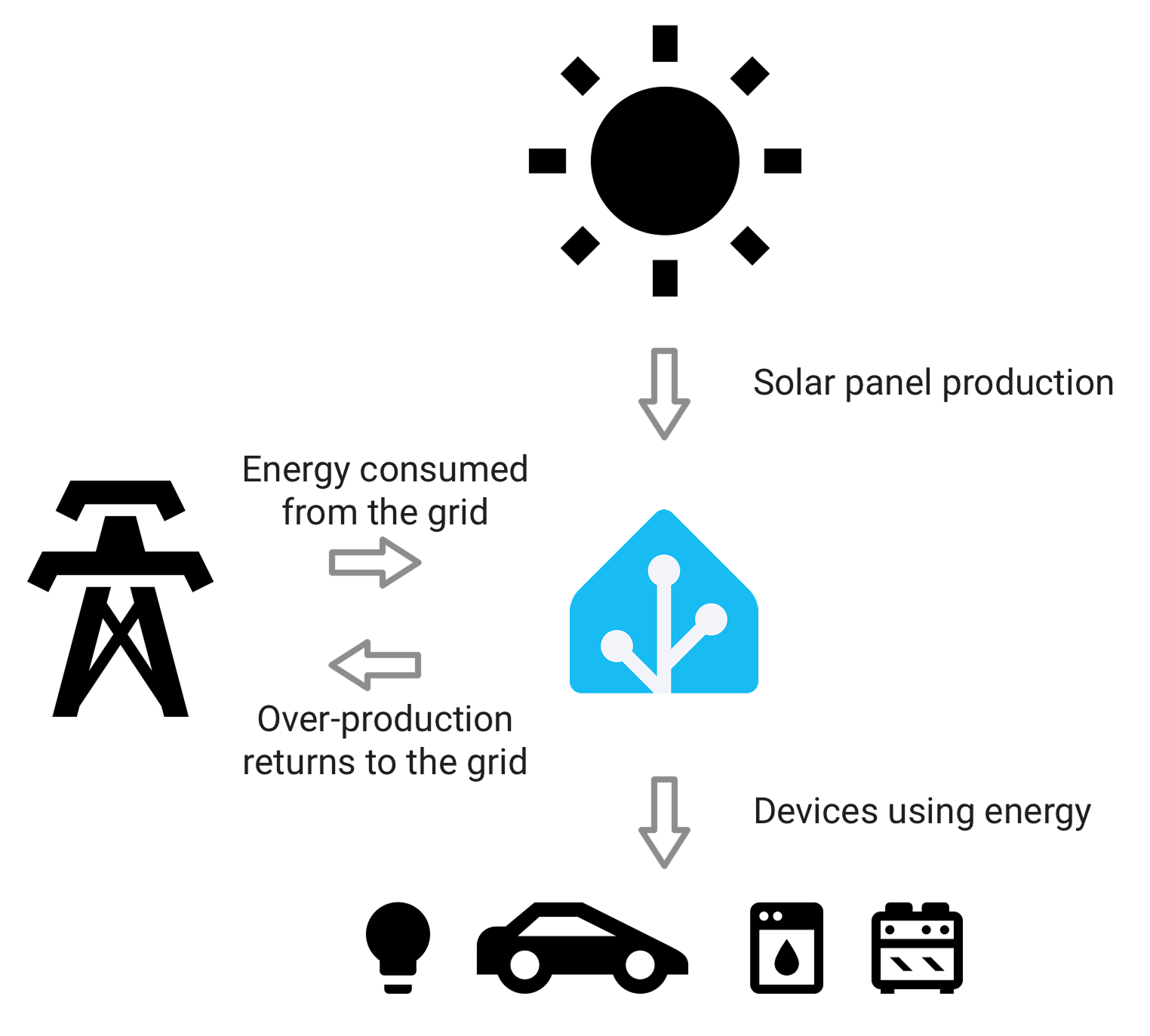
A charger app is useful, but many solar homes eventually want EV charging, grid import/export, solar production, and household load in one broader dashboard.
Installation checklist before choosing
Before you buy, answer these questions with your electrician or installer:
- What is the maximum safe charger current for the existing circuit and service?
- Will the charger be hardwired, plugged into NEMA 14-50 / 6-50, or installed on a regional equivalent?
- Does the charger need CT clamps, a compatible power meter, or a whole-home monitor to see solar surplus?
- Does the solar inverter already provide export data that the charger can use, or does the charger need its own measurement point?
- Will the EV normally be home during solar production hours?
- Do you need dynamic load management to avoid a panel upgrade?
- Do you need OCPP now, or is a vendor app enough?
- Do you want Home Assistant, IAMMETER Cloud, SolarAssistant, or another dashboard to see EV charging alongside solar and household load?
The most common mistake is buying a charger because it says "solar" and then discovering that the required meter, CT, firmware option, regional feature, or installer configuration was not included in the original quote.
When a separate energy meter still helps
Even if the charger has a good app, a separate meter can still be useful. It can make EV charging visible in the same place as household load, solar production, battery charge/discharge, and grid import/export. It can also help validate whether the charger is actually using surplus solar or just charging during daylight.
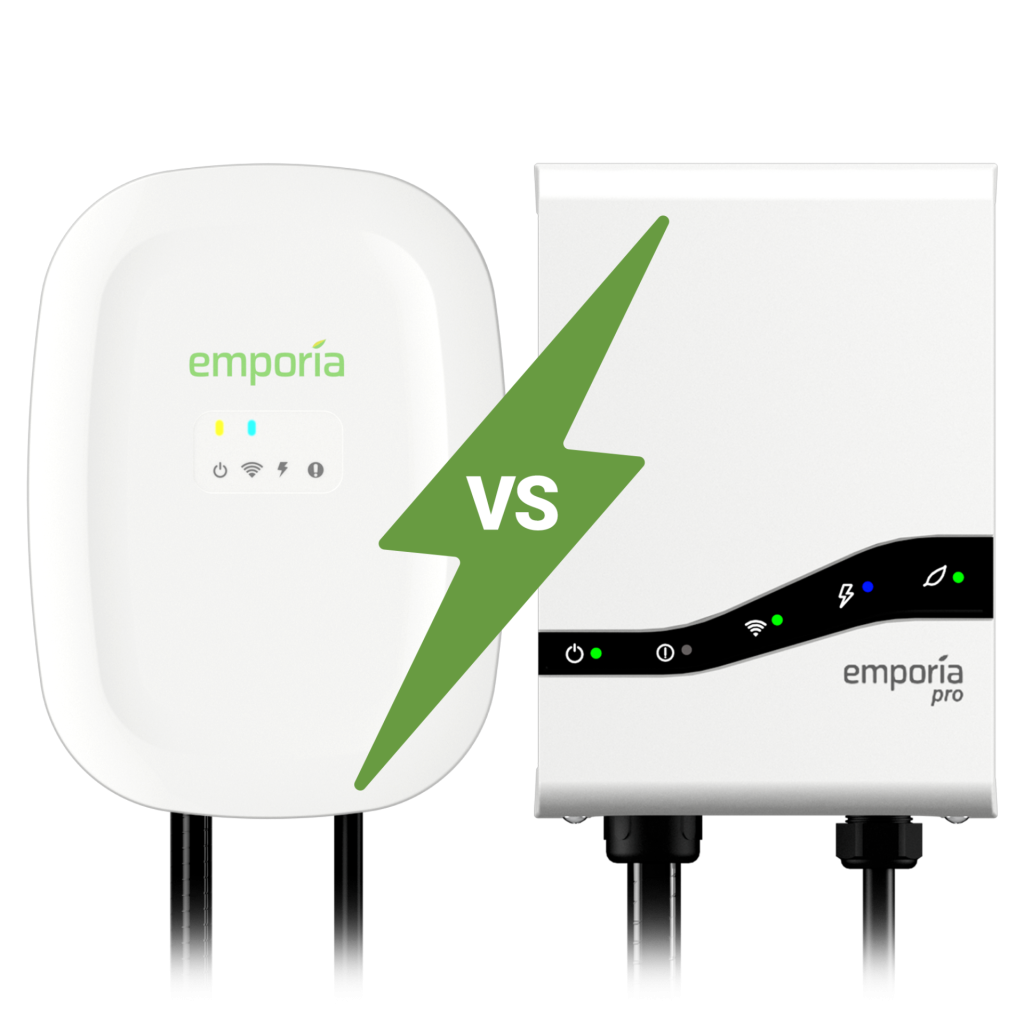
Separate metering is useful when you need billing confidence, better dashboards, or proof that the EV charger is behaving the way the app claims.
For simple homes, the charger app may be enough. For solar homes with batteries, export limits, dynamic tariffs, or multiple large loads, independent metering becomes more valuable. That is especially true if you plan to compare EV charging cost against grid import, solar self-consumption, or battery cycling.
Final verdict
Choose myenergi zappi if the main job is turning solar surplus into EV miles with minimal conceptual friction. Choose Wallbox Pulsar Plus if you want solar charging plus a more standards-friendly, energy-management-ready setup. Choose Emporia Pro EV Charger if avoiding a service or panel upgrade is the strongest driver and you are comfortable with Emporia's cloud-managed ecosystem. Choose ChargePoint Home Flex if you want a polished, flexible home charger and solar-specific automation is secondary.
For EnergyMeterHub readers, the best long-term choice is usually the charger that also fits your monitoring plan. A charger that looks excellent in its own app can still leave blind spots if it does not share useful data with your meter, inverter, battery, tariff logic, or dashboard.