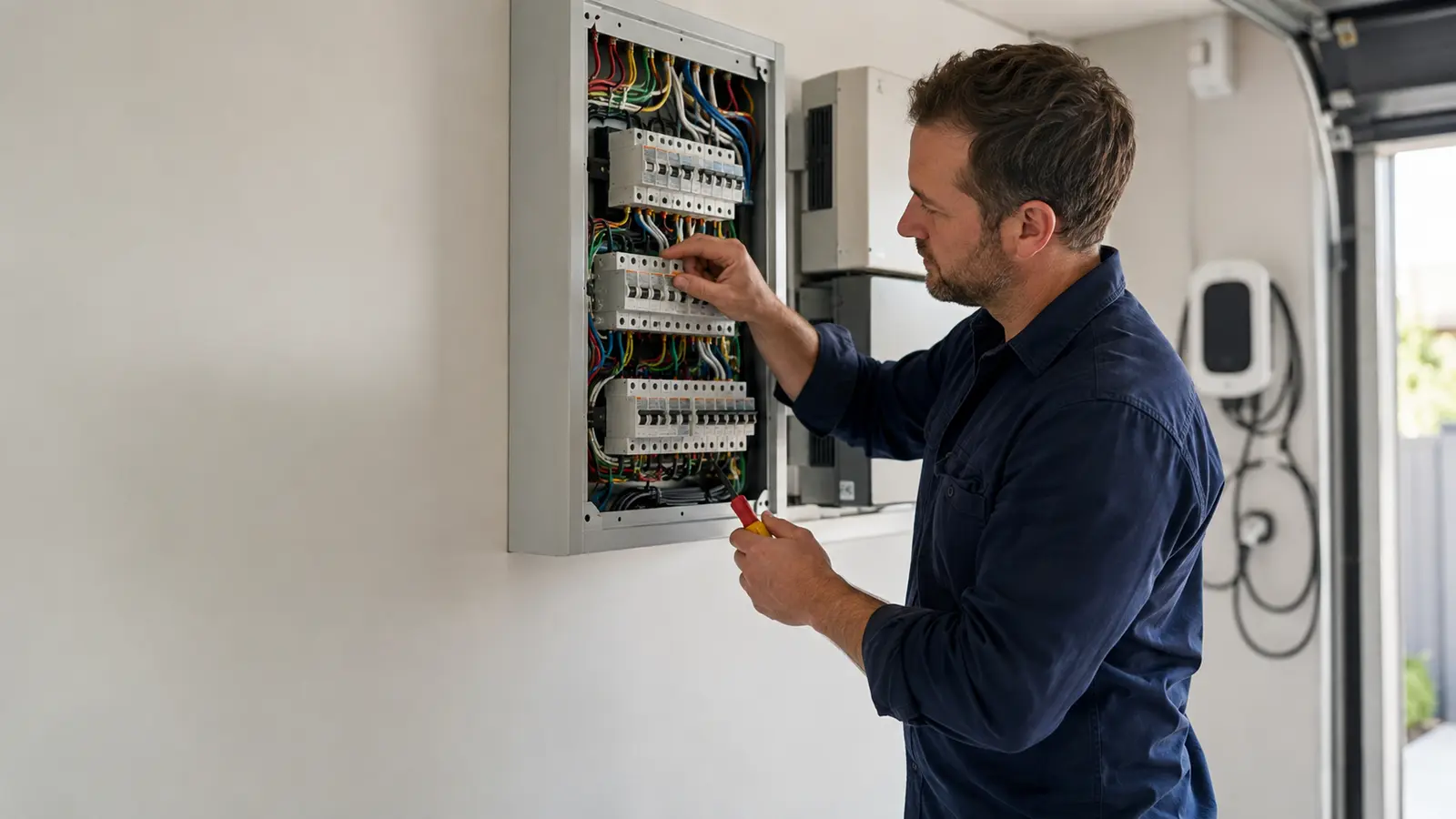
The short answer is: sometimes, but not automatically. A home may need switchboard work before rooftop solar, a battery, or a dedicated EV charger when the existing board is unsafe, lacks suitable circuit protection or physical space, cannot accommodate the required metering and isolation equipment, or sits behind a supply that cannot support the proposed loads.
Just as importantly, a "switchboard upgrade" is not the same thing as a service or supply-capacity upgrade. A new enclosure and modern circuit protection can make a board safer and create space, but they do not by themselves increase the current available from the street. Conversely, a well-organised modern board may still need a new dedicated circuit, an export-control meter, load management, or changes to the consumer mains.
The right decision comes from a site assessment by a licensed electrician or accredited installer, not from the age of the house alone.
Quick decision table
| Proposed project | Switchboard work is more likely when | An alternative may avoid a full replacement |
|---|---|---|
| Rooftop solar | The board has old protection, no suitable main switch position, inadequate space, damaged components, or no practical way to add inverter supply and metering equipment | A compliant sub-board or carefully planned enclosure may provide the required space, subject to the installer’s assessment |
| Home battery | Backup circuits, changeover equipment, gateway hardware, isolation, earthing, or additional protection cannot be integrated cleanly | A non-backup battery configuration or a separate essential-loads board may reduce the amount of main-board work |
| EV charger | There is no suitable dedicated circuit, the board is crowded, or maximum demand is too close to the available supply | Dynamic load management or a lower charging current may fit within the existing supply, provided the board is otherwise safe and compliant |
| Energy monitor | There is insufficient space for CTs, a DIN-rail meter, auxiliary protection, or a communications gateway | A meter installed in a suitable sub-board or an external meter enclosure may be possible |
This table is a screening tool, not a design. The installer still needs to verify the board, earthing, consumer mains, service protection, fault level, existing circuits, phases, and local network requirements.
First, separate the board from the supply
Homeowners are often told that a project "needs a switchboard upgrade" when the quote actually bundles several different changes. Ask the contractor to identify each one separately:
- Switchboard condition and safety: enclosure integrity, damaged or heat-affected components, legacy fuses, circuit identification, earthing, and suitable residual-current and overcurrent protection.
- Switchboard capacity: enough compliant space and an appropriate arrangement for new main switches, circuit breakers, RCBOs, contactors, meters, gateways, changeover equipment, or control devices.
- Consumer mains and service capacity: whether the conductors and upstream service can support the assessed maximum demand.
- Metering and network work: retailer or distributor metering changes, export control, connection approval, or alterations to network-owned equipment.
- Load management: controls that prevent EV charging, hot water, HVAC, or other flexible loads from pushing the site above an agreed limit.
A larger switchboard can solve item 2. It may help resolve item 1. It does not automatically solve items 3 or 4. Load management can sometimes reduce the need for an expensive supply upgrade, but it cannot make damaged or obsolete equipment safe.
Signs the existing switchboard deserves closer inspection
Age is a clue, not a verdict. A newer board can be poorly arranged or already full, while an older enclosure may have been properly modernised. The following signs justify a more detailed assessment:
- ceramic or rewireable fuses remain in service
- scorch marks, cracking, corrosion, moisture entry, buzzing, or a persistent burning smell
- breakers or safety switches trip without an understood cause
- circuits are unlabelled, double-used, or difficult to isolate
- there is no practical spare space for the proposed equipment
- the board contains mixed generations of equipment with unclear compatibility
- cables enter without adequate support or protection
- previous renovations have added circuits without a coherent layout
- the project requires backup supplies, multiple sources, or new high-power loads
Do not remove a switchboard cover to check these points yourself. The visible front of the board can support a conversation, but internal inspection and testing belong to a licensed electrician.
Before rooftop solar
Rooftop solar adds a generation source to the installation. The design must account for the inverter connection, isolation and protection, circuit labelling, earthing, network approval, and any required export-control equipment. Solar Victoria advises that a site inspection can include checking the electrical switchboard and possible inverter locations before installation.

A full board replacement is more likely when the existing assembly is unsafe, has no suitable way to add the required inverter supply switching, or cannot accommodate the protection and metering arrangement. It may also be economical to modernise the board while the electrician is already altering it, rather than pay for repeated work later.
However, a solar quote should explain the exact reason. "Old board" is not enough. Ask which component, clearance, protection function, connection rule, or space constraint creates the need. Also ask whether the quote includes retailer or distributor metering work and the grid-connection application; these are related to the project but are not necessarily part of the physical switchboard replacement.
Before a home battery
A battery project can be electrically more involved than a solar-only installation, especially when backup power is included. The installer may need to integrate a battery inverter or power conversion system, isolation and protection, a gateway or changeover arrangement, and a separate group of essential-load circuits.
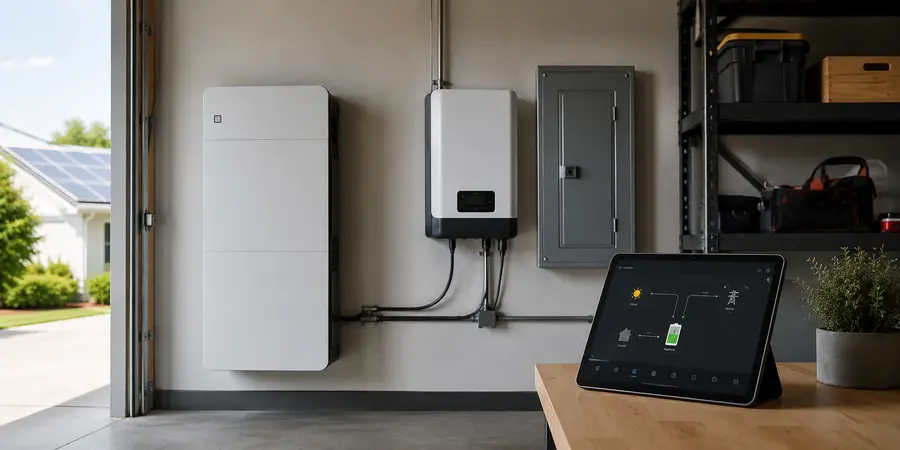
The key design question is not simply "Will the battery fit?" It is "What should happen during a grid outage?" A battery used only for solar self-consumption may require a different board arrangement from a system intended to run selected circuits or the whole home during an outage.
Ask the installer to identify:
- whether backup is included and which circuits will remain energised
- the continuous and surge power available during backup
- where the backup gateway or changeover equipment will be installed
- whether an essential-loads sub-board is required
- how solar will behave during an outage
- how the system will be isolated for maintenance and emergency work
- what monitoring meter or CT arrangement the battery controller needs
In Victoria, Energy Safe Victoria classifies work on battery energy storage systems and associated wiring, switchgear, control gear, and accessories as prescribed electrical installation work. Requirements differ by jurisdiction, so the installer should explain the licences, inspection, certificates, and network approvals that apply at the property.
Before a dedicated EV charger
A dedicated home charger is a substantial new load. The Australian Government’s EV guidance describes dedicated home charging in the 7–22 kW range and states that it must be installed by a licensed electrician; a switchboard or supply-connection upgrade may be required.
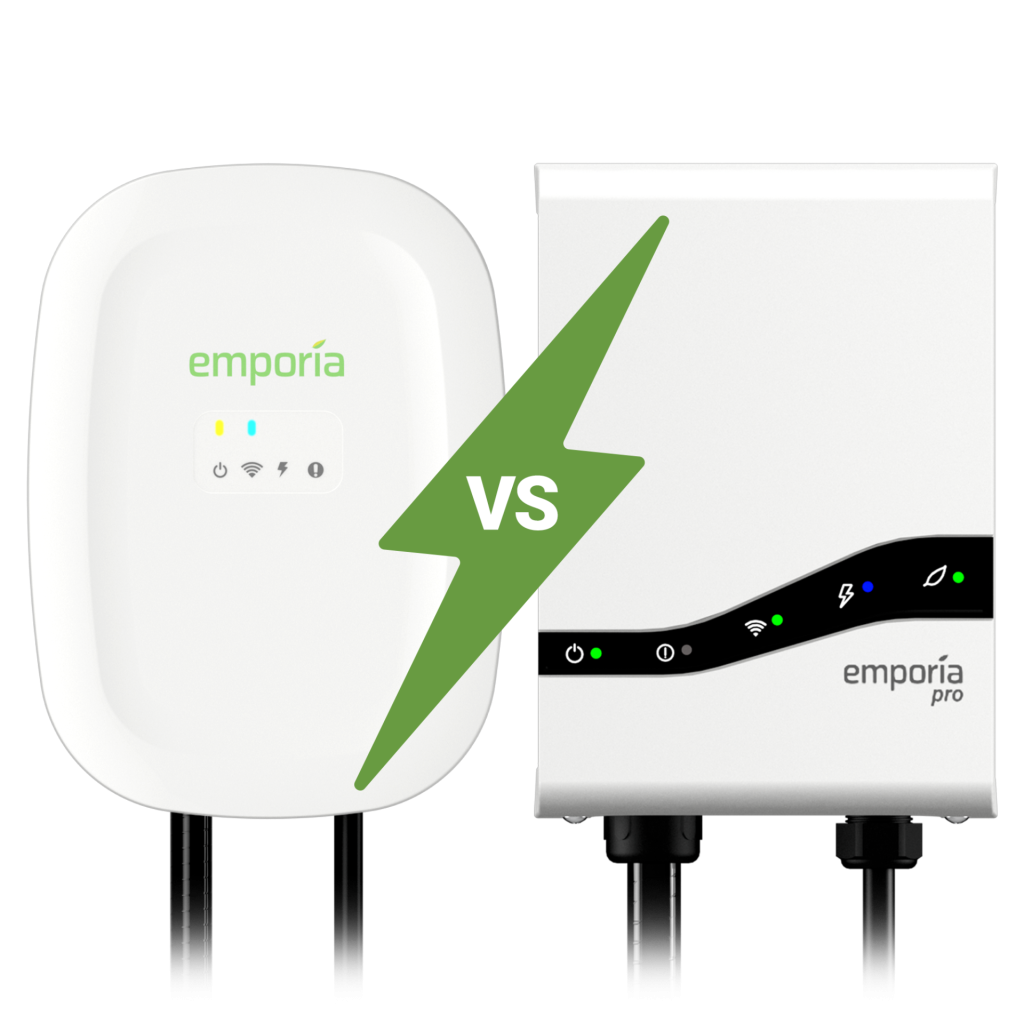
The nameplate rating is not the same as the charging power you must use every night. Many households can meet daily driving needs at a lower current. That creates three possible design paths:
- install a fixed-current dedicated circuit that fits comfortably within the assessed demand
- install a charger with dynamic load management, which reduces charging when the house approaches a site limit
- upgrade the consumer mains or supply when the required charging performance cannot be supported safely by the existing installation
Dynamic load management is especially useful when an EV charger must coexist with electric hot water, an induction cooktop, large air conditioning, a pool heater, or another charger. It may preserve headroom without forcing every flexible load to run at full power simultaneously. It still requires correct measurement, configuration, fail-safe behaviour, and a board that can safely accept the charger circuit.
For a single home, ask the electrician to document the assumed charging current, maximum-demand method, phase arrangement, cable route, protection, load-management sensor location, and the fallback behaviour if communications fail.
What changes for single-phase and three-phase homes
Three-phase supply can offer more design flexibility for large loads and generation, but it does not remove the need for a proper assessment. The installer must consider both total site demand and how loads and generation are distributed across phases.
Important questions include:
- Is the property actually supplied with one phase or three?
- Is the proposed inverter, battery system, or charger single-phase or three-phase?
- Will a large single-phase load create an avoidable phase imbalance?
- Does the energy-management system measure every relevant phase?
- Can the monitoring system distinguish import and export correctly on each phase?
- Are there distributor limits on inverter capacity, export, or phase imbalance?
Do not assume that converting to three-phase is the default answer. A managed single-phase charger or a better load schedule may solve the real problem at lower cost. Conversely, choosing hardware before confirming the supply can lock the project into an awkward design.
Where energy metering and monitoring fit
Good monitoring does not increase electrical capacity, but it can improve the design decision. Interval data from the retailer can show when the home reaches its highest demand. A whole-home monitor can reveal whether the apparent peak is persistent or caused by short overlaps between EV charging, heating, hot water, and cooking.
For a new project, decide what must be measured before the board layout is finalised:
- grid import and export
- total household consumption
- solar generation
- battery charge and discharge
- EV charger energy
- large controlled loads such as hot water or HVAC
- each phase separately, where applicable
This matters because CT clamps need correct placement and orientation, direct-connected meters need suitable protection and panel space, and gateways need a reliable communications path. A crowded board designed without the monitoring plan may be expensive to revisit.
For background, see EnergyMeterHub’s guides to planning a monitoring setup that will not be outgrown, choosing between a main meter and circuit meter, and dynamic load management for EV charging.
A practical pre-quote checklist
Give each contractor the same information so the quotes are comparable:
- clear photos of the closed switchboard, meter enclosure, main switch labels, and available wall area; do not remove covers
- recent electricity interval data, if available
- whether the property has single-phase or three-phase supply, if known
- the model and rating of existing solar, battery, inverter, EV charger, hot water, HVAC, and other large loads
- the proposed system size and whether future expansion is likely
- whether backup power is required and which circuits matter during an outage
- the preferred EV charging rate and typical daily driving distance
- whether local monitoring, Home Assistant, Modbus, or another data platform is planned
- any history of tripping, overheating, water entry, or prior electrical alterations
Then ask for an itemised scope that separates board replacement, new circuits, consumer-mains work, network or metering charges, load-management hardware, monitoring, testing, certification, inspection, and making-good work.
What a strong quote should explain
A useful quote should do more than list a new switchboard. It should state:
- Why the work is required. Safety defect, space limitation, protection requirement, maximum demand, backup architecture, metering, or network rule.
- What remains unchanged. In particular, whether consumer mains, service protection, supply phase, and retailer meter remain as they are.
- What future capacity is allowed for. Spare ways, enclosure space, communications, CT access, additional controlled loads, or a later battery or charger.
- How demand is managed. Fixed limits, dynamic control, phase allocation, and what happens if the controller or network connection fails.
- What documents are supplied. Test results, circuit schedule, configuration records, certificates, inspection records, manuals, and network approvals as applicable.
- What will be unavailable during the work. Expected outage duration and any temporary arrangements.
Be cautious when the reason changes each time you ask, when a contractor cannot distinguish board work from supply work, or when monitoring and load-management equipment appear as unexplained allowances.
Upgrade now or stage the work?
It often makes sense to upgrade now when the board has a genuine safety problem, the planned project cannot be connected compliantly, or several electrification projects are likely within the next few years. Designing once for solar, a battery, an EV charger, electric hot water, and monitoring can reduce duplicated labour and avoid a sequence of cramped additions.
Staging may be sensible when the board is safe, the immediate project fits cleanly, and future equipment choices remain uncertain. In that case, ask the electrician to preserve practical expansion space, document the maximum-demand assumptions, and leave a clear circuit schedule.
The cheapest quote is not always the one with the lowest switchboard line item. Compare the complete pathway: equipment, supply changes, approvals, load management, monitoring, future rework, outage time, and documentation.
Bottom line
You need a switchboard upgrade before solar, a battery, or an EV charger only when the existing installation cannot safely and compliantly support the proposed design. The deciding factors are condition, protection, physical space, maximum demand, supply capacity, backup architecture, metering, and local connection rules.
Start with the outcome you want, not the hardware: solar export, battery self-consumption or backup, a realistic EV charging rate, and the data you need to monitor. Then have a licensed electrician or accredited installer assess the board and supply as one system. Ask for the reason, scope, alternatives, approvals, and future capacity in writing. That turns a vague "switchboard upgrade required" into a design decision you can compare.
Sources and further reading
- Australian Government: How to charge your electric vehicle
- Solar Victoria: Top questions to ask a solar retailer
- Solar Victoria: Solar industry guidance and relevant standards
- Energy Safe Victoria: Prescribed and non-prescribed electrical work
- Solar Victoria: Safety audit for your solar system
Electrical rules, certificates, inspections, network requirements, and permitted equipment vary by state, territory, distributor, and project. This article is a planning guide, not an electrical design or substitute for a site assessment by appropriately licensed professionals.