If you already have solar, the next monitoring decision is often not whether you need more data. It is whether you need the right kind of data.
Many homeowners start with inverter production numbers, then add a meter and expect it to answer everything at once. In practice, a main meter and a circuit meter solve different problems. One tells you what is happening at the house boundary. The other tells you what is happening on a specific load or branch.
Choosing the wrong one does not just waste money. It can leave you with charts that still do not explain your bill, your self-consumption, or why one load keeps eating your solar.
The short version
If your main question is how much power your home imports, exports, and uses overall, start with a main meter.
If your main question is how much one load or one group of loads uses, start with a circuit meter.
If you want to understand both whole-home solar performance and the impact of major loads like an EV charger, heat pump, or hot-water system, you will usually end up wanting both.
What a main meter is good at
A main meter monitors the incoming mains, so it sees the house at the highest level.
In a solar home, this is the meter that usually helps you answer questions like:
- How much electricity am I importing from the grid?
- How much am I exporting?
- How much of my solar am I using directly at home?
- Is my evening usage wiping out my daytime solar gains?
- Did my battery or load-shifting strategy actually reduce imports?
IAMMETER's solar monitoring guidance puts the core requirement plainly: good solar monitoring should show solar generation, household consumption, grid import, and grid export together, not just inverter output alone. That is the level where a main meter becomes hard to replace.
A properly placed main meter is also the cleanest starting point if your real goal is:
- checking whether solar self-consumption is improving
- understanding why your inverter app does not match your utility bill
- evaluating tariff impact
- tracking the total effect of an EV charger, battery, or heat pump on the home
What a circuit meter is good at
A circuit meter watches one branch circuit, one subpanel, or one specific piece of equipment.
This is the better tool when your question is narrower, such as:
- How much energy does the EV charger use each week?
- Is the hot-water system the load that is eating my solar?
- How much does the heat pump really draw in winter?
- Is one workshop, rental unit, or outbuilding using more than expected?
This is also where lighter two-channel meters often fit well. For example, Shelly EM Gen3 is positioned as a two-channel power monitor with clamp-based measurement, which makes sense for focused monitoring of one or two circuits rather than for explaining the entire energy flow of a more complex solar home.
Circuit monitoring becomes especially useful when you already understand the whole-home picture, but need to isolate the load that is driving it.
Why solar homes often get confused here
The confusion usually comes from expecting one measurement point to answer two different questions.
A main meter can tell you that your home imported 18 kWh yesterday. It cannot tell you exactly how much of that came from your EV charger versus hot water versus air conditioning unless you add more granular monitoring.
A circuit meter can tell you that your EV charger used 11 kWh yesterday. It cannot tell you whether the house as a whole still imported heavily during the same period, or whether that charging mostly came from surplus solar.
That is why many “still not clear” monitoring setups are not actually missing data volume. They are missing the right measurement boundary.
When a main meter is enough
A main meter is often enough if your priority is one of these:
- You want a trustworthy whole-home baseline before adding more hardware.
- You want to compare solar production against grid import and export.
- You want to measure tariff exposure, overnight imports, or battery effect.
- You are trying to work out whether your home is getting real value from solar, not just producing energy.
- You want a stable foundation for dashboards, automations, or later expansion.
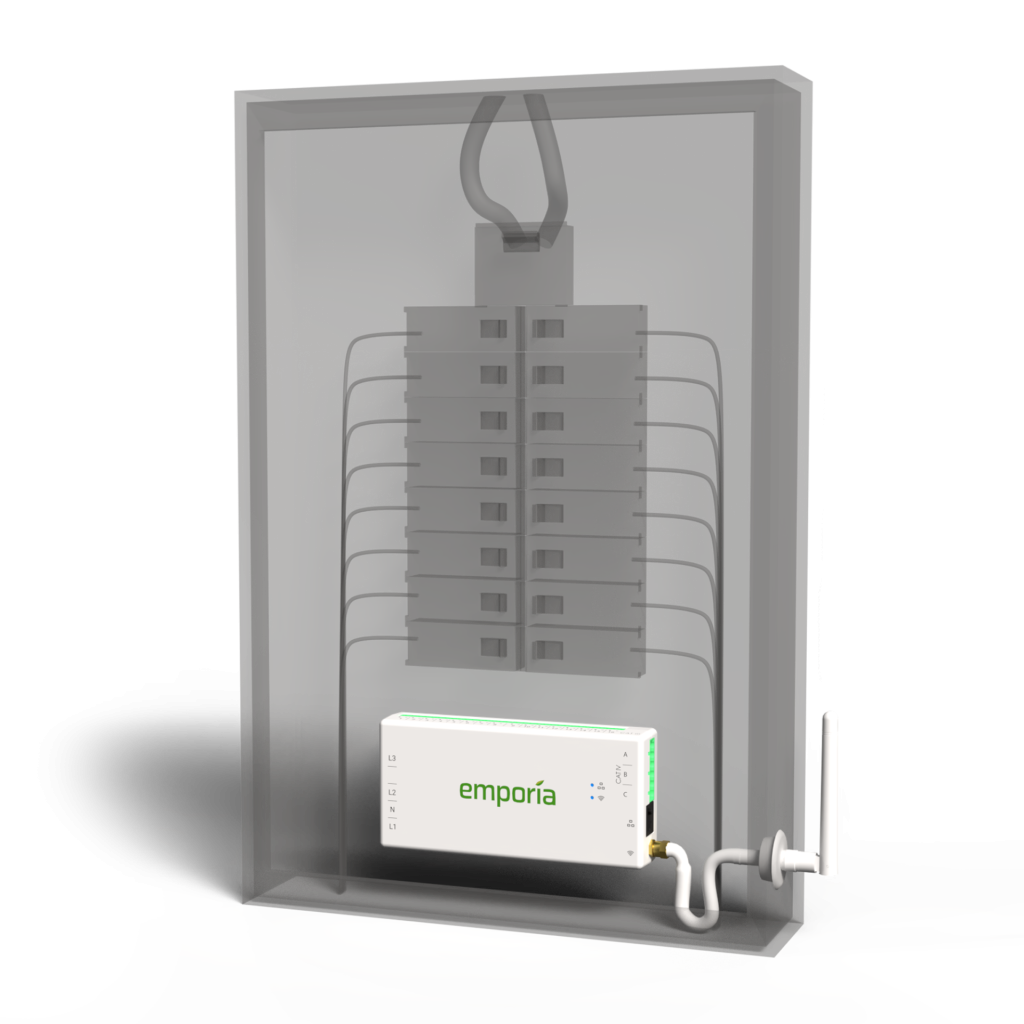
Emporia's Vue 3 installation guide shows this distinction clearly: the main CTs go on the incoming live mains, and those main CTs provide net metering out of the box. In other words, they are there to represent the whole-home position, not a single branch.
For many homes, that is the smartest first upgrade because it gives you the house-level truth that inverter-only monitoring does not provide.
When a circuit meter is enough
A circuit meter can be the right first move if the whole-home picture is already good enough, and the real decision is about one major load.
Typical examples:
- You already know your import and export pattern, but want to meter an EV charger separately.
- You want to verify whether a heat pump upgrade reduced operating cost compared with resistance heating.
- You want to see if electric hot water is consuming solar midday or reheating at night.
- You need to monitor a granny flat, workshop, pool circuit, or other sub-load independently.
This is the more surgical option. It does not give you the whole story, but it can answer a high-value local question very well.
When you really need both
You usually need both when the next action depends on understanding cause and effect.
Examples:
- You want to know whether EV charging is increasing total grid imports, or mostly soaking up solar that would otherwise be exported.
- You want to know whether a heat pump is large in absolute terms, or just looks large compared with a low-load day.
- You want to compare battery charging behavior against actual house demand.
- You want cleaner automation, such as pausing or shifting a load when export falls below a threshold.
This is also the point where data design matters. Home Assistant's energy documentation warns that when you monitor a circuit and also monitor devices beneath it, you need to model the relationship correctly to avoid double counting. Its upstream-device hierarchy exists for exactly this reason.
So the move from “one meter” to “more visibility” is not only about adding sensors. It is also about structuring the data so that totals and subloads still make sense together.
A practical way to choose
Before buying anything, answer these five questions:
1. What decision are you trying to make?
If the decision is about the whole home, imports, exports, or self-consumption, choose main metering first.
If the decision is about one expensive or hard-to-understand load, choose circuit metering first.
2. Do you already trust your whole-home numbers?
If not, do not skip straight to branch circuits. Without a reliable whole-home baseline, circuit data often creates more arguments than clarity.
3. Is your solar connected in a way that changes measurement strategy?
Main CT placement can differ depending on whether the solar is breaker-fed or connected via line-side tap. Emporia's official installation documentation calls this out because the measurement point changes what “whole-home” really means.
If your topology is not obvious, treat that as a reason to slow down and confirm the correct design before buying more sensors.
4. Are you planning future integrations?
If you want Home Assistant, local dashboards, or automation later, think about whether your first meter gives you an expansion path instead of a dead end.
5. Which loads would justify separate monitoring?
In most solar homes, the best circuit-level candidates are:
- EV charger
- heat pump or ducted HVAC
- electric hot-water system
- pool equipment
- subpanel feeding a distinct area or occupancy
If none of those matter yet, stay simpler and start with whole-home monitoring.
Common mistakes to avoid
Using a branch reading as if it were whole-home data
Emporia explicitly warns that if a sensor connected to the main ports is clamped around a branch circuit instead of the mains, the app will treat that branch reading as total usage and distort the balance calculations.
That is a good reminder that sensor location is not a detail. It defines what the data means.
Buying only circuit meters when the real problem is solar visibility
If you cannot already see import, export, and household consumption together, circuit data may be interesting but still fail to explain your solar economics.
Assuming the inverter app already covers household load
Inverter apps often show generation well, but not the full relationship between solar output, household demand, import, and export. That is the gap a main meter is usually there to fill.
Adding granular sensors without a data hierarchy
If your dashboard treats a parent circuit and its child devices as unrelated loads, you can end up double counting energy. Home Assistant's hierarchy model is a practical example of how to avoid that.
Recommended upgrade paths
Path 1: Inverter-only solar home
Start with a main meter.
This gives you the missing whole-home context first. After that, add circuit metering only for the loads that actually drive decisions.
Path 2: Solar home with one obvious heavy load
Start with a main meter if you still do not have reliable import/export visibility.
If you already do, add a circuit meter on the heavy load next.
Path 3: Advanced dashboard or automation user
Use a main meter for the house boundary and circuit metering for high-impact loads. Then make sure the data model reflects parent-child relationships correctly.
Final recommendation
For most solar homes, a main meter is the better first buy because it fixes the biggest blind spot: the lack of clear whole-home energy flow.
A circuit meter becomes the better next buy when you already know the house-level picture and need to isolate a major load.
If your goal is serious optimization rather than casual curiosity, the answer is usually not main meter or circuit meter forever. It is main meter first, then selective circuit monitoring where the extra detail will actually change what you do.
And if the electrical layout is not straightforward, especially in split-phase, three-phase, or line-side-tap solar setups, it is worth confirming the measurement design with a qualified electrician before you treat any planned CT location as final.