PVOutput still has a following in Australia for one simple reason: Australian solar households often outgrow the default inverter app faster than they expect.
At first, the vendor portal looks good enough. It tells you whether the solar system is alive, how much it generated today, and maybe whether the battery charged. Then the questions change. Are you exporting too much? Is the system weak compared with similar homes nearby? Is your retailer bill still high because your consumption pattern is wrong, not because the panels are underperforming? Can you keep the same monitoring workflow if your hardware changes later?
That is where PVOutput can still be worth using in 2026, especially in Australia.
The short answer
- Yes, PVOutput can still be worth using in Australia in 2026 if you want public benchmarking, cross-brand flexibility, or a second monitoring layer beyond the inverter app.
- It is less compelling if you only want the easiest mobile app and your current inverter platform already shows generation, consumption, imports, and exports clearly.
- It is not the best first choice for everyone. But for mixed systems, data-focused households, and comparison-minded solar owners, it still solves a real problem.
Why the Australia angle matters
Australia is one of the most natural markets for a service like PVOutput because rooftop solar is no longer a niche product here.
The Clean Energy Council's Rooftop solar and storage report, July to December 2025 says:
- rooftop solar PV had reached 28.3 GW of installed capacity in Australia,
- rooftop solar contributed 14.2% of electricity generated in Australia in the second half of 2025,
- 183,245 batteries were sold in Australia in the second half of 2025 alone,
- New South Wales had nearly 8 GW of installed rooftop PV,
- and Queensland had 1.16 million rooftop solar installations.
That scale changes what "good monitoring" means. Once a lot of homes have solar, the goal is no longer just checking whether your inverter is alive. The goal becomes understanding whether your system is performing properly relative to your tariff, your own usage pattern, and sometimes your broader region.
What the Australian Government says you should monitor
The Australian Government's solar guidance says monitoring should help you see:
- how much electricity your system is generating,
- when your battery is charging and discharging,
- whether the system is working correctly and whether faults appear,
- your electricity use,
- when electricity is best used,
- imports from the grid,
- and exports to the grid.
That matters because it creates a useful test for PVOutput.
If a platform helps you do those things more clearly than your current setup, it has value. If it adds complexity without improving those decisions, it does not.
Where PVOutput still helps Australian households
PVOutput is still useful in Australia when the real question is not just "how much solar did I make today?" but one of these:
- "Is my system weak, or has the weather just been bad across the region?"
- "Why is the bill still annoying even though generation looks healthy?"
- "Can I combine consumption and generation in one neutral service?"
- "Can I keep the same monitoring destination if I replace the inverter later?"
- "Can I use a script, uploader, gateway, or custom workflow instead of living inside one vendor portal?"
The official PVOutput overview still highlights the things that make it relevant here: automatic uploads, comparison with similar systems, live and historical graphing, open API access, and support for both generation and consumption data.
The public comparison angle is still the biggest differentiator
This is the part many modern inverter apps still do not do particularly well.
PVOutput was built around shared system data. That means the platform is not only about your roof. It is also about context.
On the public homepage, PVOutput currently shows:
- 77,910,438 outputs recorded,
- 2,864,926 panels,
- 1.61 TWh produced,
- 852.61 MW installed,
- $403.41M saved in electricity costs,
- 1,726,575 tonnes of carbon emissions saved.
That does not prove it is the best monitoring platform. It does show that it still has a large enough body of contributed data to make comparison meaningful.
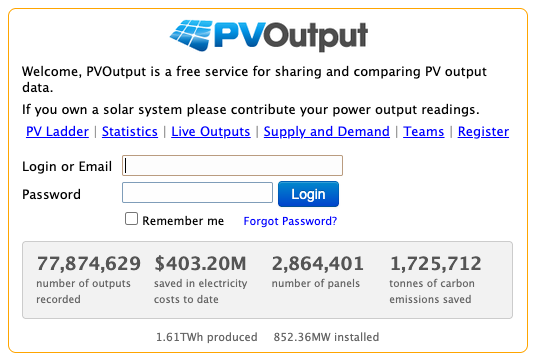
PVOutput's public homepage still reflects what makes it different: uploads, comparisons, and shared solar performance data rather than a closed one-brand app experience.
Australia is exactly the kind of market where that comparison can be useful
For Australian households, one of the more practical reasons to use PVOutput is that the platform exposes public supply-and-demand views by region.
That is helpful because Australia has large state-by-state differences in climate, system orientation, and seasonal performance. If your home in Queensland is producing poorly on a day when broader Queensland public data looks healthy, you know to inspect your own site rather than blaming the weather.
This is not a replacement for a meter or inverter app. It is a useful comparison layer.
PVOutput vs the Australian inverter app reality
| Question | Default inverter app | PVOutput | Why it matters in Australia |
|---|---|---|---|
| Is the system alive? | Usually yes | Yes | Both are fine here |
| Daily generation history | Usually yes | Yes | Both cover the basics |
| Whole-home consumption | Often limited unless extra metering is installed | Yes, if uploaded | Important for self-consumption and bill control |
| Imports and exports | Often partial or ecosystem-dependent | Yes, if data path is set up | Important where export value is falling and self-use matters more |
| Compare with other systems | Usually weak | Stronger | Helpful when diagnosing underperformance |
| Hardware independence | Usually weak | Stronger | Useful if the monitoring stack changes over time |
| Ease of setup | Usually easiest | Usually harder | The inverter app still wins on simplicity |
That table is the real answer for most Australians. PVOutput is not "better" in every sense. It is better at a specific kind of job.
Where it is still worth the extra effort
PVOutput is usually worth the effort in Australia if:
- you already have solar and want a second, more neutral reporting layer,
- your current app is poor at showing consumption and net flows,
- you care about benchmarking and comparison,
- you use mixed hardware,
- or you already have a data source such as a gateway, script, IoTaWatt, meter uploader, or custom integration.
Its service integration documentation is still broad enough to matter. The official integration service lists formats such as Tesla Powerwall, Growatt ShineNET, Enphase API / Envoy, Solar-Log, and Current Cost, while the contributed software ecosystem includes examples covering GoodWe, Sungrow, SAJ, IoTaWatt, Eastron SDM630, SMA, and Raspberry Pi based tools.
That mix lines up surprisingly well with the kinds of hardware Australian solar households actually end up discussing.
The main Australian watch-outs
There are also good reasons not to bother.
1. You may already have enough monitoring
If your inverter app already shows generation, home consumption, imports, exports, battery state, and useful history, PVOutput may not add enough value to justify another platform.
2. The setup path can still be fiddly
PVOutput is easier to appreciate once it is running than while you are trying to get the data path perfect. That matters for normal homeowners who do not want another small software project.
3. Some of the better limits sit behind donation mode
PVOutput's official donations documentation says donations of AUD 15 or greater for 1 year unlock feature bonuses such as:
- 300 API requests per hour instead of 60,
- 100 batch live uploads instead of 30,
- live backload up to 90 days instead of 14,
- extra live channels via v7 to v12,
- and support for up to 10 systems under one account.
That is not expensive, but it does mean the "free" experience is not the whole story if you want to use PVOutput more seriously.
Best fit in Australia
PVOutput is a strong fit for Australian homes that are:
- already solar-equipped,
- trying to understand self-consumption better,
- unhappy with shallow vendor monitoring,
- interested in comparison with other systems,
- or running mixed-vendor setups that do not fit neatly into one manufacturer's app.
It is a weaker fit for households that:
- want the cleanest app with the least setup effort,
- only care whether the solar system is generating,
- or would be better served by a local-first dashboard such as Home Assistant.
Bottom line
PVOutput is still worth using in Australia in 2026, but mostly for the households that already know what is missing from the default inverter app.
If you want easier onboarding and basic visibility, the vendor app is usually enough. If you want the deepest local control, Home Assistant is usually the better long-term path. But if you want a neutral cloud layer that can compare, log, and survive changes in hardware over time, PVOutput still earns its place.
That is why it remains relevant in Australia: not because it is the slickest monitoring platform, but because Australian solar households increasingly need something more flexible than a single-brand portal.
Read next
- PVOutput Review 2026: Better Than a Vendor Solar App for the Right Home
- Solar Monitoring System Australia: What Homeowners Should Buy in 2026
- Do You Need a Smart Meter for Solar Monitoring in Australia?