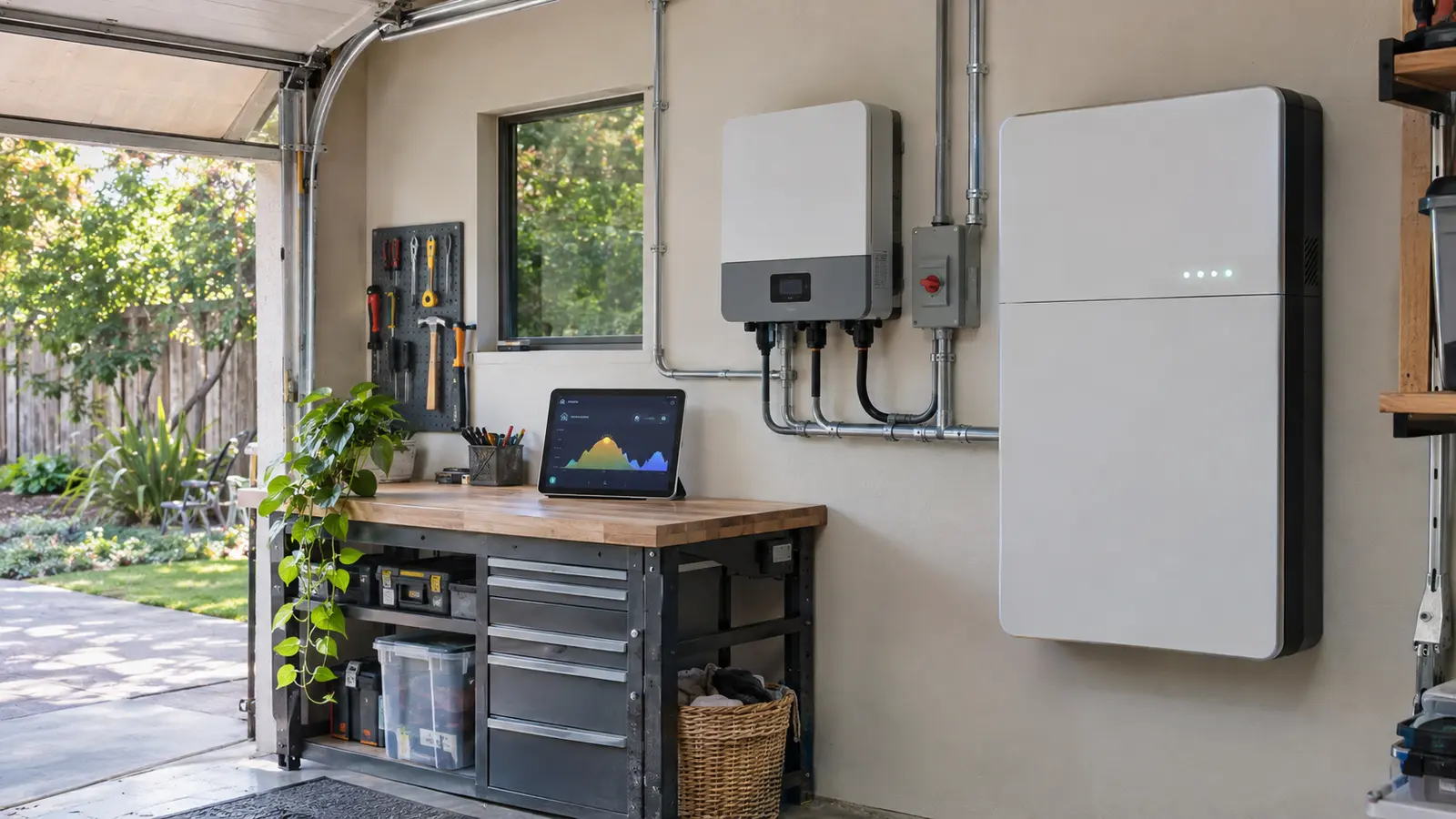
A home battery can be worth buying even when blackout backup is not your main goal, but only if it can create enough repeatable value from solar self-consumption, time-of-use arbitrage, demand reduction or a well-structured virtual power plant program.
The right question is not “Will I use the battery?” It is: How many kilowatt-hours can the battery shift into genuinely expensive periods, what is each shifted kilowatt-hour worth, and will those savings survive losses, degradation, tariff changes and financing costs?
For many homes, solar panels alone still deliver the faster payback. A battery becomes more compelling when midday exports are consistently high, evening imports are expensive, the tariff spread is wide, or an incentive materially lowers the installed cost. If those conditions are weak, a smaller system, flexible load control or simply waiting may be the better decision.
The short answer
A home battery is more likely to make financial sense without backup as the priority when most of the following are true:
- you regularly export surplus solar and buy electricity back later at a much higher price;
- your expensive grid use occurs after solar production falls;
- a time-of-use tariff creates a large and dependable price spread;
- the battery can cycle frequently without being oversized;
- the installed price is competitive after incentives;
- the warranty covers the way you intend to operate it;
- monitoring can verify charging source, discharge timing and avoided imports;
- you have already compared the battery with cheaper load-shifting options.
It is less likely to pay when exports are small, evening demand is low, import and export prices are close, the battery is much larger than the energy you can shift, or the quote relies on optimistic tariff and degradation assumptions.
The Australian Government's Solar Consumer Guide makes the same essential point: batteries can reduce bills through higher self-consumption, time-of-use operation, peak-demand reduction and VPP participation, but a battery may not repay its upfront cost within its useful life. That caution is useful in any market, even though tariffs and incentives differ by location.
Backup value and bill-saving value are different
Backup power is an insurance-style benefit. Its value depends on outage frequency, critical loads and the cost of interruption. Bill-saving value is an operational benefit that should be visible in interval data and tariff calculations.
A battery bought primarily for savings can often be configured with a low reserve, allowing more capacity to cycle each day. A battery bought for resilience may keep 20–50% in reserve, depending on the owner's risk tolerance and local conditions. That reserved energy improves outage readiness but reduces the capacity available for daily bill savings.
The hardware requirements may also differ. Some systems need extra gateway, isolation or backup-panel equipment to operate during a grid outage. If backup is not a priority, do not let a quote quietly include expensive backup hardware without showing its separate cost. Conversely, do not assume a standard grid-connected battery will power the home during an outage.
This article focuses on the financial and operational case. For outage design, see Home Battery Backup During a Blackout: What Actually Works.
Where a battery creates value
A battery does not generate energy. It moves energy from one time to another, with some loss. Its value therefore comes from the difference between the value of energy when charging and when discharging.
| Value stream | What the battery does | What must be true |
|---|---|---|
| Solar self-consumption | Stores midday surplus for evening or overnight loads | Regular surplus and later grid imports |
| Time-of-use arbitrage | Charges at a low price and discharges at a high price | A wide tariff spread and permission for grid charging |
| Demand-charge reduction | Limits short peaks in grid demand | The tariff includes a demand charge and control responds fast enough |
| Export-limit recovery | Stores generation that would otherwise be curtailed | Curtailment is frequent and measurable |
| VPP participation | Allows an operator to dispatch the battery for payments or tariff benefits | Contract terms, dispatch limits and warranty impacts are acceptable |
| Capacity deferral | Helps avoid or postpone a larger connection or demand increase | Site engineering and network rules support the strategy |
Residential systems commonly depend on the first two. Small commercial sites may also gain meaningful value from demand management, but only when the billed demand window and control strategy are understood.
The energy.gov.au battery guide notes that a battery is useful only when there is energy available to store. That sounds obvious, yet many weak proposals size the battery from annual solar generation rather than from the actual overlap between surplus production and later demand.
Start with interval data, not a battery brochure
Before requesting quotes, collect at least four weeks of 15-minute or 30-minute import and export data. A full year is better because solar production, heating, cooling and occupancy change by season.

Battery value depends on the daily overlap between charge opportunity and later demand, not on annual consumption alone.
For each day, estimate:
- Charge opportunity: solar exported or curtailed while the battery could charge.
- Discharge opportunity: grid imports during the period the battery is expected to serve.
- Shiftable energy: the smaller of the charge opportunity, discharge opportunity and usable battery capacity.
- Applicable price: the import price avoided during discharge, less the value sacrificed when charging.
- Cycle frequency: how often the pattern occurs across weekdays, weekends and seasons.
For a solar-charged battery, a simple daily estimate is:
Shiftable delivered energy = the minimum of usable battery output, evening/overnight imports and solar surplus after charging losses.
Do not size from the household's total daily consumption. A home that uses 24 kWh per day may have only 5 kWh of evening imports that a solar-charged battery can reliably replace. A 13.5 kWh battery would then cycle shallowly on many days unless future loads or grid charging create additional value.
If you need a practical method for finding cost-heavy periods, use How to Use Smart Meter Data to Find the Hours That Cost You Most.
Calculate the value of one shifted kilowatt-hour
The most useful battery calculation is the net value of one delivered kilowatt-hour.
For solar charging:
Net value per delivered kWh = avoided import price − (export price ÷ round-trip efficiency)
For grid charging:
Net value per delivered kWh = avoided peak price − (off-peak price ÷ round-trip efficiency)
This form accounts for the fact that more than 1 kWh must enter the battery to deliver 1 kWh later. Use the warranted or quoted system-level efficiency where available, not just a cell-level figure. Inverter conversion, standby consumption and auxiliary loads all matter.
NREL defines round-trip efficiency as useful energy output divided by useful energy input. Its storage modelling also treats degradation and replacement as real economic inputs rather than afterthoughts. For a purchase decision, the exact efficiency should come from the proposed system's datasheet and operating mode.
Worked example: storing exported solar
Assume:
- 8 kWh delivered from the battery on a useful day;
- 300 useful cycles per year;
- import price of $0.35/kWh during discharge;
- export credit of $0.08/kWh;
- 90% round-trip efficiency.
The value of each delivered kWh is:
$0.35 − ($0.08 ÷ 0.90) = about $0.261/kWh
Annual shifted energy is:
8 kWh × 300 = 2,400 kWh
Estimated first-year gross saving is:
2,400 × $0.261 = about $626
If the installed battery costs $12,000, a simple payback using only this value stream is over 19 years. That is before finance cost, degradation, maintenance, tariff changes or the time value of money. The system may still have non-financial value, but the savings-only case is weak.
Worked example: time-of-use charging
Assume:
- peak import price of $0.45/kWh;
- off-peak charging price of $0.15/kWh;
- 90% round-trip efficiency;
- 8 kWh delivered on 250 high-value days.
Value per delivered kWh is:
$0.45 − ($0.15 ÷ 0.90) = about $0.283/kWh
Annual gross saving is:
8 × 250 × $0.283 = about $566
A battery can combine solar charging and tariff arbitrage, but do not count the same discharged energy twice. Build the model hour by hour or use conservative separate energy buckets.
The six variables that decide the result
1. Installed cost
Use the total commissioned cost, including battery modules, compatible inverter or retrofit interface, switchboard work, metering, communications, permits, commissioning and tax. Separate optional backup equipment so the savings case is not distorted.
Subtract only incentives that you are confident the project qualifies for. If an incentive requires VPP participation or a specific tariff, include those obligations.
2. Usable energy, not nameplate energy
A 10 kWh nameplate battery may expose less usable energy because of state-of-charge limits and operating reserves. Ask for usable capacity at commissioning and the warranted capacity or energy throughput later in life.
Capacity determines how much energy can be shifted. Power, measured in kW, determines how many loads can be served at once. A battery may have enough energy for the evening but insufficient power to cover simultaneous cooking, heating and EV charging.
3. Actual cycles
A salesperson may model one full cycle every day. Real homes often deliver fewer equivalent full cycles because of cloudy weather, low summer evening demand, high winter demand with limited solar, holidays or reserve settings.
Calculate useful cycles from interval data. A half-cycle on two days is roughly one equivalent full cycle, but the economic value can differ if the discharge occurs under different tariff periods.
4. Tariff spread
The relevant spread is not simply peak minus off-peak. It must include efficiency loss, export income forgone, fixed fees, demand-charge rules and any tariff changes required to access a battery plan.
A high export credit reduces the value of storing solar. A low export credit and high evening import price improve it. Dynamic prices can create more opportunity, but they also add volatility and require reliable automation.
5. Degradation and warranty
Battery capacity declines with time and use. Review:
- warranty years;
- warranted usable capacity at the end of the term;
- cycle or energy-throughput limits;
- maximum charge and discharge power;
- temperature and installation requirements;
- grid-charging restrictions;
- VPP participation conditions;
- labour, transport and call-out coverage.
A ten-year warranty is not the same as a guarantee of ten years of identical savings. Model declining throughput, or at minimum reduce projected savings conservatively over time.
6. Control quality and metering
Value depends on the controller knowing when to charge and discharge. Poor CT placement, delayed data, incorrect tariff schedules or weak inverter integration can cause grid charging at the wrong time, unnecessary exports or discharge before the expensive period.
The monitoring system should separately show:
- solar production;
- site consumption;
- grid import and export;
- battery charge and discharge power;
- battery state of charge;
- tariff periods or price signals;
- daily and monthly energy totals.
See Best Way to Monitor a Home Battery, Solar, and Grid in One Place for architecture choices.
When a battery is a strong fit without backup
A battery deserves serious consideration when the data shows a repeatable energy-shifting job.
High midday exports and high evening imports
This is the classic solar-battery case. The strongest candidates export several kilowatt-hours most days and then import a similar amount after sunset. The battery is bridging a visible daily gap.
A large and stable time-of-use spread
Grid charging can create value even without solar, particularly where off-peak prices are low and evening prices are high. Confirm that the retailer allows battery grid charging and that the tariff will remain available long enough to support the investment case.
Demand charges or expensive short peaks
For small businesses and some homes, a few high-demand intervals can materially affect the bill. A battery with sufficient power and a properly configured controller can shave those peaks. This requires a tariff-specific simulation; energy capacity alone is not enough.
Frequent export curtailment
Where export limits regularly waste solar generation, the opportunity cost of charging can approach zero during curtailed periods. Measure how often curtailment occurs before assigning a value. The government guidance warns that curtailment savings are modest for many systems.
A credible incentive or VPP payment
An upfront rebate can change the economics immediately. A VPP may add ongoing value, but read the dispatch, reserve, exit, data access and warranty terms. More frequent cycling may increase revenue while accelerating throughput usage.
Planned electrification with known load growth
A future heat pump, electric water heater or EV can increase evening energy demand. Include future loads only when timing and usage are reasonably known. Do not buy excess capacity today based on vague possibilities.
When waiting is probably smarter
Delay or reject the battery if:
- the home exports little solar;
- evening imports are already low;
- flexible loads can be moved into solar hours more cheaply;
- import and export prices are close;
- the quote assumes 365 full cycles without evidence;
- the proposed battery is sized to total daily use rather than shiftable energy;
- the financing term extends beyond the likely economic life;
- the warranty excludes the intended tariff or VPP operation;
- the system cannot provide the monitoring needed to verify savings;
- a future inverter or switchboard change would make the current installation redundant.
Before buying storage, test lower-cost measures such as scheduling water heating, pool pumps, dishwashers, laundry or EV charging into solar or off-peak periods. Direct use avoids battery losses and usually needs less capital.
For the wider solar economics, read Is Solar Still Worth It When Feed-In Tariffs Are Low?.
Compare quotes on the same basis
A cheap battery quote can be poor value if it includes less usable energy, lower power, limited integration or weak warranty support. A more expensive system can still be poor value if it is oversized.

Normalize every quote to the same operating assumptions before comparing price or payback.
Ask each provider to state:
| Quote item | What to request |
|---|---|
| Total installed price | All hardware, electrical work, commissioning and taxes |
| Usable capacity | Initial usable kWh and reserve assumption |
| Continuous and peak power | Charge and discharge ratings at the proposed connection |
| System efficiency | AC-to-AC or relevant end-to-end efficiency |
| Warranty | Years, throughput, retained capacity and exclusions |
| Compatibility | Existing inverter, meter, EV charger, heat pump and energy platform |
| Control modes | Solar self-consumption, tariff scheduling, demand control and VPP |
| Monitoring | Import, export, solar, battery and downloadable interval data |
| Expected annual throughput | Based on your data, not a generic household |
| Savings model | Tariffs, escalation, degradation and replacement assumptions |
| Optional backup cost | Gateway, essential-loads board and installation separated |
| Service responsibility | Installer, manufacturer and remote-support roles |
Request the hourly or half-hourly simulation behind the sales estimate. A single annual savings number is not enough.
A practical decision rule
Use three tests.
Test 1: Energy fit
Can the battery charge and discharge useful energy on most days without being routinely empty before the high-price period or full while valuable solar is still available?
If not, change the capacity or control strategy.
Test 2: Financial fit
Calculate annual gross value from each independent value stream. Deduct maintenance, subscription fees and expected VPP costs. Then compare:
- simple payback;
- net present value at a reasonable discount rate;
- savings under lower tariff spreads;
- savings with degradation;
- savings with 20% fewer useful cycles.
A project that works only in the most optimistic case is not robust.
Test 3: Operational fit
Confirm the installation location, ambient temperature, communications, inverter compatibility, metering layout, software access, data ownership and service support. The best spreadsheet result is irrelevant if the system cannot be installed or controlled as modelled.
Verify the result after installation
Treat commissioning as the start of measurement, not the end of the project.
During the first month:
- confirm CT direction and phase mapping;
- compare inverter, battery and utility-meter totals;
- check that solar charges the battery before avoidable export;
- confirm discharge occurs during the intended high-price window;
- verify reserve settings;
- check that the battery is not charging from the grid unintentionally;
- compare actual shifted energy with the quote model;
- calculate the real value per discharged kWh.
After three months, review sunny, cloudy, weekday and weekend operation. After a full seasonal cycle, update the payback model with actual throughput and tariffs.
The energy.gov.au monitoring guide recommends tracking solar and battery self-consumption, grid imports and exports. Those are the minimum data streams required to prove that the battery is delivering the expected result.
Bottom line
A home battery does not need backup power to justify its existence. It can be a useful energy-management asset when it repeatedly moves low-value energy into high-value periods. But that result must be demonstrated with interval data, tariff-aware modelling and a correctly sized system.
The strongest savings-only case usually combines high solar exports, expensive evening imports, frequent useful cycling, a competitive installed price and transparent monitoring. The weakest case relies on annual averages, oversized capacity and an optimistic assumption that every stored kilowatt-hour is worth the full retail price.
Measure first, value each shifted kilowatt-hour, compare alternatives, and make the installer show the operating model. If the conservative case still works, the battery may be worth it even if the lights rarely go out.