
If you compare only the energy that reaches the pan, induction has a major efficiency advantage. ENERGY STAR says induction transfers about 85% of its heating energy into cookware, while gas transfers roughly one-third. That does not mean induction is automatically cheaper everywhere: the answer still depends on your electricity tariff, gas price, fixed gas connection charges, cookware, installation work, and how much you cook.
For many households, the practical answer is:
- Induction is usually the lower-energy option and is often cheaper when electricity is reasonably priced, rooftop solar can cover daytime cooking, or removing the cooktop allows the gas account to be closed.
- Gas can still have a lower marginal fuel cost where gas is inexpensive and the home will remain connected for heating or hot water anyway.
- The biggest saving may come from avoiding a gas connection charge, not from the small difference between individual meals.
This guide shows how to compare both options using your own bill rather than a generic national average.
Quick comparison
| Decision factor | Induction | Gas |
|---|---|---|
| Energy delivered to cookware | About 85% in ENERGY STAR guidance | About one-third in ENERGY STAR guidance |
| Typical response | Very fast, precise and responsive | Fast visual flame control |
| Running-cost driver | Electricity rate, time-of-use period and solar availability | Gas unit rate plus any daily or monthly connection charge |
| Kitchen heat | Less waste heat released around the pan | More heat escapes around the cookware |
| Ventilation | Still needed for steam, grease and cooking particles | Especially important because combustion adds pollutants |
| Cookware | Requires magnetic cookware | Works with most heat-safe cookware |
| Installation | Full-size units may need a dedicated high-capacity circuit | Requires a compliant gas connection and ventilation |
| Easy low-cost trial | Portable plug-in induction unit | Usually no equivalent low-cost conversion trial |
Why induction uses less energy for the same cooking job
An induction cooktop creates a changing magnetic field that heats compatible cookware directly. The glass surface warms mainly because the hot pan transfers heat back into it. A gas burner first creates a flame, then tries to move that heat into the cookware while a large share escapes around the sides and into the room.
ENERGY STAR's consumer guidance puts the approximate energy transfer at 85% for induction versus about 33% for gas. Treat those figures as useful comparison values, not a guarantee for every meal. Pan size, burner setting, lid use, cooking duration and test method all matter.
The efficiency gap is why comparing only the price of one kilowatt-hour of electricity with one kilowatt-hour of gas is misleading. You must compare the cost of delivering the same useful heat to the food.
The fair running-cost formula
Use the following method with the rates shown on your own bills.
Step 1: Put both tariffs into cost per kWh of input energy
Electricity is normally already billed per kWh.
Gas may be billed per kWh, therm, megajoule, cubic metre or cubic foot. Use the conversion factor printed by your utility where possible because gas heat content varies. For a rough U.S. conversion, the EIA notes that one therm is 100,000 Btu, or about 29.3 kWh of thermal energy.
If your gas price is stated per therm:
gas cost per kWh = price per therm / 29.3
If your bill uses megajoules:
gas cost per kWh = price per MJ x 3.6
Step 2: Adjust for heat-transfer efficiency
For one useful kWh delivered to the cookware:
induction input energy = 1 / 0.85 = about 1.18 kWh
gas input energy = 1 / 0.33 = about 3.03 kWh
Then calculate:
induction cost = electricity price per kWh x 1.18
gas marginal cost = gas price per kWh x 3.03
These are comparison estimates, not appliance ratings. They are most helpful for seeing whether your tariff difference is large enough to overcome induction's efficiency advantage.
Step 3: Add fixed gas charges when they are avoidable
If gas cooking is the only reason the property remains connected, add the annual gas account or network charge to the gas side. This can be much larger than the fuel used by the cooktop.
If gas will remain connected for water heating or space heating, do not assign the full fixed charge to cooking. In that case, compare the cooktops mainly on marginal energy cost, then consider whether a later all-electric upgrade could remove the charge.
A simple break-even rule
Using the 85% and 33% comparison efficiencies, induction has the lower marginal energy cost when:
electricity price per kWh < about 2.6 x gas price per kWh of fuel
For example, if gas costs 10 cents per kWh of thermal input, induction breaks even at roughly 26 cents per kWh of electricity. If electricity costs more than that, gas may be cheaper on marginal fuel alone. If solar supplies the electricity, use the value of the solar export you give up, not a retail electricity rate of zero.
This rule excludes fixed charges, installation, finance, maintenance, ventilation-related heating or cooling loads, and cookware replacement. It is a quick screen, not a complete ownership-cost model.
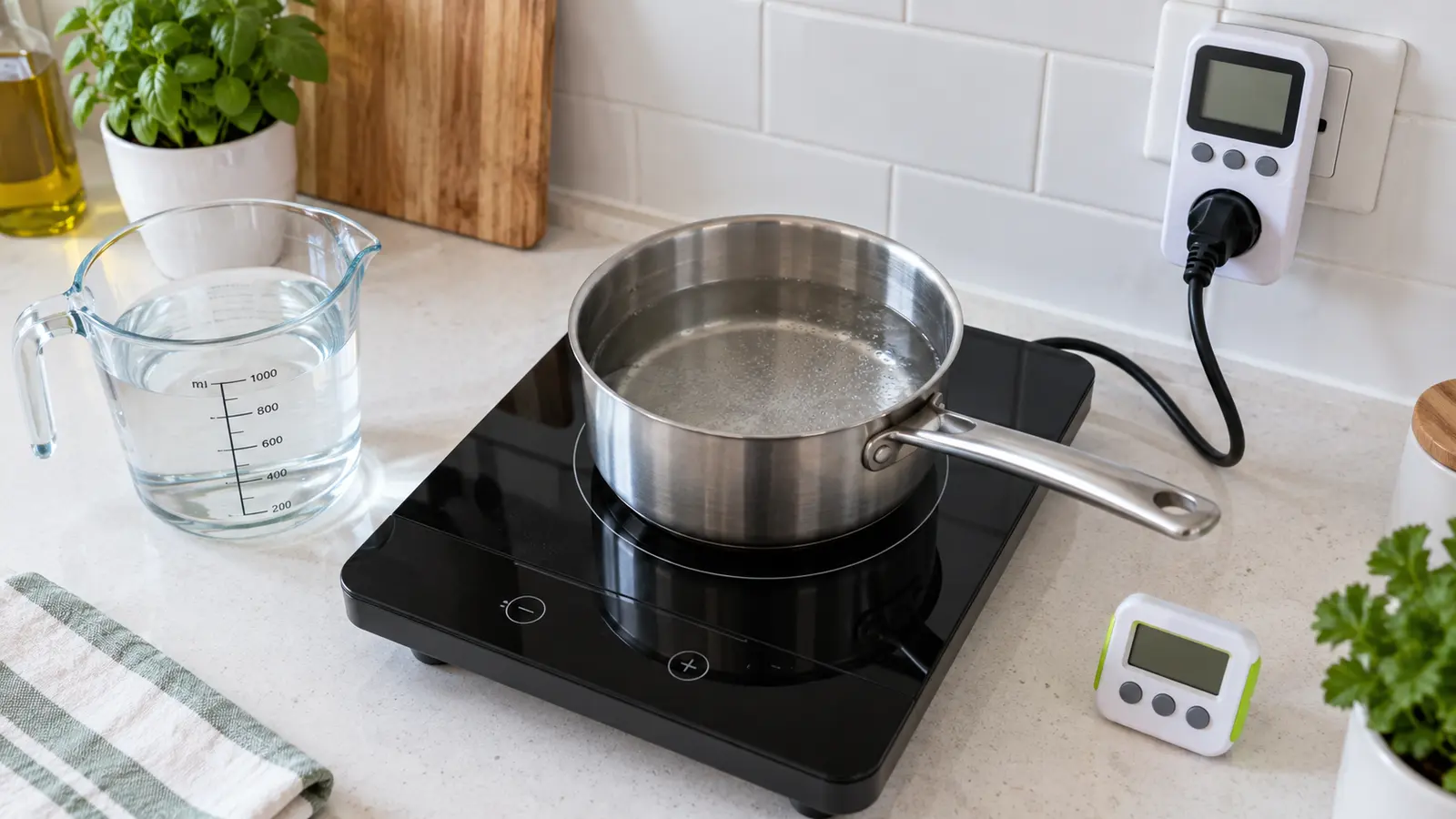
A repeatable water-heating test can reveal actual kWh use for a portable induction unit. Full-size hardwired cooktops require circuit-level monitoring by a qualified professional.
How to measure real cooking energy
Published efficiency figures are useful, but your cooking habits decide the bill. A household that cooks briefly once a day may see only modest annual savings; a large family or frequent batch cooker has more energy to shift.
For a portable induction unit, a rated plug-in energy meter can measure kWh directly, provided the meter is approved for the appliance's voltage and current. Run a repeatable task such as heating the same mass of water from the same starting temperature, with the same pan and lid.
For a built-in induction cooktop, use one of these approaches:
- Read a dedicated circuit meter if one is already installed.
- Use a panel energy monitor that can isolate the cooktop circuit.
- Compare whole-home interval data during a controlled cooking window when other large loads are off.
Do not put an improvised plug, adapter or consumer energy meter on a hardwired cooktop. Panel work and permanent submeters belong with a licensed electrician.
Gas cooking is harder to isolate because many utility meters report the combined use of cooking, hot water and heating. A controlled test can still help if the gas meter has sufficient resolution and all other gas appliances are off, but a short cooking event may be too small to read accurately.
For a broader monitoring workflow, see Is a Whole-Home Energy Monitor Worth It? and How to Use Smart Meter Data to Find the Hours That Cost You Most.
Solar and time-of-use tariffs can change the answer
Induction becomes more attractive when cooking can use low-cost electricity:
- Rooftop solar: lunch preparation, batch cooking and early dinner prep may overlap with solar production. The true cost is usually the export credit forgone, not zero.
- Time-of-use tariffs: pressure cooking, slow cooking or meal prep can be scheduled outside peak windows, although normal cooking times should not be distorted just to save a few cents.
- Home batteries: battery energy is not free. Include efficiency losses and the alternative value of using stored energy later in the evening.
An energy dashboard can confirm whether cooking is actually drawing from solar, the grid or a battery. The relevant measurement boundary is the whole home: cooktop data alone cannot show whether the electricity was locally generated.
Do not ignore installation cost
Running cost is only one part of the decision. Before buying a full-size induction cooktop, ask an electrician to confirm:
- cooktop voltage and maximum demand;
- dedicated circuit and breaker requirements;
- cable size and route;
- available switchboard or panel capacity;
- whether load management is relevant;
- local isolation, protection and electrical-code requirements.
A service or panel upgrade can overwhelm years of cooking-energy savings. Conversely, replacing a gas cooktop may involve capping or removing the gas connection, changing the benchtop cut-out, and verifying that the existing circuit is suitable.
A portable induction unit is a useful trial if you want to test speed, noise, controls and cookware before committing to a built-in model. It will not reproduce the power sharing, zone size or finish of a full-size cooktop, but it can answer whether induction fits the way you cook.
Cookware compatibility and practical performance
Induction needs cookware with a magnetic base. A refrigerator magnet that sticks firmly to the bottom is a quick first check, but it does not reveal how evenly a pan will heat. Thin or warped bases can perform poorly, and a pan that is too small may not be detected by a large zone.
Before budgeting for a complete cookware replacement:
- Test every pan with a magnet.
- Check the cooktop manufacturer's minimum pan diameter.
- Keep the pans that sit flat and respond reliably.
- Replace only the pieces that fail the test or cook unevenly.
Induction can boil water quickly and respond rapidly to setting changes. Gas remains familiar and visually intuitive for many cooks, and particular wok or open-flame techniques may influence the choice. Those preferences are real, but they should be separated from claims about energy efficiency.
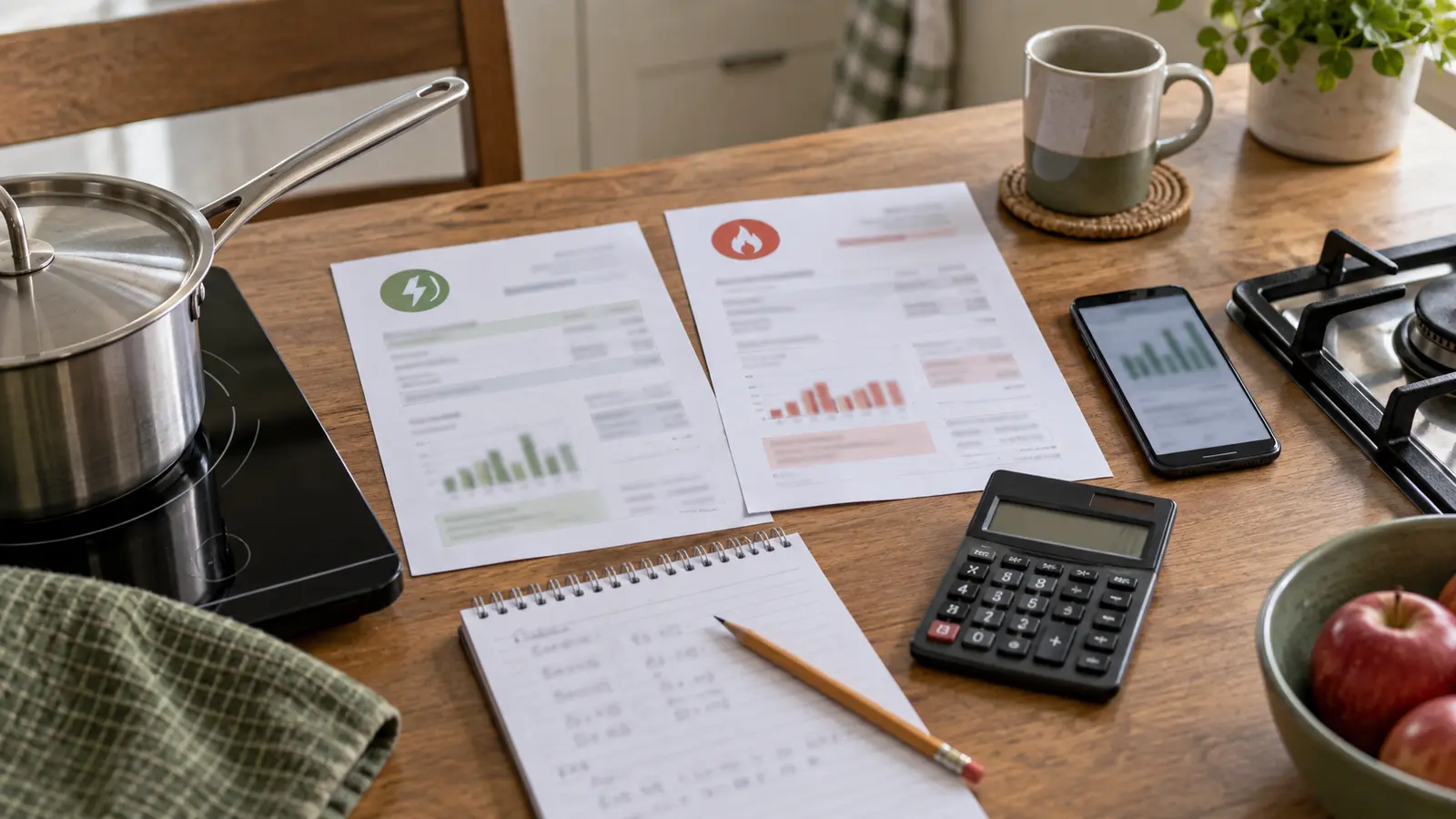
Use your actual variable rates, then decide whether any fixed gas connection charge belongs in the cooking comparison.
Indoor air and ventilation
All cooking produces moisture, grease and particles, so ventilation matters with either technology. Gas adds combustion products to the kitchen. ENERGY STAR notes that electric cooking avoids pollutants produced by burning gas or propane.
EPA cooking and indoor-air guidance recommends using a range hood that vents outdoors, cooking on back burners when practical to improve capture, and using an appropriate air filter where the home system supports one. A recirculating hood can help with grease but does not remove all combustion gases outdoors.
If you keep gas:
- use a correctly installed, externally vented range hood;
- run it during cooking and for a short period afterward;
- keep burners clean and have abnormal flames or odors investigated;
- follow local requirements for gas servicing and carbon-monoxide alarms.
Ventilation and alarms do not make a faulty appliance acceptable. If you smell gas or suspect incomplete combustion, stop using the appliance and follow your utility's emergency guidance.
Which cooktop is the better fit?
Induction is usually the stronger choice when
- you are already renovating or replacing the cooktop;
- the existing electrical service can support it without major work;
- cooking is the home's last gas use and disconnecting gas removes a fixed charge;
- rooftop solar or off-peak electricity can cover meaningful cooking time;
- fast heat response, easier cleaning and lower kitchen heat are priorities;
- you want cooking energy visible in an electricity monitoring system.
Gas may still make sense when
- the cooktop works well and replacement would be premature;
- gas will remain connected for other major loads;
- local gas is much cheaper per unit of delivered cooking heat;
- the electrical upgrade cost is high;
- your cooking style depends on equipment or techniques that your shortlisted induction model cannot support.
Buying checklist
Before choosing, collect these numbers:
- your electricity variable rate for the hours you usually cook;
- your gas variable rate converted to cost per kWh;
- daily or monthly gas connection charges;
- expected electrical and gas-disconnection work;
- compatible cookware you already own;
- expected years in the property;
- solar export rate and likely cooking overlap;
- warranty, controls, zone sizes, noise and service support.
Then compare annual ownership cost, not just burner efficiency:
annual cost = annual cooking energy + avoidable fixed charges + annualized installation and cookware costs
Bottom line
Induction uses substantially less input energy to put the same heat into cookware, but local tariffs decide whether that efficiency becomes a lower marginal bill. The strongest financial case appears when induction can use reasonably priced or self-generated electricity and replacing gas removes an avoidable connection charge.
If you already have working gas, will keep the gas account, and would need expensive electrical work, immediate replacement may not pay back quickly. Measure a representative week, calculate with your own rates, and make the upgrade when the energy, installation and household-fit numbers line up.