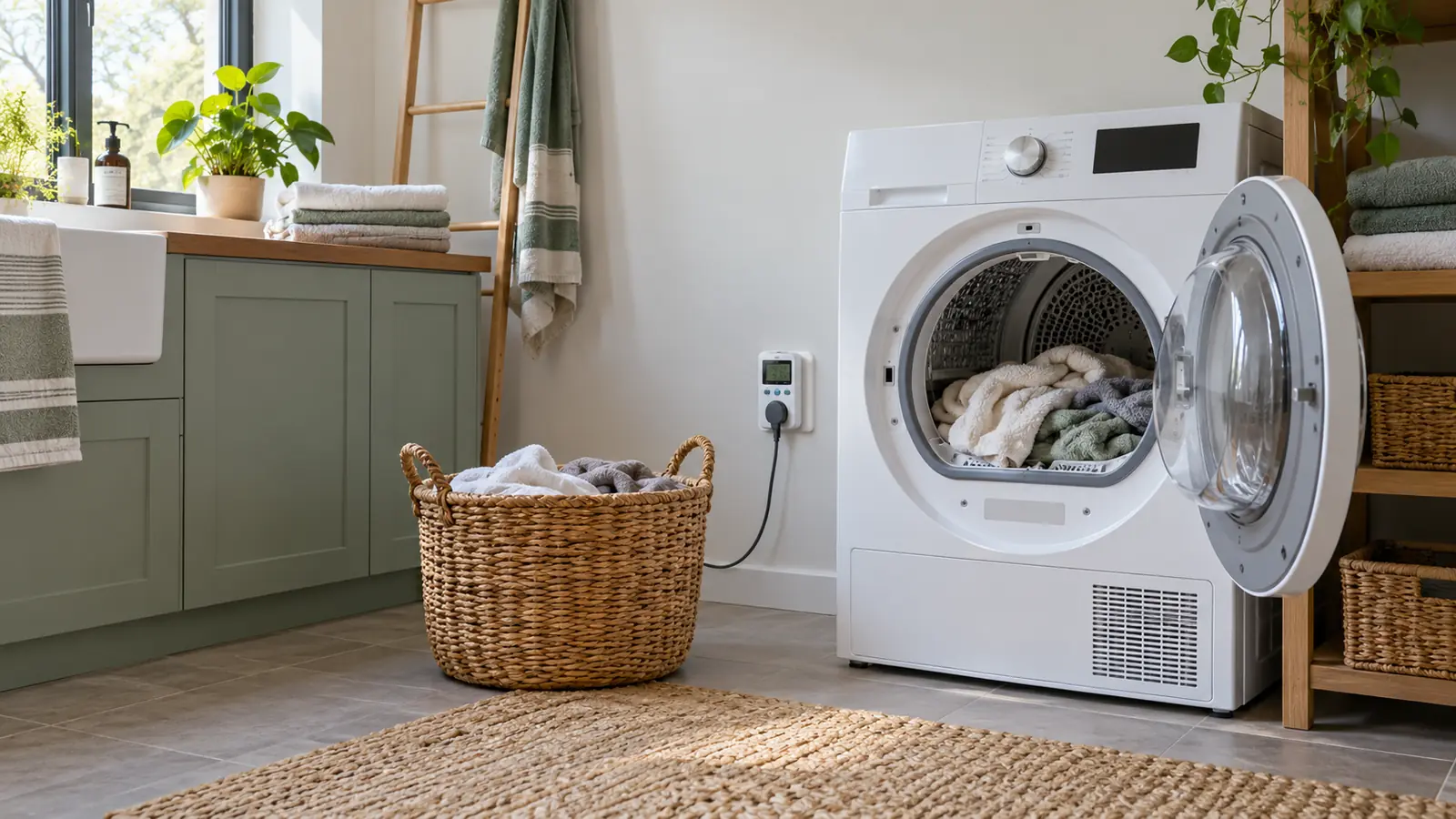
A heat-pump dryer usually costs less to run than a vented dryer because it recovers and reuses heat instead of continually heating new air and exhausting warm, moist air. The saving can be substantial for households that dry several loads each week, but the higher purchase price does not automatically pay back for an occasional user.
The right choice depends on five numbers: purchase-price difference, tested energy use, loads per year, electricity price, and expected ownership period. Installation space, moisture management, cycle time, fabric care, filter maintenance, and service support matter too. This guide shows how to compare those factors without relying on star ratings or headline claims alone.
The short answer
Choose a heat-pump dryer when you use a dryer regularly, electricity is expensive, the laundry has no practical external vent, lower-temperature fabric care matters, or you want to schedule drying around solar generation without using a large resistive load.
Choose a vented dryer when the purchase budget is tight, drying is genuinely occasional, a compliant external vent or very good room ventilation is available, and the energy saving would not recover the price premium during the period you expect to own the machine.
Before buying either type:
- Compare models with similar usable capacity and the same test program.
- Read the tested energy consumption, not the star count alone.
- Recalculate annual cost using your real loads per week and electricity tariff.
- Check drainage, ventilation, ambient-temperature and stacking requirements.
- Confirm filter-cleaning tasks and local service support.
- Measure complete drying cycles after installation if you want to verify the result.
Quick comparison
| Decision factor | Heat-pump dryer | Vented dryer |
|---|---|---|
| Heating method | Refrigeration circuit recovers and reuses heat | Electric resistance heater warms incoming air |
| Moisture path | Condenses water to a tank or drain | Exhausts warm, moist air to the room or outside |
| Typical purchase price | Higher | Lower |
| Energy per comparable load | Usually much lower | Usually higher |
| Drying temperature | Lower | Higher |
| Cycle duration | Can be longer, although modern models vary | Often shorter on high heat |
| External duct required | No, but condensate must be managed | Ideally yes; otherwise room humidity rises |
| Fabric treatment | Gentler temperatures can reduce overdrying risk | Higher heat can be harder on sensitive fabrics |
| Maintenance | Lint filters plus heat-exchanger or secondary-filter care | Lint filter and exhaust-path care |
| Best fit | Frequent users and long ownership periods | Light or backup use with low upfront budget |
This is a technology-level comparison. Individual models can perform very differently, so the label, data sheet, manual and warranty should decide the final shortlist.
How the two dryer types use energy
A vented electric dryer uses a resistance element to heat air. The warm air passes through the drum, absorbs moisture, and is then expelled. The next volume of incoming air must be heated again. If moist exhaust enters the laundry instead of a proper duct, the room may also need extra ventilation or dehumidification.
A heat-pump dryer works as a closed loop. Warm air passes through the clothes, an evaporator removes moisture, and a condenser reheats the air for another pass. ENERGY STAR describes the same principle and notes that heat-pump models do not need an external dryer vent. The Australian Government likewise describes heat-pump condenser dryers as capturing and reusing energy within the drying cycle.
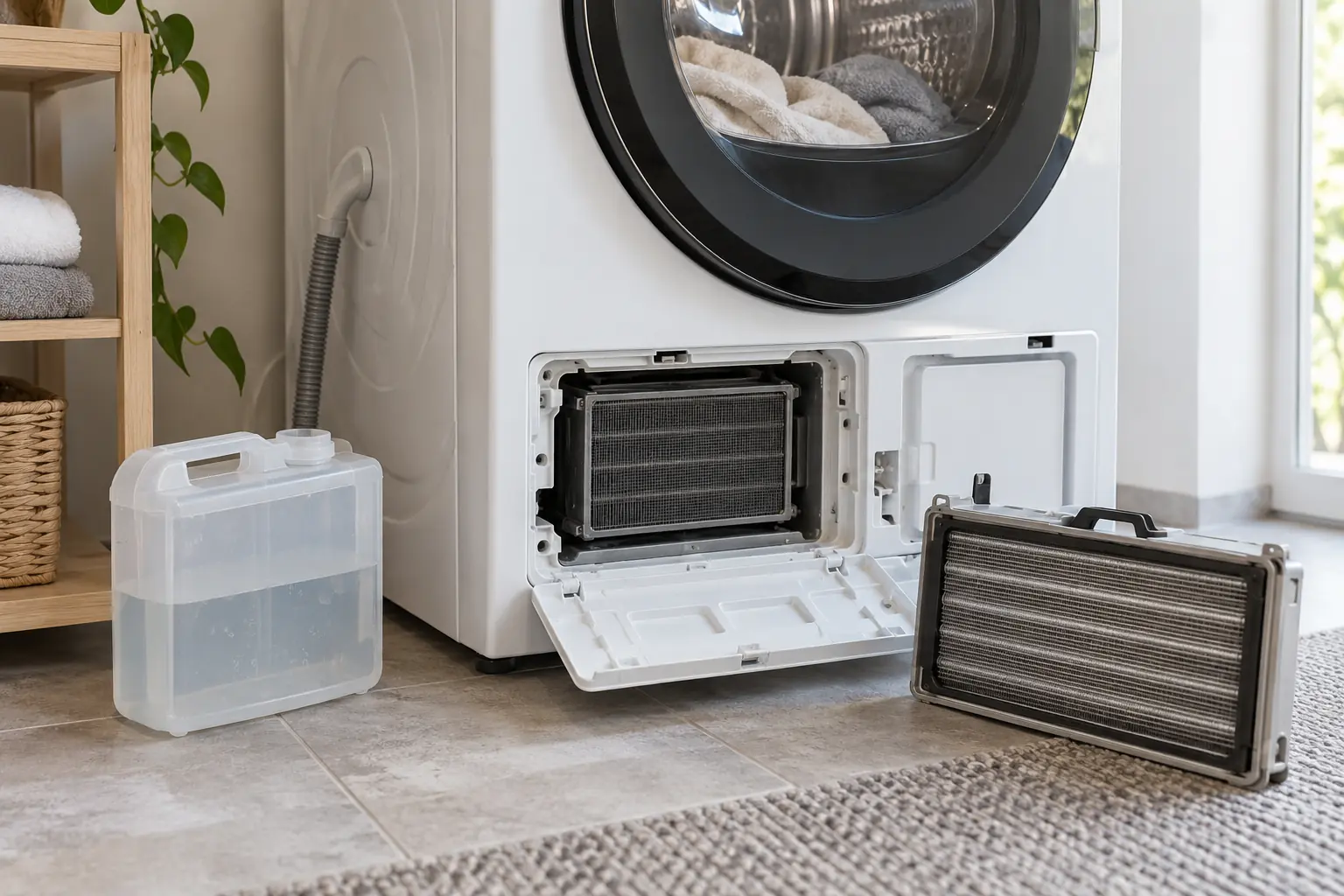
Heat-pump dryers keep air and heat within the appliance, while condensed water is collected in a tank or sent to a drain.
Official efficiency claims differ because programs use different baselines, qualification levels and test methods. ENERGY STAR says qualified heat-pump dryers can use at least 28% less energy than standard dryers, while its current laundry factsheet reports much larger savings for certified heat-pump models against conventional dryers. An Australian Government market report says heat-pump clothes dryers can use roughly 40% to 50% of the energy of conventional resistive dryers.
Treat those figures as context, not a quote for the machine in front of you. The reliable comparison is the tested kWh for two models of similar capacity under the same local label program.
Read the energy label correctly
Energy labels answer a standardized question. They do not predict every household perfectly.
In Australia, the Energy Rating Label shows efficiency and estimated energy consumption. Current guidance says to compare products of similar size and features. For clothes dryers, the annualized label calculation assumes one full load per week, or 52 uses per year. If your household dries four loads each week, the label's annual kWh is not your likely annual consumption; it is a comparison baseline that must be scaled.
Read the label in this order:
- Dryer type: vented, condenser or heat-pump condenser.
- Rated capacity: compare similar kilograms.
- Named test program and cycle time: especially on newer labels.
- Energy consumption: the standardized kWh figure.
- Star rating: useful after type, capacity and program are aligned.
- Other constraints: noise, dimensions, stacking kit and installation conditions.
A larger dryer can have more stars and still use more electricity per cycle than a smaller appliance. A high rating also does not fix chronic under-loading: repeatedly drying small loads in an oversized drum can weaken the household result.
Calculate your real running cost
Start by converting the label value to energy per standardized load:
kWh per test load = label kWh / 52
Then estimate annual energy from your actual use:
annual kWh = kWh per test load x loads per week x 52
Finally:
annual running cost = annual kWh x electricity price per kWh
Consider two hypothetical 8 kg models tested under the same program:
| Input | Heat-pump example | Vented example |
|---|---|---|
| Label energy for 52 uses | 120 kWh | 300 kWh |
| Energy per labelled load | 2.31 kWh | 5.77 kWh |
| Loads per week | 3 | 3 |
| Estimated annual energy | 360 kWh | 900 kWh |
| Cost at 0.30/kWh | 108 | 270 |
In this illustration, the heat-pump model saves 162 per year in the reader's local currency. If it costs 650 more to buy, the simple energy-only payback is about four years:
simple payback = price premium / annual energy-cost saving
Change every example input to match the shortlisted models, your tariff and your laundry pattern. Also consider financing, warranty, expected service life, repairability and any cost needed to create a compliant vent.
Usage frequency decides whether the premium pays
The same efficient dryer can be a strong investment for one household and poor value for another.
Frequent drying
A family running four to seven loads a week has many opportunities to recover the price premium. Energy per cycle, moisture sensing, washer spin performance, maintenance and tariff timing all become important. Heat-pump technology is usually easiest to justify here.
Moderate drying
At one to three loads a week, calculate rather than guess. A mid-priced heat-pump dryer may work well, but a premium model can take longer to repay. Compare the actual kWh gap, not a generic percentage.
Occasional or emergency drying
If the dryer is used only during prolonged rain or for a few bulky items, energy savings may never repay a large upfront difference. A low-cost vented dryer can be financially rational if moisture is exhausted safely and the appliance does not quietly become an everyday default.
Line drying remains the lowest-energy option where weather, space, accessibility and fabric requirements allow it. The best dryer is sometimes the one used less often.
Drying time and fabric care
Heat-pump dryers generally use lower air temperatures. This can be gentler on elastic, printed garments and other heat-sensitive fabrics, but cycles may feel slower than a high-heat vented program. Modern products vary, and ENERGY STAR reports that qualifying models can achieve cycle times comparable to conventional dryers within its program limits.
Do not compare only the shortest displayed program. Ask:
- Was the cycle tested at full rated capacity?
- Does the sensor stop accurately at cupboard dry?
- Are mixed loads consistently dry, or do heavy items need another run?
- Does the quick cycle accept only a small load?
- Can the household tolerate a longer efficient cycle?
- Does the washer's final spin leave excess water for the dryer to remove?
A fast washer spin can reduce dryer work. An extra ten minutes of spinning is often cheaper than asking any dryer to evaporate avoidable water.
Installation and moisture management
A heat-pump dryer is ventless, but it is not installation-free. Condensed water must go to a removable tank or suitable drain. The machine also needs specified clearances and an ambient environment within the limits in its manual. Some models can be stacked only with an approved kit.
A vented dryer needs a safe exhaust strategy. The Australian Government warns that vented dryers can release moisture into the laundry, raising humidity and causing condensation. An open window may help in some rooms, but a compliant duct to the outside is the more controlled solution where the manufacturer and local building rules permit it.
Check before ordering:
- appliance width, depth and door swing;
- delivery route and floor level;
- stacking compatibility;
- outlet voltage, circuit rating and plug access;
- drain location for a heat-pump model;
- duct diameter, length, bends and termination for a vented model;
- required room ventilation and ambient-temperature range;
- access for filter cleaning and service.
Installation cost belongs in the comparison. A cheap vented dryer plus a difficult external duct may cost more upfront than expected.
Maintenance affects measured efficiency
Every dryer moves lint. Restricted airflow increases drying time, weakens moisture removal and can create a safety or reliability problem.
Clean the primary lint filter at the frequency specified by the manufacturer. On a heat-pump model, follow the manual for secondary filters and heat-exchanger access; designs differ, and components that look washable may not be. Empty the condensate tank when required or verify that the drain hose remains clear.

Filter care is part of the energy calculation: poor airflow can turn a normal cycle into a long, inefficient one.
For a vented dryer, inspect the approved exhaust path for lint buildup, crushing and excessive bends. Do not run either dryer with filters removed, bypass safety devices, or improvise ducting. Persistent long cycles, unusual heat, error codes or a burning smell call for qualified service.
Maintenance is also a buying criterion. Before paying a premium, check how filters are reached, what the manual requires, whether the heat exchanger is user-serviceable, and whether parts and technicians are available locally.
Solar, time-of-use tariffs and peak demand
Running a dryer during a low-price period can reduce cost, but timing does not change how much energy the cycle consumes. Efficiency and scheduling solve different problems.
For a solar home, a heat-pump dryer usually has a lower and steadier electrical demand than a resistive vented dryer. That can make it easier to cover more of the cycle with surplus generation and avoid importing during brief cloud cover. The exact result depends on the dryer's power profile, solar output and other household loads.
On a time-of-use tariff, use the delay-start feature only when it is permitted by the appliance instructions and you are comfortable with unattended operation. Compare the avoided tariff cost with the convenience and safety implications. Our guide to the best time to run household appliances explains the scheduling logic in more detail.
Demand tariffs add another consideration: a resistive dryer running beside an oven, water heater or EV charger may contribute to a higher short-duration peak. A lower-power heat-pump cycle may reduce that coincidence, although the result must be checked against the tariff's demand window.
Measure kWh per cycle, not only instantaneous watts
A power reading at one moment cannot tell you which dryer costs less per load. Heat cycles on and off, drum motors change state, and sensor-controlled programs stop at different times. Measure the complete cycle.
For a cord-connected dryer, a plug-in electricity meter may be suitable only if it is correctly rated for the local voltage, plug, current, power and appliance load. Many ordinary smart plugs are not appropriate for high-power heating appliances. Follow the dryer and meter instructions, keep the outlet accessible, and use a qualified electrician for hardwired or circuit-level measurement.
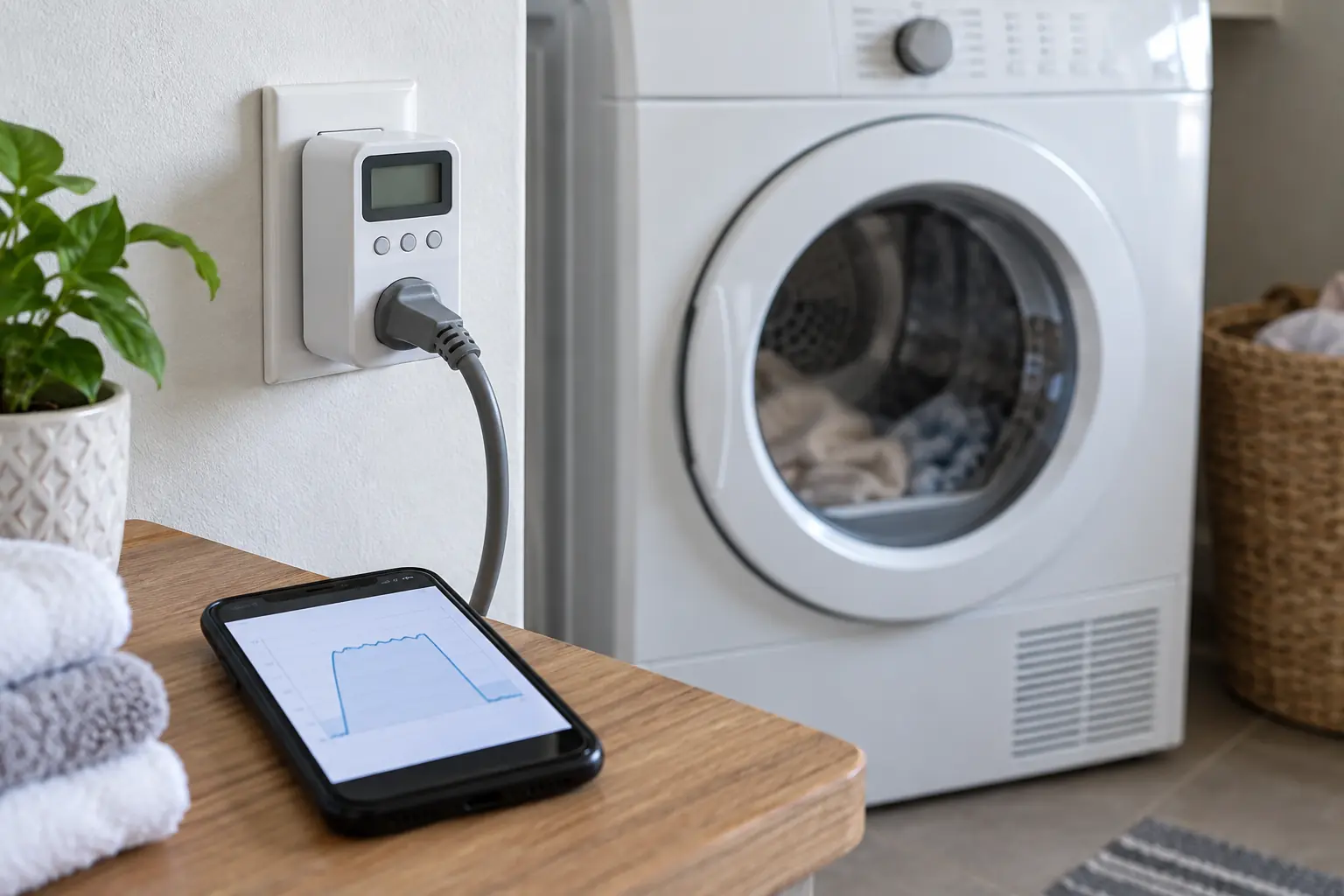
Record the complete cycle energy in kWh, load mass, program and starting moisture if you want comparisons to mean anything.
A useful test log includes:
| Field | Why record it |
|---|---|
| Dry load mass | Prevents a half-load from being compared with a full load |
| Washer spin speed | Changes how much water enters the dryer |
| Program and dryness target | Affects temperature and stop point |
| Cycle duration | Reveals performance drift |
| Cycle energy in kWh | Main operating-cost input |
| Indoor conditions | Cold or hot rooms can affect some designs |
| Filter status | Helps explain longer cycles |
| Final dryness | Energy is not comparable if one load remains damp |
Measure several representative loads. Towels, mixed clothing and bedding behave differently. A repeatable trend is more useful than one unusually easy cycle.
For permanent or shared-laundry monitoring, a properly installed circuit meter can track cycle energy and demand without relying on a portable adapter. See how to meter a heat pump or other large appliance separately for the design choices.
For landlords, laundries and facilities teams
In a multi-dwelling laundry, hospitality site, aged-care facility or other high-use setting, energy per cycle is only one part of the business case. Throughput, drum utilization, cleaning labour, downtime, moisture load, replacement parts and service response can outweigh a small efficiency difference.
Track:
- kWh per completed load;
- cycles per day and idle time;
- average cycle duration;
- repeat cycles caused by incomplete drying;
- peak electrical demand;
- room temperature and humidity;
- filter and service intervals;
- downtime and repair cost;
- linen or garment damage;
- cost per usable kilogram dried.
Submetering can show whether a projected saving survives real workflows. It can also reveal deteriorating airflow or longer cycles before users report a failure.
Buying checklist
Use this scorecard for every shortlisted model:
| Criterion | What to verify |
|---|---|
| Dryer type | Heat pump, conventional condenser or vented |
| Capacity | Appropriate for normal washer loads |
| Test energy | kWh under the same local label program |
| Test cycle time | Program, minutes and rated load |
| Your annual cost | Actual loads x kWh/load x tariff |
| Simple payback | Price premium divided by annual saving |
| Moisture management | Tank, drain or compliant external vent |
| Installation | Dimensions, clearances, stacking and ambient limits |
| Sensor drying | Available on the programs you will use |
| Maintenance | Filter and heat-exchanger tasks |
| Service | Warranty, parts and local support |
| Monitoring | Safe plug-level or circuit-level method |
Reject a model when the installation does not work, the service path is weak, or the premium depends on unrealistic usage. Efficiency is valuable only when the appliance fits the household and remains efficient in service.
Final verdict
For frequent dryer users, a well-sized heat-pump dryer is usually the stronger long-term choice. It reuses heat, avoids dumping moist exhaust into the laundry, operates at gentler temperatures, and can materially reduce kWh per load.
A vented dryer still makes sense for occasional use and tight budgets when moisture can be exhausted correctly. Its lower purchase price is real value if the machine will run so rarely that the heat-pump premium cannot be recovered.
Make the decision with comparable label data, your real load count and your electricity price. Then verify complete-cycle kWh after installation. That turns a broad technology claim into a result you can defend.
Sources
- Australian Government: Appliances and clothes dryer types
- Australian Energy Rating: Understand the Energy Rating Label
- Australian Energy Rating Calculator: Dryer information
- Australian Government: Research before you buy washers and dryers
- Australian Government: Heat pumps, emerging trends in the Australian market
- ENERGY STAR: Heat Pump Dryer
- ENERGY STAR: Certified Washers and Dryers factsheet