A branded DIN-rail energy meter is worth paying for when the installation must remain accurate, documented, serviceable, and easy to integrate for years. It is usually not worth the premium when you only need a rough live-power number for a hobby dashboard.
The ABB B23 312-100 and Carlo Gavazzi EM340DINAV23XS1X occupy a similar practical space: both are direct-connected, three-phase meters rated up to 65 A, both can measure imported and exported energy, and both are available with RS485 Modbus RTU. The important differences are not headline accuracy alone. They are panel width, tariff and I/O flexibility, display design, connection diagnostics, exact certification variant, documentation, and how well the meter fits the system around it.
This guide compares the two specific Modbus models rather than treating every B23 or EM340 suffix as interchangeable.
Quick verdict
Choose the ABB B23 312-100 when you want a four-module meter with two inputs, two outputs, up to four tariffs, a wide specified operating-temperature range, and a device that fits naturally into an ABB-standardized panel or multi-site specification.
Choose the Carlo Gavazzi EM340DINAV23XS1X when panel space matters, you want a three-module meter with a clear three-row display, flexible RS485 settings, two-tariff handling, and useful wrong-connection or current-direction diagnostics.
Do not select either meter by brand alone. Confirm the exact order code, voltage system, communication option, certification status, register map, and the electrical role the meter will perform.
| Decision point | ABB B23 312-100 | Carlo Gavazzi EM340DINAV23XS1X |
|---|---|---|
| Connection | Direct, three-phase | Direct, two- or three-phase |
| Maximum current | 65 A | 65 A |
| Nominal system | 3 x 230/400 V AC | 208-400 V L-L family range; product page lists multiple 2- and 3-phase systems |
| Width | 4 DIN modules | 3 DIN modules |
| Communication | RS485 Modbus RTU | RS485 Modbus RTU |
| Active-energy class | Class B / Class 1 | Class B / Class 1 |
| Import/export | Active and reactive energy | Consumption and generation; imported/exported kWh and kvarh |
| Tariffs | Up to 4 | 2 |
| Physical I/O | 2 inputs and 2 outputs on the compared Silver version | 1 digital input for tariff selection on the family; output depends on ordered variant |
| Display | 7-digit backlit LCD | Three-row, 8-digit backlit LCD with touch keys |
| Exact compared variant MID status | Verify the ordered variant and current regional documentation | The XS1X variant is not the MID-certified PF version |
| Best fit | Standardized panels, richer I/O and tariff logic | Space-sensitive panels, readable local diagnostics, straightforward Modbus submetering |
Why this comparison matters
Low-cost meters can report kWh accurately enough for informal monitoring. The difference becomes visible later, when someone must commission the device, map its Modbus registers, explain import and export totals, replace a gateway, audit a tenant allocation, or prove that the installed order code matches the project specification.
A better meter does not automatically create a better monitoring system. It does, however, reduce several sources of lifecycle friction:
- Clear product and protocol documentation
- Stable model and order-code identification
- Defined accuracy and environmental limits
- Better terminal, sealing, and display design
- Explicit import/export behavior
- Regional approvals and legal-metrology variants
- Predictable integration into PLC, BMS, SCADA, gateway, or home automation systems
- Manufacturer support and distributor continuity
Those qualities matter more in commercial submetering, solar import/export monitoring, EV charger allocation, heat-pump metering, tenant reporting, and long-lived building-management installations than they do in a temporary energy audit.
ABB B23 312-100 overview
The ABB B23 312-100 is the RS485 version of a direct-connected three-phase B-series meter. ABB's B23/B24 technical leaflet identifies it as a 65 A, four-DIN-module meter for 3 x 230/400 V AC systems. The Silver version measures active and reactive energy in all four quadrants, including import and export, and exposes electrical values such as active power, reactive power, apparent power, current, voltage, power factor, and frequency.
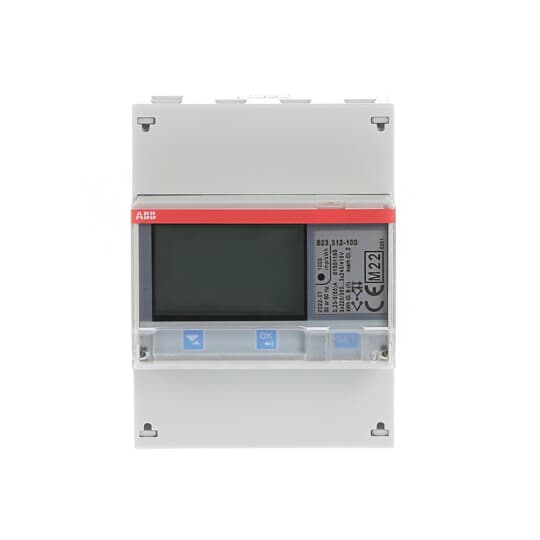
The B23 312-100 is the RS485 Modbus variant. ABB uses nearby order codes for no-communication and M-Bus versions, so the suffix matters.
The feature that most clearly separates this B23 configuration from simpler meters is its control and allocation flexibility. The referenced Silver model provides two inputs, two solid-state outputs, and up to four tariffs. Tariffs can be controlled through the physical inputs or serial communication, while outputs can be configured for energy pulses or alarms.
That makes the B23 useful where the meter is not merely feeding one dashboard. It can participate in tariff selection, pulse collection, alarm logic, and a broader panel standard. The wide documented operating range, from -40 C to +70 C in the referenced leaflet, can also matter in plant rooms, outdoor-rated enclosures, workshops, and other locations with more temperature variation than a conditioned home.
The tradeoffs are straightforward. It occupies four DIN modules, uses a more traditional seven-digit display, and its model family contains enough communication and certification variations that procurement must be order-code specific. A buyer asking only for "an ABB B23" may not receive the RS485 model or the approval combination expected by the design.
Carlo Gavazzi EM340 overview
The Carlo Gavazzi EM340DINAV23XS1X is a self-powered, direct-connected energy analyzer for systems up to 65 A. Its current official product page lists two-phase three-wire and three-phase three- or four-wire voltage systems, consumption and generation metering, and RS485 Modbus RTU.
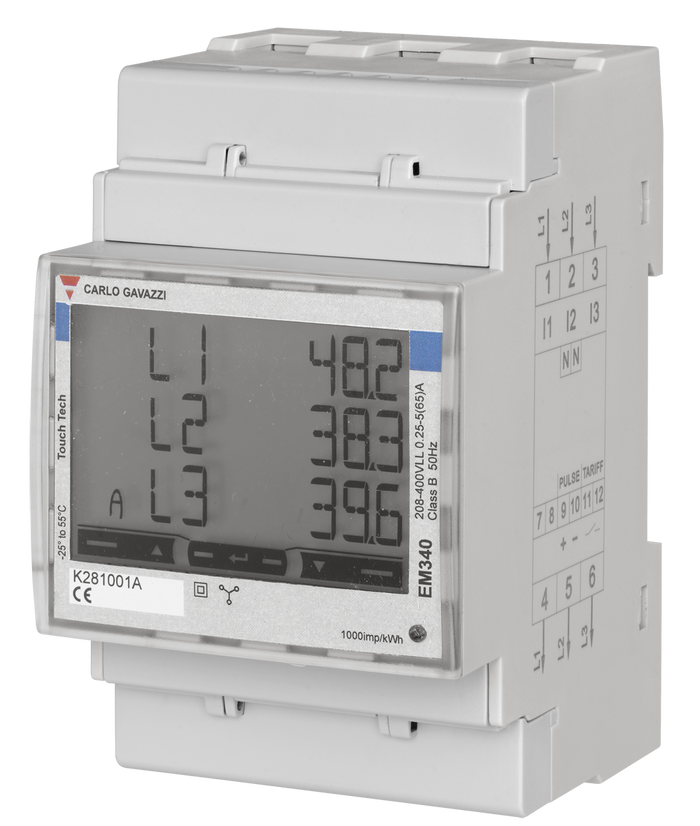
The EM340 uses a three-module housing and a three-row display, making it attractive where local readability and panel space both matter.
The EM340 family measures imported and exported active and reactive energy, per-phase energy, system power, phase power, voltage, current, frequency, power factor, and demand values. The RS485 implementation supports configurable baud rates from 9.6 to 115.2 kbaud, addresses from 1 to 247, and a one-second data refresh time according to the official datasheet.
It also includes practical commissioning aids. The datasheet describes phase-sequence, wrong-connection, and current-direction indications under defined load conditions. These do not replace electrical testing, but they can shorten the path from "the dashboard looks wrong" to a specific wiring or configuration check.
The three-DIN-module housing is one module narrower than the B23. That difference is modest on paper but valuable in retrofit switchboards where every module is already claimed.
The critical purchasing detail is certification. The exact EM340DINAV23XS1X model uses the X option and is not the MID-certified PF version. Carlo Gavazzi offers MID variants within the EM340 family, but a family-level statement about MID should never be used as proof that a specific ordered suffix is certified.
Measurement and accuracy: effectively a draw for most projects
Both compared meters use direct current measurement up to 65 A and specify Class B / Class 1 active-energy performance. Both also support reactive-energy measurement and bidirectional energy accounting.
That makes accuracy a weak reason to choose between them for ordinary submetering. The more important questions are:
- Is 65 A direct connection suitable for the circuit?
- Does the project need direct connection or a CT-operated meter?
- Must the reading be accepted for billing or legal metrology?
- Does the selected order code measure import and export in the required way?
- Will totals be interpreted per phase or as a net system value?
- Does the data consumer understand the register format and sign convention?
For a feeder above 65 A, or a site requiring current transformers for isolation, range, or installation practicality, neither direct-connected model is the right starting point. A CT-operated meter such as an ABB B24-class device or another appropriately specified analyzer may fit better.
Modbus integration: documentation matters more than the logo
Both meters can be read locally over RS485 Modbus RTU. Neither needs a vendor cloud for core measurement. That is valuable for energy-management systems where data ownership, predictable polling, and long-term platform independence matter.
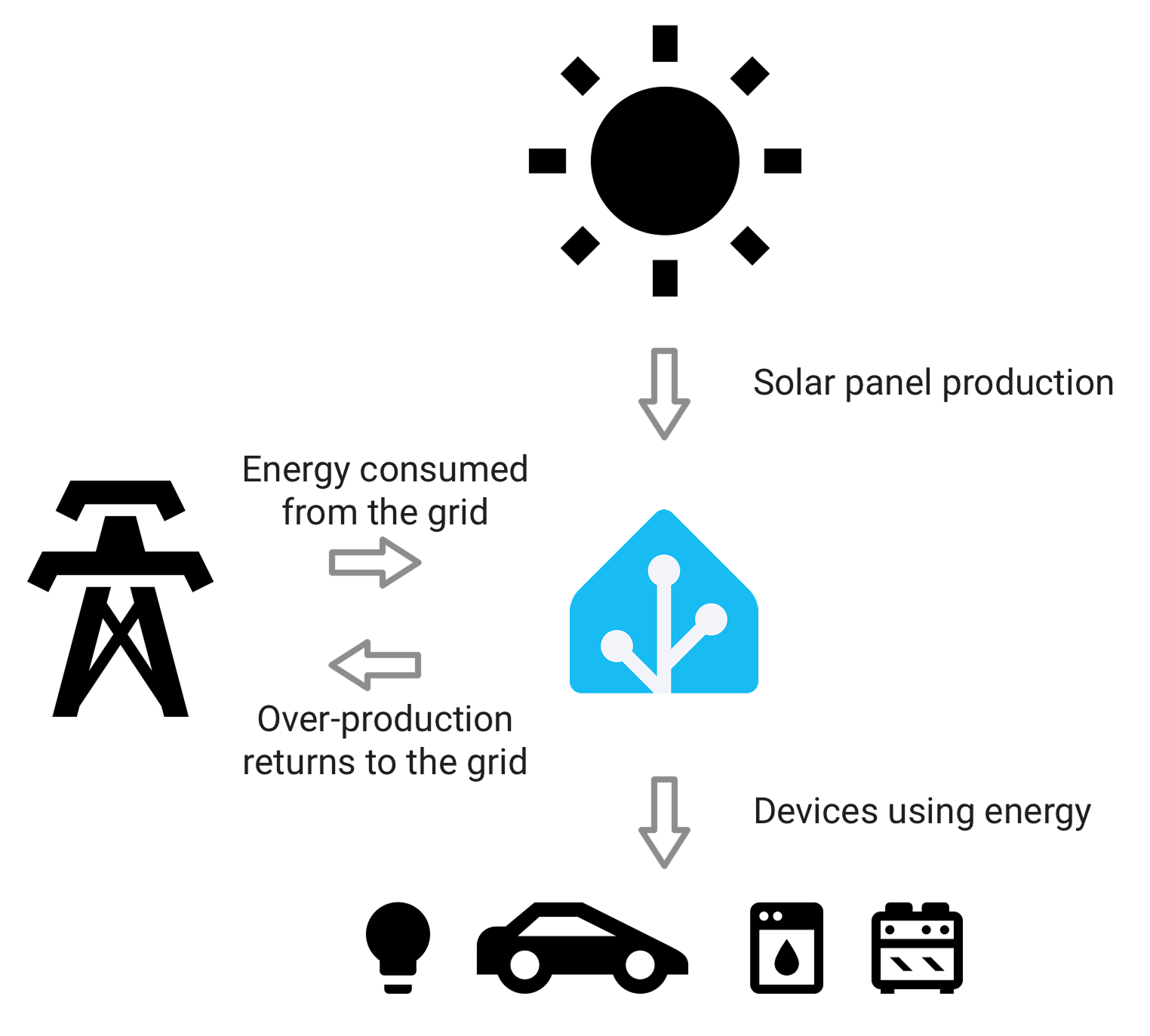
Modbus provides the transport. The dashboard still depends on correct register addresses, data types, scaling, byte order, units, and energy semantics.
Home Assistant's official Modbus integration supports serial RS485 connections as well as Modbus TCP through a suitable gateway. It requires the installer or integrator to define the registers exposed by the meter. The same principle applies to a PLC, BMS, SCADA platform, Node-RED flow, or custom data logger.
Before buying either meter for a connected project, obtain and review:
- The register map for the exact model and firmware
- Supported baud rates, parity, stop bits, and device address range
- Register data types and word order
- Import and export total definitions
- Per-phase versus system-total behavior
- Whether demand, reset, tariff, and alarm functions are readable or writable
- Polling limits and practical scan intervals
- The gateway mode if converting Modbus RTU to Modbus TCP
The EM340 datasheet is especially explicit about its serial speeds, address range, one-second refresh, and ability to read up to 50 words in one command. ABB also publishes Modbus documentation for its B-series meters, but integrators should match the protocol document to the installed generation and order code.
A strong brand cannot protect a project from a wrong register type. A dashboard can show a plausible but incorrect value if it reads half of a 32-bit number, swaps words, applies the wrong scale, or treats exported energy as imported energy.
Panel space, wiring, and serviceability
The EM340's three-module width is a clear advantage in a crowded retrofit panel. The B23 uses four modules but provides richer physical I/O in the compared Silver configuration.
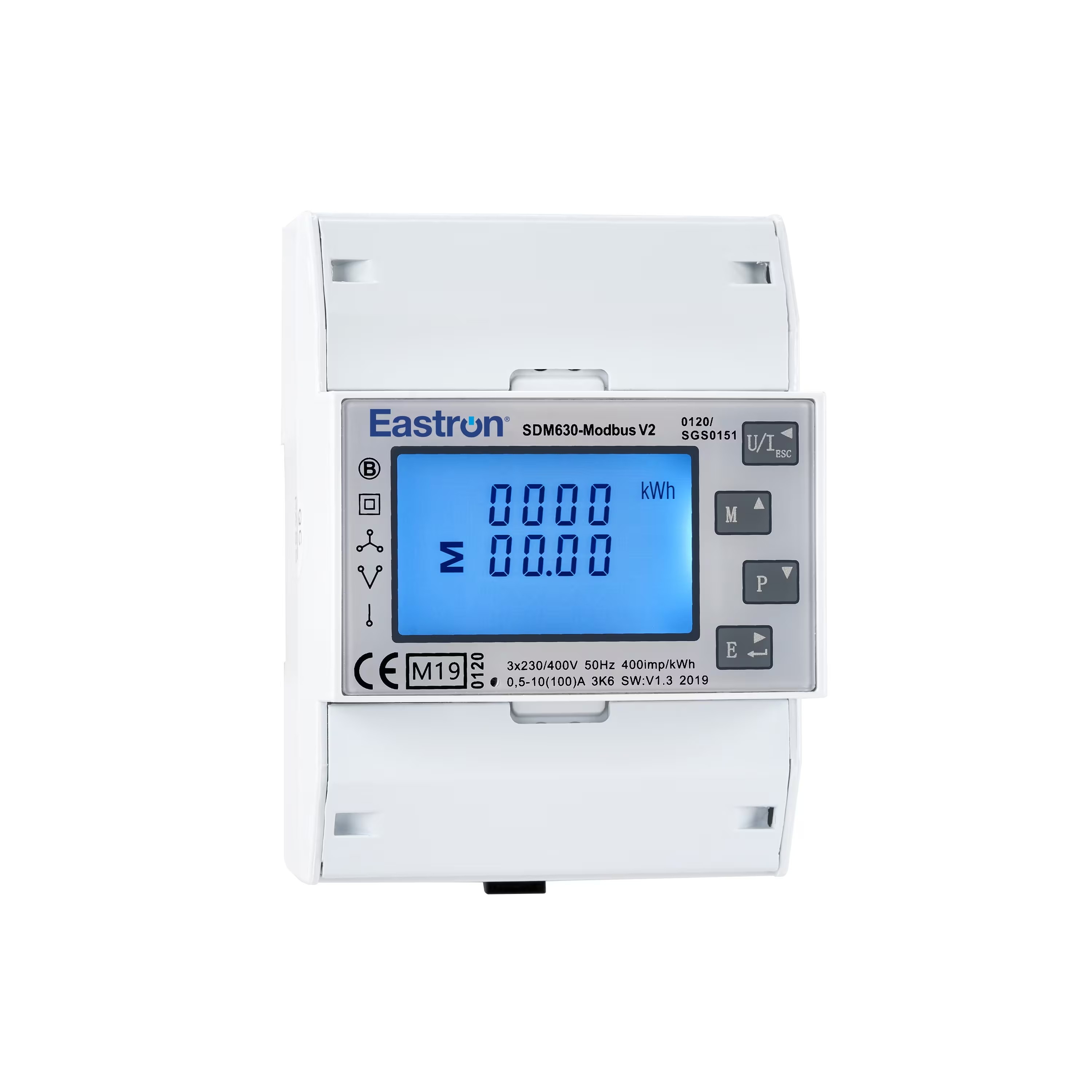
Module count is only one part of panel fit. Terminal access, conductor size, isolation, protective devices, sealing, heat, and communications wiring all need space.
Direct-connected meters place the measured conductor through the meter terminals. That can simplify the bill of materials, but it also means the installation must account for conductor size, tightening torque, protective coordination, isolation, enclosure temperature, and safe service access.
Use a qualified electrician or suitably licensed professional. Do not treat the DIN-rail form factor as permission for DIY work inside a live switchboard.
For a maintainable installation, document:
- Meter order code and serial number
- Circuit and measurement boundary
- Phase order
- Modbus address and serial settings
- Register-map revision
- Import/export sign convention
- Tariff-input logic
- Gateway IP address and mode
- Commissioning readings
- A photo of final wiring and labels
That record is often worth more than the small price difference between two meters.
Tariffs and I/O: ABB has the stronger feature set
The B23 312-100 supports up to four tariffs, two inputs, and two outputs in the referenced Silver specification. This gives it more flexibility for external tariff control, pulse forwarding, or alarm behavior.
The EM340 family supports two tariffs, with a digital input used to switch between them. Its communication or pulse capability depends on the ordered output code. The compared XS1X model is the RS485 version.
For a simple dashboard that calculates cost in software, neither meter needs elaborate physical tariff logic. Software can multiply interval energy by a tariff schedule. Hardware tariff registers become more useful when the site needs an auditable meter-side allocation, an external tariff signal, or continuity when the monitoring server is offline.
Similarly, pulse outputs are valuable when an existing BMS or logger accepts pulses but not Modbus. They are less important when the design already has a well-managed RS485 network and requires live power, voltage, current, and power factor in addition to cumulative energy.
Solar import/export and mixed-direction loads
Both meters can support bidirectional energy monitoring, but commissioning matters. A solar site may simultaneously import on one phase and export on another. The way a meter accumulates per-phase energy and calculates system totals can change how the dashboard interprets self-consumption.
The EM340 datasheet explicitly describes separate positive and negative totalizers and gives an example where positive phase energy is added to the positive total while negative phase energy is added to the negative total. The selected measurement mode and exact variant affect what is displayed and certified.
For ABB, the B23 Silver documentation describes full four-quadrant measurement of active and reactive import/export energy.
Before using either device for solar, battery, or EV analysis, test four conditions:
- Site importing with solar off
- Solar producing below household load
- Solar producing above household load
- A large known load switching on and off
Then compare the meter display, Modbus registers, inverter data, and utility meter direction. This catches reversed conductors, phase mapping errors, sign inversions, and incorrect dashboard arithmetic before months of misleading data accumulate.
For more on selecting and interpreting three-phase solar meters, see Chint DTSU666 vs Eastron SDM630 and When a Three-Phase Meter Is Worth It for a Solar Home.
When the branded-meter premium is worth it
Tenant, departmental, or cost allocation
When reports affect internal charging, tenant discussions, or department budgets, repeatability and traceability matter. A documented meter with a known order code, accuracy class, sealing provisions, and stable register map is easier to defend than an anonymous device with uncertain firmware.
Certification requirements vary by jurisdiction and application. MID availability does not automatically make every reading legally billable everywhere. Confirm the local rules and the exact certified variant.
Multi-site standardization
A facilities team maintaining dozens of panels benefits from consistent menus, register maps, spares, terminal practices, and documentation. The cost of retraining and troubleshooting can exceed the meter price quickly.
ABB may have an advantage where the wider panel specification already uses ABB components. Carlo Gavazzi may be attractive where its meters, analyzers, relays, or energy-management conventions are already standard.
Solar, battery, and EV energy management
These systems need trustworthy direction, phase, and cumulative-energy data. They also tend to outlive the first dashboard. Local Modbus access lets the meter feed a new gateway or platform without replacing the measurement hardware.
Harsh or variable environments
The B23 leaflet specifies a broad operating-temperature range. That can be meaningful in unconditioned electrical spaces. The entire enclosure, terminal, protective-device, and communications design still has to match the environment.
Projects that need commissioning support
Clear error indications, protocol documents, drawings, and accessible regional support reduce labor during commissioning. The EM340's wrong-connection and direction aids are particularly useful here, while ABB's broader I/O and tariff options may reduce the need for extra components.
When a cheaper meter is enough
A lower-cost meter can be reasonable when:
- The data is for informal visibility, not allocation or billing
- One circuit is being monitored temporarily
- The installer already knows the device and register map
- Failure would be inconvenient rather than operationally expensive
- Replacement access is easy
- No formal certification or environmental requirement applies
- The dashboard only needs a small set of basic values
Even then, insist on a real datasheet, a complete register map, defined accuracy, clear import/export behavior, and a traceable supplier. A cheap meter with poor documentation can become expensive the first time its data must be trusted.
Which meter should you choose?
Choose ABB B23 312-100 if your priority list includes four tariffs, two inputs and two outputs, a four-module ABB panel standard, a broad specified temperature range, or continuity across an ABB-oriented building portfolio.
Choose Carlo Gavazzi EM340DINAV23XS1X if you value a narrower three-module footprint, a dense three-row display, documented connection diagnostics, broad serial-speed options, and straightforward three-phase Modbus submetering.
Choose a different variant or device if you require:
- MID or another legal-metrology approval on the exact purchased order code
- CT operation above 65 A
- Native Ethernet, Wi-Fi, or MQTT
- A vendor-supported plug-and-play home automation integration
- Revenue billing accepted under local regulations
- Advanced power-quality functions beyond the scope of these energy meters
- Direct compatibility with a particular inverter, EV charger, or battery controller
Procurement checklist
Before issuing a purchase order, capture these items in writing:
- Exact manufacturer order code
- Direct-connected or CT-operated design
- Phase and voltage configuration
- Maximum current and conductor requirements
- Active and reactive accuracy class
- Import/export behavior
- Required certification and whether it applies to that exact suffix
- Modbus, M-Bus, or pulse-output requirement
- Register-map and protocol-document revision
- Tariff inputs and output logic
- DIN-module width and enclosure space
- Operating-temperature requirement
- Regional availability and replacement route
- Commissioning and acceptance-test method
This checklist prevents the most common failure in branded-meter procurement: buying the right family but the wrong variant.
Bottom line
The ABB B23 312-100 and Carlo Gavazzi EM340DINAV23XS1X are both credible choices for direct-connected three-phase Modbus metering up to 65 A. The ABB is the stronger fit for richer tariff and I/O requirements, portfolio standardization, and demanding panel specifications. The Carlo Gavazzi is especially compelling where module width, local display clarity, and commissioning diagnostics matter.
The premium is justified when the meter is part of an operating system rather than a gadget. If people will use its data to allocate cost, control loads, evaluate solar, manage EV charging, or maintain a building for years, documentation and serviceability deserve a line in the budget.