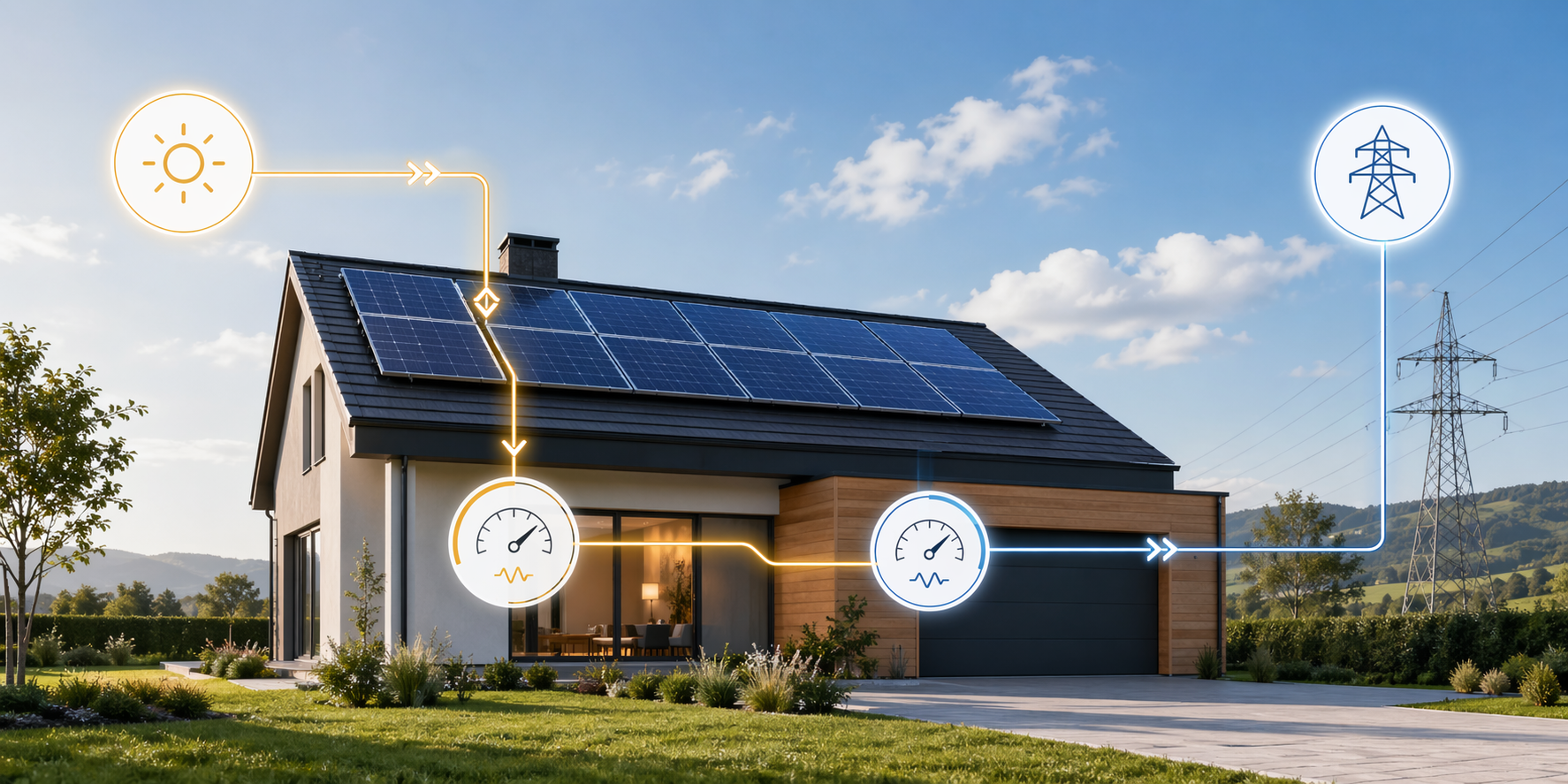
If your solar app says the system produced 28 kWh today but your utility meter or export graph only shows 11 kWh sent to the grid, that does not automatically mean something is wrong.
In most homes, solar production and solar export are supposed to be different.
Production is the total electricity your panels made. Export is only the leftover electricity that your home did not use and pushed out to the grid. The gap between the two numbers is usually your own household consumption during solar hours, plus sometimes battery charging, meter timing differences, or the way the system is wired.
The short version
Solar production= everything the panels generated.Solar export= only the surplus sent out to the grid.- The difference is usually
self-consumption. - A battery can widen the gap because some solar goes into storage instead of export.
- Monitoring systems and meters may also disagree slightly because they measure at different points and update on different schedules.
- It is only a real problem if the gap is unusually large and the explanation does not match how your system is set up.
What production and export actually mean
Homeowners often compare the wrong two numbers.
Your inverter usually reports production. That is the electricity coming from the solar array.
Your smart meter, retailer app, or grid-export graph usually reports export. That is the electricity that left the house and went to the network.
Those are not competing measurements. They are different parts of the same energy flow.
A simple way to think about it is this:
solar production = self-consumption + battery charging + export
If you do not have a battery, then the picture is usually:
solar production = self-consumption + export
That is why production is often the bigger number.
A quick example
Imagine your system makes 20 kWh between sunrise and sunset.
During that same time:
- your fridge, air conditioner, router, pool pump, and other daytime loads use 8 kWh,
- your hot water system uses 3 kWh,
- and the remaining 9 kWh goes out to the grid.
In that case:
- production = 20 kWh
- export = 9 kWh
- daytime self-consumption = 11 kWh
Nothing is wrong. Your home simply used a large part of the solar before the leftover energy reached the grid.
The most common reason: your home used the solar first
This is the normal answer in most households.
Solar power is used by live household loads before anything is exported. If the dishwasher is running, the EV is charging, the hot water system is on, or the air conditioner is working through the middle of the day, those loads can absorb a surprisingly large share of production.
This is especially common in homes with:
- electric hot water,
- pool pumps,
- ducted cooling,
- daytime EV charging,
- home offices,
- or simply a lot of background load.
Many people underestimate how much power is being used while the sun is up because the grid import may be near zero, which makes the house feel "cheap to run" at that moment. But low grid import does not mean the house is not consuming energy. It often means solar is quietly covering it.
If you want a cleaner explanation of why app numbers and billed numbers diverge more broadly, see Why Your Inverter App Does Not Match Your Power Bill in 2026.
Batteries make the gap larger
If you have a battery, part of the solar may go into storage instead of leaving the property.
That means a home can produce a lot of solar, export only a small amount, and still be behaving exactly as designed.
A common midday flow looks like this:
- solar runs the house,
- extra solar charges the battery,
- only the remaining surplus is exported.
So if you compare inverter production against grid export alone, the gap can look bigger than expected.
The bigger your battery charging window, the bigger that gap may be.
Meters and apps may measure at different points
Another common source of confusion is measurement location.
Different devices may be looking at different parts of the system:
- the inverter may measure solar generation at the inverter output,
- a smart meter measures net grid import and export at the connection point,
- a clamp meter may measure only one circuit or one direction,
- and a battery system may report its own charging or discharging separately.
So two dashboards can both be "right" while still showing different numbers.
This gets more confusing when the site has:
- a hybrid inverter,
- an AC-coupled battery,
- multiple inverters,
- separate sub-meters,
- or CT clamps placed on only part of the system.
That is one reason homeowners often need a better mental model of what each device is measuring, not just a better app.
Timing differences also matter
Even when the hardware is correct, numbers may not line up perfectly because of timing.
For example:
- your inverter app may update every few seconds or every 5 minutes,
- your utility smart meter may record interval data every 15 or 30 minutes,
- your retailer portal may delay updates by a day or more,
- and cloud dashboards may round totals differently.
That means daily totals may be close but not identical. Small differences are normal.
A mismatch becomes more suspicious when it is large and persistent, not when it is just a little untidy.
When the gap is probably normal
In most homes, the mismatch is not a fault if one or more of these are true:
- you use a fair amount of energy during the middle of the day,
- you have a battery that charges from solar,
- the system is measuring at different points,
- the numbers come from different apps or different update windows,
- or the gap changes logically with household behavior.
For example, if exports are low on air-conditioning days but higher on mild-weather days, that is usually a sign the system is behaving normally.
When the gap may point to a real problem
There are cases where the numbers deserve a closer look.
Pay more attention if:
- production looks healthy but export is near zero even on mild-load days,
- your battery appears full yet exports are still strangely low,
- household daytime loads are modest but the self-consumption implied by the data is unrealistically high,
- one app shows frequent clipping, zeroing, or flat spots,
- or the mismatch suddenly changed after electrical work, inverter replacement, meter work, or CT clamp changes.
That can point to issues such as:
- CT clamps installed in the wrong place or facing the wrong way,
- a meter configured for the wrong phase arrangement,
- a monitoring input mapped incorrectly,
- export limiting being active when it should not be,
- or one system reporting generation while another is really showing net flow.
6 checks to do before assuming anything is broken
1. Check whether the house was actually busy during solar hours
Look at daytime loads first.
Hot water, heating, cooling, EV charging, ovens, and pool pumps can explain a lot. If the house was working hard in the middle of the day, low export may be perfectly normal.
2. Check whether a battery was charging
If your battery state of charge climbed quickly during the same period, part of the missing solar likely went there.
3. Compare the same date range and same time window
Do not compare today's inverter production against yesterday's retailer export summary, or a live app view against a delayed utility portal.
4. Confirm which device is measuring what
Read the labels carefully. Some dashboards show generation, some show grid flow, some show home load, and some mix them into a single card layout that is easy to misread.
5. Look for changes after installer work or monitoring updates
If the mismatch only began after a meter replacement, battery install, inverter change, or CT clamp adjustment, configuration is a stronger suspect.
6. Check whether the result makes real-world sense
If your home supposedly self-consumed 18 kWh during a quiet workday with nobody home, that deserves scrutiny. If it self-consumed 18 kWh while EV charging, cooling, and heating water, that may be entirely reasonable.
What not to do
A lot of unnecessary stress comes from comparing one big solar number against one big export number and assuming they should match exactly.
They usually should not.
Also avoid:
- blaming the inverter immediately,
- assuming the utility meter is wrong without evidence,
- using one screenshot from one app as proof of a fault,
- or forgetting that your own house loads sit in the middle of the energy flow.
If you want better visibility, measure the right thing
If you still cannot explain the gap, the next step is better monitoring rather than guesswork.
A proper whole-home or import/export-aware meter can show whether the missing solar is being:
- used in the house,
- stored in the battery,
- exported to the grid,
- or misreported by the monitoring stack.
That is also where a smart meter or better interval data can genuinely help. If you want to understand how monitoring can improve decisions rather than just add another chart, see Can a Smart Meter Actually Lower Your Bill in 2026? What It Can and Cannot Do and How to Read Smart Meter Interval Data Before You Buy Solar or a Battery in Australia (2026).
Bottom line
Solar production and solar export do not need to match.
In a healthy system, production is usually the bigger number because your home uses some of the solar first, and a battery may absorb even more before anything reaches the grid.
The real question is not "why are these numbers different?" It is "does the difference make sense for how my house and monitoring setup actually work?"
If the answer is yes, the system is probably fine.
If the answer is no, start by checking daytime loads, battery charging, meter position, CT clamp setup, and time-window mismatches before assuming a hardware fault.