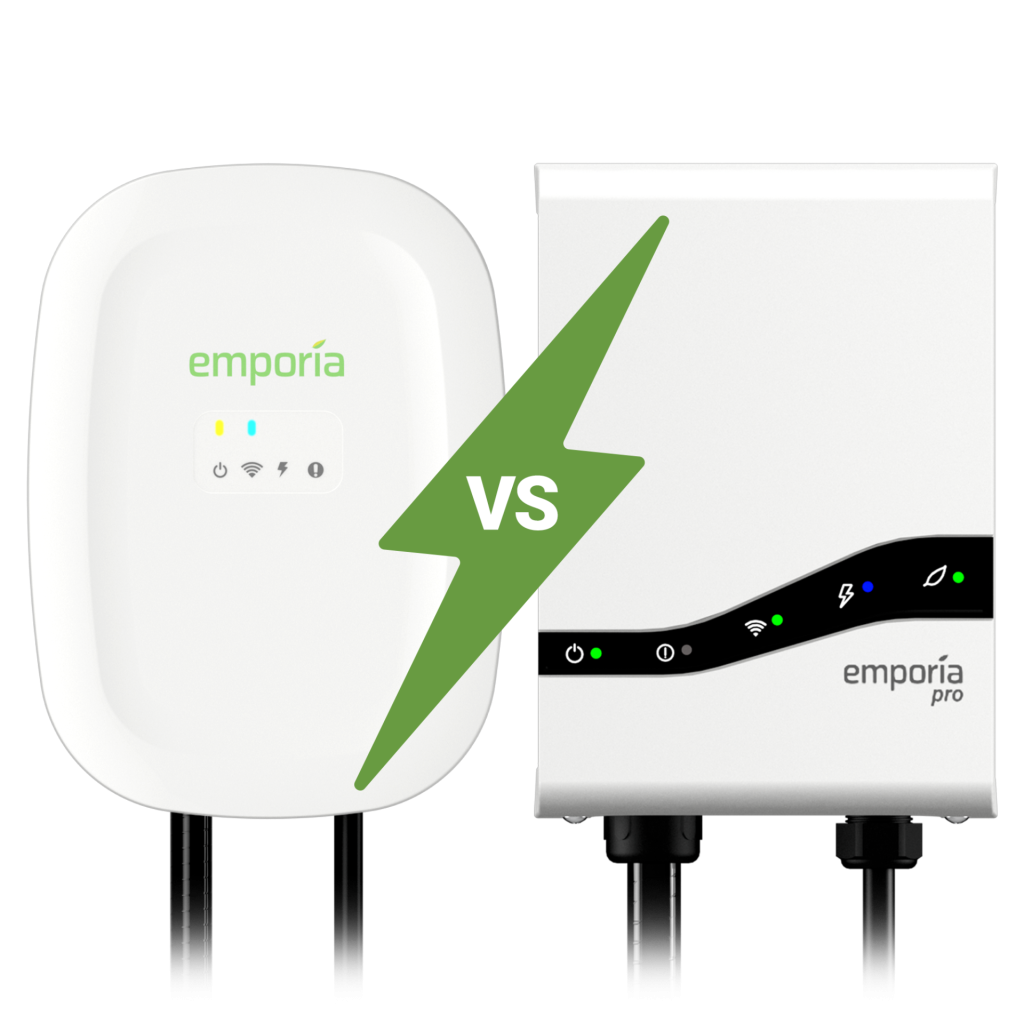
The short answer: choose the Emporia Pro EV Charger when limited panel capacity, automatic load management, whole-home monitoring, or excess-solar charging are central to the project. Choose the ChargePoint Home Flex when you want a simpler standalone charger, up to 50 A hardwired output, and one established app for home and public ChargePoint charging.
Both are capable North American Level 2 chargers, but they solve different problems. Emporia sells a charger plus an energy-management system. ChargePoint sells a flexible charger with a polished network-led ownership experience.
Market note: This comparison uses the current North American J1772 and NACS configurations. Connector availability, electrical codes, rebates, tariffs, and installation requirements vary by region. A licensed electrician should confirm circuit and service capacity before purchase.
Quick comparison
| Decision point | Emporia Pro EV Charger | ChargePoint Home Flex |
|---|---|---|
| Best fit | Homes needing active load management, solar-aware charging, or whole-home energy visibility | Drivers wanting a straightforward connected charger and a strong home/public charging app |
| Maximum output | 48 A hardwired, about 11.5 kW at 240 V | 50 A hardwired, up to 12 kW at 240 V |
| Plug-in limit | 40 A on NEMA 14-50 | 40 A on NEMA 6-50 or 14-50 |
| Load management | PowerSmart dynamically adjusts charging from whole-home load data | Adjustable circuit setting, but no equivalent native whole-home dynamic load management was verified |
| Solar charging | Native excess-solar workflow with the bundled Vue 3 monitor | Scheduling and manual rate control; no native solar-surplus mode was verified |
| Energy monitoring | Vue 3 whole-home monitor included | Charger session and cost reporting |
| Connector options | J1772 or NACS | J1772 or NACS |
| Cable length | 25 ft | 23 ft |
| Connectivity | Wi-Fi and Emporia cloud/app | Wi-Fi, Bluetooth, ChargePoint cloud/app |
| Local integration | No official local API or direct Home Assistant support verified | No owner-configurable local API or direct Home Assistant support verified |
| Warranty | 3 years | 3 years |
The headline charging-speed difference is small. The important difference is how each charger decides when and how hard to charge.
Where the Emporia Pro is genuinely different
The Emporia Pro is bundled with an Emporia Vue 3 Home Energy Monitor. Its main current sensors watch the home's total demand, while PowerSmart adjusts the EV charging rate around the configured service limit.
That matters when a home has a 60 A, 100 A, or heavily loaded 200 A service and adding a fixed high-power EV load could otherwise trigger an expensive upgrade. Instead of assuming the charger can always draw 40 or 48 A, the system can reduce EV charging when the oven, dryer, heat pump, or water heater is drawing heavily, then raise it again when capacity becomes available.
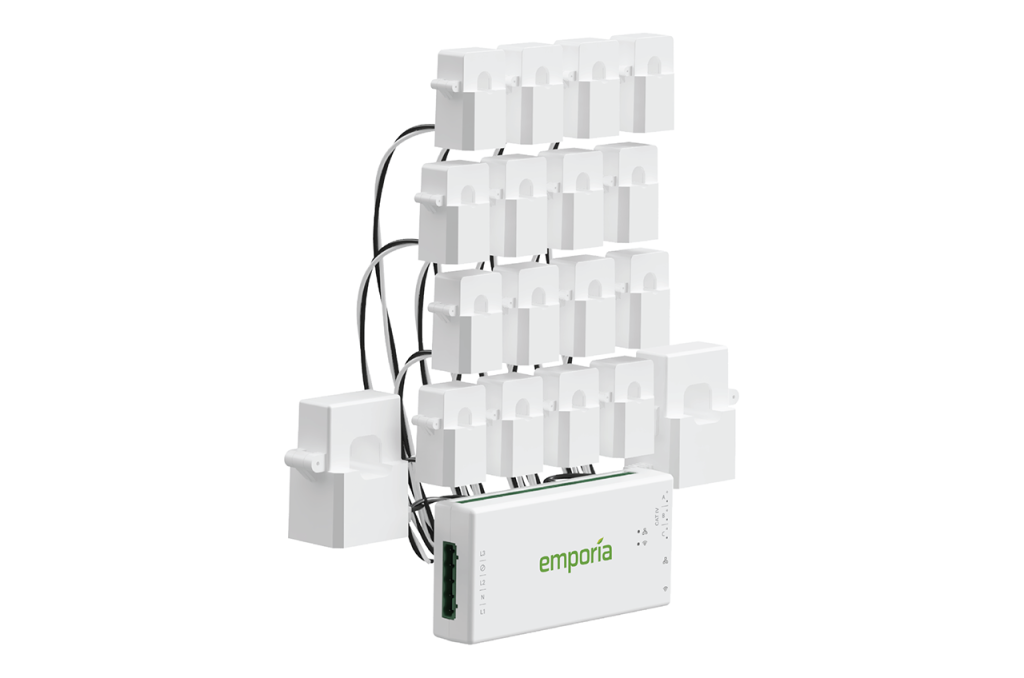
The Vue 3 is not just an accessory in the Pro package. It supplies the whole-home load data that makes PowerSmart useful.
This does not mean the Emporia Pro automatically eliminates every panel upgrade. The service, switchboard, branch circuit, wiring route, breaker spaces, grounding, local code, and installation conditions still need to work. What it can do is change the design question from "Can the panel support the charger at full output all the time?" to "Can the charger safely use the capacity that is available right now?"
Read the full Emporia Pro EV Charger device profile for the verified installation and monitoring details.
Where ChargePoint Home Flex is stronger
The ChargePoint Home Flex takes a more conventional approach. An electrician sets it to match the installed circuit, with app-selectable output steps from 16 A to 50 A. The hardwired model can operate across a wide range of circuit sizes, while plug-in versions are limited to 32 A or 40 A operation depending on the circuit.
Its clearest advantage is the ChargePoint experience. The same app can manage home charging and show public ChargePoint activity, which is convenient for drivers already using that network. The charger also stores a limited amount of session data through network interruptions and uploads it when connectivity returns.
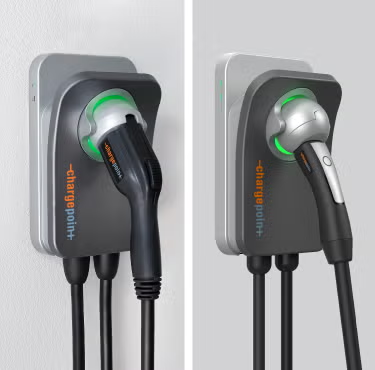
Home Flex is a strong fit when the electrical service can support a fixed charger circuit and the owner values a familiar charging app more than whole-home automation.
ChargePoint's maximum 50 A setting is slightly higher than Emporia's 48 A hardwired maximum, but this should rarely decide the purchase by itself. The vehicle's onboard AC charger, daily driving distance, overnight charging window, and panel capacity usually matter more than a 2 A difference.
See the ChargePoint Home Flex device profile for configuration, connector, installation, and data details.
Dynamic load management versus adjustable amperage
These two features sound similar but are not interchangeable.
Adjustable amperage means the charger is configured to a fixed ceiling that matches the installed circuit. A Home Flex on a 40 A circuit, for example, would normally be configured for a 32 A continuous load. It stays within that charger circuit limit, but it does not continuously watch the rest of the home's demand.
Dynamic load management uses a separate measurement of the home's total electrical load. The Emporia system can lower the EV charging rate when other large loads turn on, then restore charging power when those loads stop.
Dynamic control is most valuable when:
- the service is near its calculated capacity;
- a heat pump, electric range, dryer, water heater, or second EV creates overlapping peaks;
- the cost of a panel or service upgrade is high;
- the household wants the fastest safe charge rate available at each moment, not a permanently conservative setting.
A fixed circuit is often enough when:
- the panel has comfortable spare capacity;
- overnight loads are predictable;
- a lower 16 A, 24 A, or 32 A charging rate already replaces the normal daily driving energy;
- simplicity matters more than squeezing the maximum power from the existing service.
Use the EV Charging Window Calculator before paying for a larger circuit. Many drivers discover that a moderate overnight charging rate is already sufficient.
Solar charging: the biggest practical split
Emporia has the clearer fit for a solar home. With the Vue 3 measuring grid flow and household load, the app can prioritize excess solar for EV charging. This can be more useful than a simple midday schedule because solar surplus changes with clouds, household demand, and inverter output.
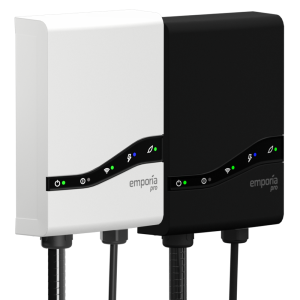
Emporia positions the Pro as an energy-management package, with PowerSmart, solar charging, scheduling, and whole-home monitoring tied together.
ChargePoint Home Flex supports schedules and charge-rate control, so a solar owner can still target likely production hours. However, no native feature was verified that continuously follows measured solar surplus in the way the Emporia and Vue combination can.
This distinction matters only if the car is regularly parked at home while solar is available. If the EV arrives after sunset, off-peak scheduling may be more valuable than solar-following control. The EV Charger Selector can help separate the charger features you will actually use from those that merely sound attractive.
App experience and data ownership
Both chargers are cloud-led products. Neither should be bought on the assumption that it offers a documented local API, owner-controlled OCPP backend, or direct official Home Assistant integration.
Emporia's app is stronger when the goal is to see EV charging beside whole-home demand, solar flow, circuits, and compatible Emporia devices. That broader energy context is useful for troubleshooting demand peaks and evaluating whether solar charging is working.
ChargePoint's app is stronger when the driver wants one account for home charging and public ChargePoint sessions. It provides scheduling, reminders, charging history, cost tracking, and remote control without requiring a separate whole-home monitor.
For buyers who require local-first automation, MQTT, Modbus, or a self-hosted energy stack, neither is the obvious default. Start with the Device Compatibility Checker and verify the exact data path before purchase.
Installation choices that change the answer
Hardwired versus plug-in
Both products reach their highest output only when hardwired. Emporia supports up to 48 A on a 60 A circuit. ChargePoint supports up to 50 A with a suitably rated hardwired circuit; current ChargePoint guidance shows a 70 A circuit for a 50 A continuous load.
Plug-in installation is capped at 40 A for both. A plug can make removal easier, but the receptacle, enclosure, GFCI arrangement, cable routing, and continuous-load rating must suit EV charging. A household should not assume that any existing NEMA outlet is ready for hours of sustained charging.
Connector choice
Both products are sold with J1772 and NACS options. Choose for the vehicle you own, likely future vehicles, and adapter tolerance. The connector decision does not change the underlying load-management or solar features.
Wi-Fi coverage
Both products depend on connected services for their full smart experience. Check garage or driveway Wi-Fi before installation, especially through masonry, metal doors, or detached-building walls. ChargePoint also includes Bluetooth for setup and local communication tasks, while its primary smart workflow remains app and cloud based.
Which charger should you buy?
Choose Emporia Pro if:
- an electrician identifies limited service or panel headroom;
- avoiding or deferring a service upgrade has real value;
- you want automatic charging adjustment rather than a fixed conservative limit;
- you have solar and want charging to follow measured surplus;
- whole-home and circuit-level energy data are useful to you;
- you are comfortable with the Emporia cloud ecosystem.
Choose ChargePoint Home Flex if:
- the panel can comfortably support the selected fixed circuit;
- you want a simpler standalone installation;
- the ChargePoint public charging network is already part of your routine;
- a polished home-and-public charging history matters;
- scheduled off-peak charging is more important than live solar-following control;
- you want the option of up to 50 A hardwired output and the vehicle can use it.
Choose neither yet if:
- the electrician has not completed a load calculation;
- you do not know whether 16 A, 24 A, or 32 A already meets your daily driving need;
- local data access or Home Assistant control is mandatory;
- you need two chargers sharing one service and have not designed the load-management strategy;
- the vehicle is rarely home during solar hours but solar charging is your main reason for buying.
Final verdict
For a home with constrained electrical capacity or meaningful rooftop solar, the Emporia Pro is the more capable energy-management choice. Its bundled Vue 3 and PowerSmart system address a problem that a normal adjustable charger does not: coordinating EV charging with the rest of the home's live electrical demand.
For a home with adequate panel capacity and a driver who values a straightforward, established charging ecosystem, the ChargePoint Home Flex is the cleaner standalone choice. Its flexible circuit settings, strong app, public-network connection, and broad connector options make it easy to live with.
Do not let the 48 A versus 50 A headline decide the purchase. Size the charger around the home's electrical capacity, the car's AC limit, the real charging window, and whether solar or whole-home load data should actively control charging. For more installation context, see Do You Need Dynamic Load Management for a Home EV Charger?.