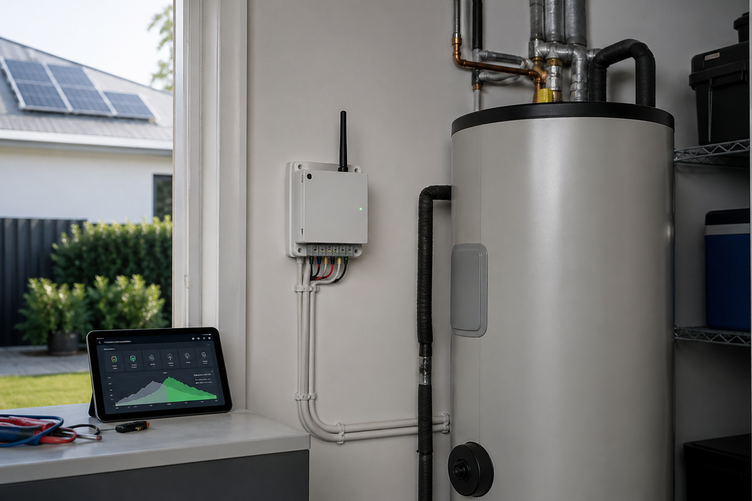
The IAMMETER WPC3700 sits in an unusual part of the home-energy market. It is not a smart meter, not a battery, and not just a smart plug. It is a single-phase Wi-Fi power controller designed to linearly adjust the power of resistive loads. In plain terms, it is made for jobs like controlling an electric water-heater element more smoothly than a basic on/off relay can.
If you want the product-level view first, see the full IAMMETER WPC3700 device page for specs, gallery images, and buying links.
That matters because many solar homes do not have a battery, but they do have a daytime load that can absorb extra solar production. Hot water is the obvious example. Instead of exporting a large share of midday solar to the grid, the WPC3700 can push more of that energy into a heater load and do it in a more controlled way.
What the WPC3700 actually is
According to IAMMETER's product documentation, the WPC3700 is a single-phase Wi-Fi power controller that can linearly adjust the power output of resistive loads. Its output is not just full-on or full-off. That is the key difference.
For the right kind of load, this gives the device a useful middle ground:
- more flexible than a timer
- finer control than a simple relay or contactor
- cheaper and simpler than adding a battery just to catch some daytime surplus
The rated context is also clear in the datasheet:
- single phase
- 220V-260V, 50-60Hz input range
- up to 3700W class output
- 0-98% output voltage control through phase-shift control
- built-in 2.4 GHz Wi-Fi
- overheating protection
The main idea: turn exported solar into useful heat
The WPC3700 is easiest to understand if you start with the problem it solves.
A home with rooftop solar often has a strong mismatch between generation and demand. Solar production peaks in the middle of the day, while many loads are small or irregular. If the home has an electric storage water heater, that heater can act like a simple thermal energy sink. The question is how to feed it well.
A basic timer helps only a little. It can shift heater operation into daytime hours, but it still cannot react to weather changes, cloud movement, or other household loads in real time.
This is where the WPC3700 becomes more interesting. IAMMETER's official quickstart and product pages describe a mode where the controller works with an IAMMETER energy meter and adjusts heater power based on measured grid conditions. If the grid threshold is set to zero, the system aims to run the heater entirely from solar surplus instead of imported grid power.
That does not turn the hot-water tank into a perfect battery replacement. But it can be a practical way to improve self-consumption when the household already has the right kind of electric heating load.
Two ways to use it
1. Manual or standalone mode
In standalone use, the WPC3700 can be controlled through its own app or local API. You define the operating parameters and set the output power directly.
This mode suits people who already have an automation layer and want to write their own logic. For example:
- Home Assistant users who want solar-aware automation
- Node-RED users building custom logic flows
- developers integrating the controller into a local energy system
This is also the mode that makes sense when you do not want to depend on IAMMETER's auto logic and prefer to make decisions yourself based on tariff, weather forecast, occupancy, or a mixed-device automation stack.
2. Auto mode with an IAMMETER meter
IAMMETER's recommended usage is to pair the WPC3700 with an IAMMETER energy meter on the grid side. In that setup, the controller can respond to measured import or export conditions and change output power automatically.
That is the stronger default for homes that want a simpler solar-surplus workflow.
The benefit is not just automation. It is continuous adjustment. If clouds pass over the array or another household load turns on, the WPC3700 can reduce output instead of staying fully on and pulling more grid power than intended. When surplus grows again, it can raise output.
If you are comparing it as a product rather than just a concept, the IAMMETER WPC3700 device page is the quickest place to check the current specifications and official visuals.
Why linear control matters
A lot of solar-diversion thinking is still framed as binary control: either the load is on or it is off.
That works for some scenarios, but it can be clumsy. A 3 kW heater switched on at the wrong moment can instantly move a home from exporting solar to importing power from the grid. If your available surplus is only 800W, a pure on/off approach usually wastes the control opportunity.
The WPC3700 tries to solve that by letting the load operate at a lower effective power level. That makes it better suited to following fluctuating surplus power, especially on partly cloudy days or in homes where the background load changes throughout the day.
This is also why IAMMETER repeatedly positions the device around boiler or water-heater control rather than generic appliance control. Simple resistive heating loads are a much better match for this kind of power modulation than mixed-electronics or motor-driven appliances.
API and local-control flexibility
One of the more appealing parts of the WPC3700 is that IAMMETER documents local APIs rather than hiding the device behind app-only control.
The published API page shows that the controller supports:
GET /api/setpowerto change output power directlyPOST /api/setadvto write advanced parameters such as max power, threshold, hysteresis, auto/manual mode, MQTT settings, and time window settingsGET /api/getadvto read the active advanced configurationPOST /api/setwifiadvto configure Wi-Fi settings
That matters for three reasons.
First, it gives technically confident users a cleaner route into local automation.
Second, it makes the device more future-proof than cloud-only controllers that stop being useful once the vendor app changes direction.
Third, it broadens the possible workflows. A user can keep IAMMETER's own meter-driven auto logic, build a Home Assistant control layer, or integrate the device into a custom local energy-management system.
IAMMETER's advanced parameter examples also mention MQTT and Home Assistant discovery-related settings, which reinforces that this device is meant to sit comfortably in a more open automation environment.
What it is good for
The WPC3700 makes sense when several things are true at the same time:
- you have a single-phase resistive load that can absorb daytime energy
- you want better solar self-consumption
- you do not want to spend battery-level money just to shift one kind of load
- you are comfortable with either IAMMETER's ecosystem or your own automation tools
The classic fit is a home with:
- rooftop solar
- an electric storage hot-water tank
- regular daytime export
- a desire to reduce wasted export without jumping straight to battery storage
It can also appeal to technically confident hobbyists and integrators who want a documented local controller instead of an app-only black box.
What it is not good for
This device is easy to misread if you treat it like a general-purpose smart energy gadget. It is more specialized than that.
The biggest limits are straightforward:
- it is for resistive loads, not every appliance in the house
- it is single phase, so it is not a universal answer for larger or three-phase systems
- it is a power controller, not an energy meter
- it does not replace a battery for whole-home load shifting or blackout support
- it still needs the right installation context to deliver real value
That last point matters. If a home has very little daytime export, no suitable resistive load, or a tariff structure that rewards a different strategy, the WPC3700 may be the wrong answer. In those cases, a timer, relay, EV charging schedule, or battery may produce a better outcome.
WPC3700 vs a timer or simple relay
A timer is the cheapest option. It is simple and often good enough when the goal is only to push water heating into a rough solar window.
A relay or contactor with automation is the next step. It gives more intelligence, but it is still often limited to on/off behavior.
The WPC3700 becomes more compelling when the home has variable surplus and you want to avoid the all-or-nothing behavior of switching a large heater load fully on.
That means its value is strongest in homes where:
- solar output changes quickly during the day
- exports are frequent but not always large enough for full-power heater operation
- the homeowner wants a smoother solar-following result
Installation and buyer caution
The device's electrical role is significant enough that this is not the kind of product most people should treat as a casual plug-and-play purchase. The load type, wiring context, and local electrical rules all matter.
For most homeowners, the better buying mindset is:
- confirm the load is truly a suitable resistive load
- confirm the electrical service and phase arrangement fit the device
- decide whether you want IAMMETER auto mode or your own automation logic
- check whether your installer or electrician is comfortable with the intended control approach
If you already run IAMMETER meters, the WPC3700 is much easier to position. If you do not, the value proposition depends more on whether you specifically want its local-control and modulation features.
Final take
The IAMMETER WPC3700 is a narrow but genuinely useful device. It is not trying to solve whole-home energy management by itself. It is trying to solve one practical problem well: how to feed a suitable resistive load with more intelligence than a timer or basic relay can offer.
For the right solar home, especially one with electric water heating and meaningful daytime export, that can be enough to make it a worthwhile piece of hardware.
Its biggest strengths are clear:
- real-time adjustable control rather than crude switching
- good fit for solar-surplus hot-water use
- documented local API support
- better integration potential than many closed consumer products
Its weakness is just as clear: it only makes sense in the right setup.
That makes the WPC3700 a good device to buy for a specific problem, not a device to buy just because it sounds clever.
References
- IAMMETER, Datasheet of WPC3700
- IAMMETER, WPC3700 Quickstart
- IAMMETER, APIs of WPC3700
- IAMMETER, Wi-Fi Power Controller product page
- IAMMETER Store, WiFi Power Controller (WPC3700)